Call for Papers Focus & Scope Author Guidelines Template: Title Page Template: Anonymised Manuscript Template: Statement of Originality Online Submission Peer Review Process Publication Ethics Generative AI Policy Plagiarism Policy Authorship Policy Conflict of Interest Correction and Retraction Post-Publication Discussions Research Misconduct Open Access Policy Archiving Policy Author Fees Copyright Notice Ownership and Management Editorial Team Reviewers Journal History Abstracting & Indexing Helpdesk Editor 1 Helpdesk Editor 2 Editor-in-Chief
Ownership and Management
This page sets out who owns Efisiensi, how it is governed and financed, and how its editorial independence is protected, following the COPE Core Practice on journal management and the Principles of Transparency and Best Practice in Scholarly Publishing.
1. Ownership
| Journal title | Efisiensi: Kajian Ilmu Administrasi |
| Owner and publisher | Departemen Pendidikan Administrasi (Department of Administration Education), Fakultas Ekonomi dan Bisnis (Faculty of Economics and Business), Universitas Negeri Yogyakarta |
| Partner | ASPAPI (Asosiasi Sarjana dan Praktisi Administrasi Perkantoran Indonesia), under a cooperation agreement signed on 7 March 2020 |
| Type of owner | Public, not-for-profit higher education institution |
| First published | August 2001 |
| ISSN | p-ISSN 1412-1131 (print); e-ISSN 2528-5750 (online) |
| DOI prefix | 10.21831 (e.g., 10.21831/efisiensi.v23i1.xxxxx) |
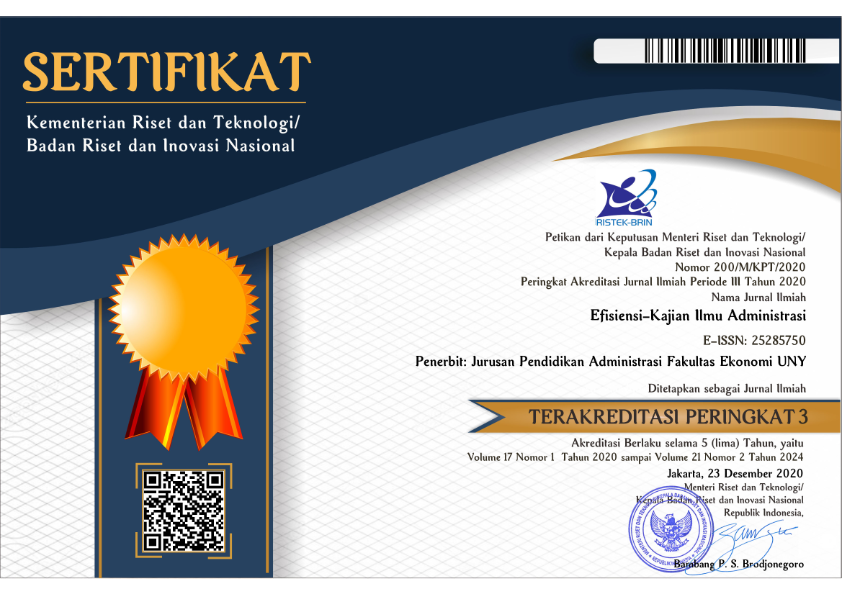
| Accreditation | Sinta 3, 2020–2024 (SINTA profile 5860) |
| Frequency | Two issues per year, in February and August |
| Language | English from Volume 24 Number 1 (February 2027); Indonesian or English, with abstracts in both languages, up to Volume 23 Number 2 (2026) |
| Access model | Open access under Creative Commons Attribution-NonCommercial-ShareAlike 4.0 International (CC BY-NC-SA 4.0) |
2. Governance Structure
| Body | Role |
|---|---|
| Publisher (Department of Administration Education, FEB UNY) | Owns the journal, appoints the Editor-in-Chief, provides funding and facilities, and protects editorial independence. |
| ASPAPI | Supports the journal through its professional network of office administration scholars and practitioners; has no role in editorial decisions. |
| Editor-in-Chief | Leads the journal, sets editorial policy, and makes final publication decisions. |
| Editorial Board | Experts from several institutions who handle manuscripts as section editors, advise on policy, and promote the journal. |
| Reviewers | Independent experts who review manuscripts under double-blind review. |
| Secretariat | Supports administration, correspondence, layout, and publication. |
The current members are listed on the Editorial Team and Reviewers pages, with their affiliations and countries.
3. Appointment and Terms of Office
- The Editor-in-Chief is appointed by the Head of the Department of Administration Education for a term of office stated in the appointment decree, renewable.
- Editorial board members are appointed on the recommendation of the Editor-in-Chief for a term of office stated in the appointment decree, based on their expertise and publication record, and with their written consent.
- Members who are no longer active are replaced, and the Editorial Team page is updated accordingly.
4. Editorial Independence
Editorial decisions are made by the editors on the basis of peer review and scholarly merit only. The publisher, ASPAPI, the university, and payment of fees have no influence on decisions. Manuscripts by members of the editorial team are handled by another editor (Conflict of Interest Policy).
5. Financing and Business Model
- Article processing charges paid after acceptance (IDR 500,000), with waivers available (Author Fees).
- Institutional support from the Faculty of Economics and Business and Universitas Negeri Yogyakarta, including hosting of the journal on the university's OJS platform.
- The journal carries no advertising.
6. Operational Management
- Manuscripts are managed in Open Journal Systems (OJS) from submission to publication.
- Similarity is checked with Turnitin; DOIs are registered with Crossref.
- Content is preserved through LOCKSS.
7. Policies
- Publication Ethics
- Peer Review Process
- Author Guidelines
- Generative AI Policy
- Plagiarism Policy
- Authorship Policy
- Conflict of Interest Policy
- Correction and Retraction
- Post-Publication Discussions and Corrections
- Research Misconduct
- Open Access Policy
- Archiving Policy
- Author Fees
8. Complaints
Complaints about the journal's processes are sent to the Editor-in-Chief at efisiensi@uny.ac.id. Complaints about the Editor-in-Chief are sent to the Head of the Department of Administration Education, Faculty of Economics and Business, Universitas Negeri Yogyakarta. Every complaint is acknowledged within 7 days.
Address. Department of Administration Education, Faculty of Economics and Business, Universitas Negeri Yogyakarta, Karangmalang Campus, Yogyakarta 55281, Indonesia · Phone (0274) 586168 · Email: efisiensi@uny.ac.id
Sources
- Committee on Publication Ethics. (2017). Core practices. https://publicationethics.org/core-practices
- COPE, DOAJ, OASPA, & WAME. (2022). Principles of transparency and best practice in scholarly publishing (Version 4). https://doi.org/10.24318/cope.2019.1.12