Ownership and Management Policy
This page sets out who owns Jurnal Civics: Media Kajian Kewarganegaraan, how the journal is governed and managed, and how its editorial independence is protected. It follows the COPE Core Practice on Journal management and the Principles of Transparency and Best Practice in Scholarly Publishing.
1. Ownership
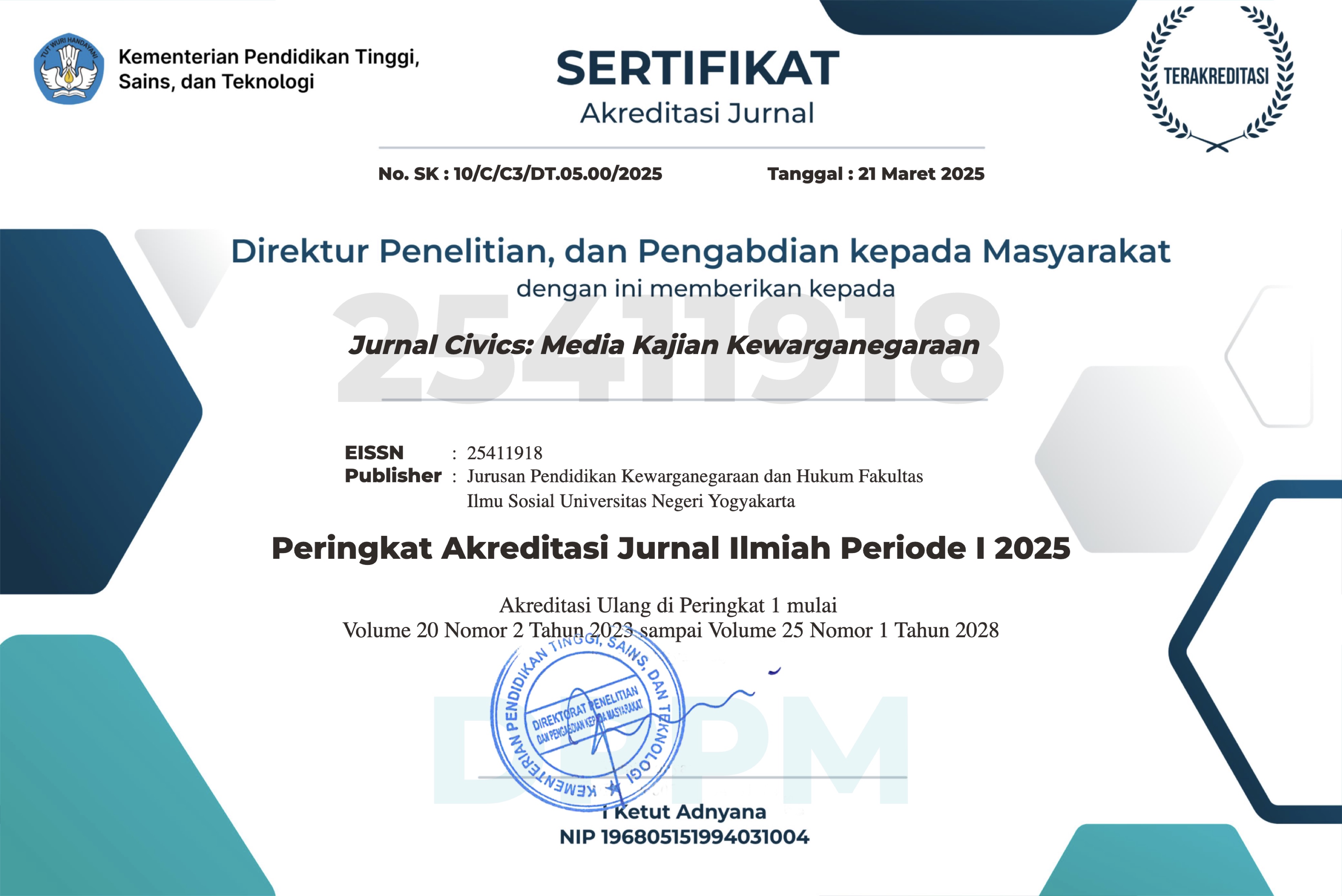
| Journal title | Jurnal Civics: Media Kajian Kewarganegaraan |
| Owner and publisher | Universitas Negeri Yogyakarta (UNY), Indonesia |
| Managing unit | Department of Civic Education, Faculty of Social Science and Politics (FISIP), Universitas Negeri Yogyakarta |
| Collaboration partner | Indonesian Association of Pancasila and Civic Education (AP3KnI), since 2019 |
| Type of owner | Public, not-for-profit higher education institution |
| First published | 2004 (print); online on OJS since 2016 |
| ISSN | p-ISSN 1829-5789 (print); e-ISSN 2541-1918 (online) |
| DOI prefix | 10.21831 |
| Frequency | Two issues per year, in April and October |
| Language | English (British spelling) |
| Access model | Open access, under a Creative Commons Attribution-ShareAlike 4.0 International (CC BY-SA 4.0) |
| Address | Department of Civic Education, FISIP Building, 3rd Floor, Universitas Negeri Yogyakarta, Sleman, Daerah Istimewa Yogyakarta 55281, Indonesia |
| Contact | journalcivics@uny.ac.id · https://journal.uny.ac.id/index.php/civics |
The journal’s name, ownership, and ISSN are not changed without public notice on the journal website and notification of the ISSN centre and indexing services.
2. Governance Structure
- Publisher (Universitas Negeri Yogyakarta):
- appoints the Editor-in-Chief;
- provides financial, technical, and administrative support;
- approves the journal’s policies;
- guarantees editorial independence.
- Editor-in-Chief:
- holds overall responsibility for the journal’s content, editorial decisions, policies, and ethical standards;
- appoints and leads the editorial team.
- Managing Editor: manages day-to-day operations, the OJS workflow, schedules, communication with authors and reviewers, and production.
- Section Editors / Associate Editors: handle manuscripts in their area of expertise, select reviewers, and recommend decisions.
- Book Review Editor: commissions and assesses book reviews.
- Editorial Board:
- includes recognised scholars from Indonesia and abroad, representing diverse institutions, regions, and genders;
- advises on scope, policy, and quality;
- promotes the journal;
- may handle manuscripts or appeals.
- Technical team: copyeditors, layout editors, proofreaders, and the OJS/IT administrator.
The full names, affiliations, and roles of all editorial team members are published on the Editorial Team page. Board members must have agreed to serve.
3. Appointment and Terms of Office
- The Editor-in-Chief is appointed by the publisher for a term of four years, renewable once, based on scholarly standing and editorial experience.
- Editors and editorial board members are appointed by the Editor-in-Chief for renewable terms of three years. Appointments are based on:
- expertise in citizenship and civic education or related fields;
- a record of publications in reputable journals;
- commitment to the journal.
- The editorial board is reviewed periodically to ensure active participation, international representation, and diversity. Inactive members may be replaced.
- All editorial team members declare conflicts of interest each year, as set out in the Conflict of Interest Policy.
4. Editorial Independence
- Editorial decisions are made solely by the editors, based on scholarly merit, relevance to the journal’s scope, and the peer-review process.
- The publisher, the university leadership, funders, and other parties do not interfere in decisions about individual manuscripts.
- Manuscripts from the publisher’s own staff or students receive no preferential treatment. They follow the same double-anonymous peer review as all other submissions.
- The journal works to maintain a diverse authorship. It monitors the proportion of articles from authors at the publisher’s own institution, so that the journal is not used mainly as an outlet for in-house publication.
- Article processing charges (if any) and other income are handled separately from the editorial process and never influence decisions.
5. Financing and Business Model
- The journal is financed by Universitas Negeri Yogyakarta, with support from its collaboration partner, AP3KnI, and by an Article Processing Charge (APC) payable only after acceptance. Details are given on the Author Fees page.
- All fees are published clearly on the journal website before submission, together with the conditions for waivers.
- The journal does not carry advertising or sponsored content. If this changes, a separate policy will be published, and editorial decisions will remain independent of advertising.
6. Operational Management
- Platform: The journal runs on Open Journal Systems (OJS), hosted by Universitas Negeri Yogyakarta. All submissions, reviews, and decisions are managed and recorded in the system.
- Workflow and timelines:
- initial screening within 7 days;
- first decision within about 6 weeks;
- final decision (accept or decline) within a maximum of 4 months, excluding copyediting and publication.
- Quality assurance:
- similarity checking (maximum 20% overall, with no single match above 1%);
- standard templates;
- copyediting and proofreading;
- DOI registration with Crossref.
- Archiving and preservation: published content is preserved through the PKP Preservation Network and LOCKSS, with additional copies in Garuda and the university’s servers (see the Archiving Policy), so that it remains permanently available if the journal ceases publication.
- Indexing: the journal is indexed in DOAJ, SINTA (Science and Technology Index, rank S1), Garuda, and Google Scholar. Indexing claims are kept accurate and up to date.
- Records: editorial and peer-review records are kept confidentially for at least five years.
- Review of policies: the journal’s policies are reviewed at least every two years, or sooner if needed, and the date of the latest revision is shown on each policy page.
7. Policies
The journal’s management is guided by the following published policies:
- Author Guidelines
- Peer Review Process
- Publication Ethics
- Research Misconduct
- Plagiarism Policy
- Conflict of Interest Policy
- Authorship Policy
- Generative AI Policy
- Correction & Retraction
- Post-publication Discussions and Corrections
- Author Fees
- Archiving Policy
8. Complaints
- Complaints about the journal’s management, processes, or staff should be sent to the Editor-in-Chief through the journal website.
- They are acknowledged within 7 working days and answered within 30 days.
- Complaints about the Editor-in-Chief are handled by a senior member of the editorial board or by the publisher.
- If a complainant remains dissatisfied, they may refer the matter to COPE.
Sources
- Committee on Publication Ethics. (2017). Core practices [Journal management; Complaints and appeals]. https://publicationethics.org/core-practices
- Committee on Publication Ethics, Directory of Open Access Journals, Open Access Scholarly Publishing Association, & World Association of Medical Editors. (2022). Principles of transparency and best practice in scholarly publishing (Version 4). https://doi.org/10.24318/cope.2019.1.12
- Directory of Open Access Journals. (n.d.). Guide to applying. https://doaj.org/apply/guide/