The impact of the professional education program for in-service teachers on pedagogical competence in Indonesia
Downloads
The Teacher Professional Education Program (PEP) is a government-initiated in-service training scheme intended to strengthen Indonesian teachers’ professional, social, personal, and pedagogical competence. This study describes the pedagogical competence of in-service English as a Foreign Language (EFL) teachers who have completed PEP. A descriptive survey was conducted with 47 in-service EFL teachers who attended PEP at Universitas Muhammadiyah Makassar in the 2020–2021 academic year, selected through purposive sampling. Teachers’ pedagogical competence was measured using a Likert-scale questionnaire that covered six components: use of learning media, understanding students’ characteristics, pedagogical knowledge, interactive teaching methods, lesson planning, and assessment practices. Descriptive analysis of the questionnaire responses shows that participants generally report high levels of pedagogical competence across these components, particularly in planning lessons and conducting assessment, while some aspects, such as the consistent use of technology and English in the classroom, remain less strong. These findings portray the pedagogical profile of PEP graduates and suggest that structured professional education programs can support the ongoing development of in-service EFL teachers in the Indonesian context.
Downloads
Adnan, A., Suwandi, S., Nurkamto, J., & Setiawan, B. (2019). Teacher competence in authentic and integrative assessment in Indonesian language learning. International Journal of Instruction, 12(1), 701–716. https://doi.org/10.29333/iji.2019.12145a
Afdal, Hidayah, N., Budiman, N., Maulida, Y., Sukmawati, I., Hariko, R., Fikri, M., Nurfarhanah, & Netrawati. (2023). Expectations and reality regarding teacher personality: Perspectives of indonesian students using importance-performance analysis. International Journal of Learning, Teaching and Educational Research, 22(5), 620–632. https://doi.org/10.26803/ijlter.22.5.32
Albiladi, W. S., & Alshareef, K. K. (2019). Blended learning in english teaching and learning: a review of the current literature. Journal of Language Teaching and Research, 10(2), 232. https://doi.org/10.17507/jltr.1002.03
Amirkhanova, K. M., & Bobyreva, N. N. (2020). Communication in training future efl teachers: Simulation and roleplay in the english classroom. International Journal of Higher Education, 9(8), 7–12. https://doi.org/10.5430/ijhe.v9n8p7
Ani Hastuti, T., Soegiyanto, Suherman, W. S., Rahayu, S., & Utami, N. S. (2022). Improving the pedagogic competence of physical education teachers. Cakrawala Pendidikan, 41(2), 377–387. https://doi.org/10.21831/cp.v41i2.48231
Arvaja, M., Sarja, A., & Rönnberg, P. (2022). Pre-service subject teachers’ personal teacher characterisations after the pedagogical studies. European Journal of Teacher Education, 45(5), 653–669. https://doi.org/10.1080/02619768.2020.1860010
Asaad Hamza Sheerah, H., Sharma Yadav, M., & Arabia, S. (2022). The use of english placement test (EPT) in assessing the efl students’ language proficiency level at a saudi university title the use of english placement test (EPT) in assessing the efl students’ language proficiency level at a Saudi University. 1–24.
Asrial, Syahrial, Kurniawan, D. A., Chan, F., Nugroho, P., Pratama, R. A., & Septiasari, R. (2019). Identification: The effect of mathematical competence on pedagogic competency of prospective teacher. Humanities & Social Sciences Reviews, 7(4), 85–92. https://doi.org/10.18510/hssr.2019.7413
Asriati, S., Nappu, S., & Qalbi, N. (2022). Professional education program for junior high school in-service teachers’ social competence. Jurnal Pendidikan, 14(2), 2563–2570. https://doi.org/10.35445/alishlah.v14i1.1342
Asriati, S., Qalbi, N., Marwiah, & Hamsinah, S. (2020). The contribution of reading motivation in social collaboration dimension to students’ reading comprehension. Universal Journal of Educational Research, 8(6), 2383–2390. https://doi.org/10.13189/ujer.2020.080622
Awwad, A. A. (2022). The impact of efl teachers‟ emotional intelligence and teacher-related variables on self-reported efl teaching practices. World Journal of English Language, 12(6), 166–175. https://doi.org/10.5430/wjel.v12n6p166
Baecher, L., & Chung, S. (2020). Transformative professional development for in-service teachers through international service learning. Teacher Development, 24(1), 33–51. https://doi.org/10.1080/13664530.2019.1682033
Benoliel, P., & Berkovich, I. (2020). Ideal teachers according to TALIS: Societal orientations of education and the global diagnosis of teacher self-efficacy. European Educational Research Journal, 20(2), 143–158. https://doi.org/10.1177/1474904120964309
Borkowska, A. (2022). The relationship among age-advanced learners’ in-class willingness to communicate in english, intrinsic motivation, classroom environment and teacher immediacy-a pilot study. Theory and Practice of Second Language Acquisition, 8(2), 1–25. https://doi.org/10.31261/TAPSLA.8989
Budianto, L., Arifani, Y., Wardhono, A., & Poedjiastutie, D. (2023). The TPACK level of in-service EFL teacher online professional training: The perspectives of teachers, students, and trainers. Journal of Digital Learning in Teacher Education, 39(2), 87–101. https://doi.org/10.1080/21532974.2023.2167024
Cabero-Almenara, J., Barroso-Osuna, J., Gutiérrez-Castillo, J. J., & Palacios-Rodríguez, A. (2021). The teaching digital competence of health sciences teachers. A study at andalusian universities (Spain). International Journal of Environmental Research and Public Health, 18(5), 1–13. https://doi.org/10.3390/ijerph18052552
Coman, C., Țîru, L. G., Meseșan-Schmitz, L., Stanciu, C., & Bularca, M. C. (2020). Online teaching and learning in higher education during the coronavirus pandemic: Students’ perspective. Sustainability (Switzerland), 12(24), 1–22. https://doi.org/10.3390/su122410367
Crowley, J. (2021). Social vulnerability factors and reported post-disaster needs in the aftermath of hurricane florence. International Journal of Disaster Risk Science, 12(1), 13–23. https://doi.org/10.1007/s13753-020-00315-5
Dela Cruz, A. A. (2020). Direct and indirect factors affecting teachers’ burnout in the new normal. Recoletos Multidisciplinary Research Journal, 8(2), 75–86. https://doi.org/10.32871/rmrj2008.02.06
Dewaele, J. M., & Li, C. (2021). Teacher enthusiasm and students’ social-behavioral learning engagement: The mediating role of student enjoyment and boredom in Chinese EFL classes. Language Teaching Research, 25(6), 922–945. https://doi.org/10.1177/13621688211014538
Dias-Trindade, S., Moreira, J. A., & Ferreira, A. G. (2020). Assessment of university teachers on their digital competences. Qwerty, 15(1), 50–69. https://doi.org/10.30557/QW000025
Dias-Trindade, S., Moreira, J. A., & Ferreira, A. G. (2021). Evaluation of the teachers’ digital competences in primary and secondary education in portugal with digcompedu checkin in pandemic times. Acta Scientiarum - Technology, 43, 99–100. https://doi.org/10.4025/actascitechnol.v43i1.56383
Ding, D., & Yusof, A. M. B. (2025). Investigating the role of AI-powered conversation bots in enhancing L2 speaking skills and reducing speaking anxiety: a mixed methods study. Humanities and Social Sciences Communications, 1–16. https://doi.org/https://doi.org/10.1057/s41599-025-05550-z
Erviana, V. Y., Ghufron, A., Haryanto, & Retnawati, H. (2023). Validity and reliability of iojepd model instruments to improve elementary school teacher competence. Pegem Egitim ve Ogretim Dergisi, 13(2), 200–206. https://doi.org/10.47750/pegegog.13.02.24
Faez, F., Karas, M., & Uchihara, T. (2021). Connecting language proficiency to teaching ability: A meta-analysis. Language Teaching Research, 25(5), 754–777. https://doi.org/10.1177/1362168819868667
Faidal, N. F., Nur, R.-, & Suriani, S. (2020). The teachers’ pedagogic competence in teaching english through online and offline setting. ELT Worldwide: Journal of English Language Teaching, 7(1), 42. https://doi.org/10.26858/eltww.v7i1.13294
Gadušová, Z., Hašková, A., & Predanocyová, Ľ. (2019). Teacher’s professional competences and their evaluation. Education & Self Development, 14(3), 17–24. https://doi.org/10.26907/esd14.3.02
Ganeeva, A. R., & Anisimova, T. I. (2020). Continuing professional education for pre-service teachers of mental arithmetic. Universal Journal of Educational Research, 8(9), 3989–3996. https://doi.org/10.13189/ujer.2020.080924
García-González, E., Jiménez-Fontana, R., & Azcárate, P. (2020). Education for sustainability and the sustainable development goals: Pre-service teachers’ perceptions and knowledge. Sustainability (Switzerland), 12(18). https://doi.org/10.3390/su12187741
Gehlen-Baum, V., & Weinberger, A. (2014). Teaching, learning and media use in today’s lectures. Computers in Human Behavior, 37, 171–182. https://doi.org/10.1016/j.chb.2014.04.049
Hartwig, L. D., Jackson, S., Markham, F., & Osborne, N. (2022). Water colonialism and Indigenous water justice in south-eastern Australia. International Journal of Water Resources Development, 38(1), 30–63. https://doi.org/10.1080/07900627.2020.1868980
Hindun, I., Husamah, H., Nurwidodo, N., Fatmawati, D., & Fauzi, A. (2021). E-learning in COVID-19 Pandemic: Does it challenge teachers’ work cognition and metacognitive awareness? International Journal of Instruction, 14(3), 547–566. https://doi.org/10.29333/iji.2021.14332a
Holzberger, D., Maurer, C., Kunina-Habenicht, O., & Kunter, M. (2021). Ready to teach? A profile analysis of cognitive and motivational-affective teacher characteristics at the end of pre-service teacher education and the long-term effects on occupational well-being. Teaching and Teacher Education, 100, 103285. https://doi.org/10.1016/j.tate.2021.103285
Hwang, S., Waller, R., Hawes, D. J., & Allen, J. L. (2020). Callous-unemotional traits and antisocial behavior in south korean children: Links with academic motivation, school engagement, and teachers’ use of reward and discipline. Journal of Abnormal Child Psychology, 48(9), 1183–1195. https://doi.org/10.1007/s10802-020-00663-2
Ibrahim, M. Y., Yusof, M. R., Yaakob, M. F. M., & Othman, Z. (2019). Communication skills: top priority of teaching competency. International Journal of Learning, Teaching and Educational Research, 18(8), 17–30. https://doi.org/10.26803/ijlter.18.8.2
Ibrahim, N. C. (2022). Examining a Northern Sámi-Norwegian dual language picturebook in English language education through a critical translingual-transcultural lens. Intercultural Communication Education, 5(3), 105–124. https://doi.org/10.29140/ice.v5n3.847
Ilgaz, G., Vural, L., & Eskici, M. (2019). Is the source for my curriculum knowledge and other competencies the same? Evidence from PISA 2015. Cypriot Journal of Educational Sciences, 14(4), 706–722. https://doi.org/10.18844/cjes.v11i4.4122
Imants, J., & Van der Wal, M. M. (2020). A model of teacher agency in professional development and school reform. Journal of Curriculum Studies, 52(1), 1–14. https://doi.org/10.1080/00220272.2019.1604809
Julia, J., Subarjah, H., Maulana, M., Sujana, A., Isrokatun, I., Nugraha, D., & Rachmatin, D. (2020). Readiness and competence of new teachers for career as professional teachers in primary schools. European Journal of Educational Research, 9(2), 655–673. https://doi.org/10.12973/eu-jer.9.2.655
Kali, Y., Sagy, O., Benichou, M., Atias, O., & Levin‐Peled, R. (2019). Teaching expertise reconsidered: The Technology, Pedagogy, Content and Space (TPeCS) knowledge framework. British Journal of Educational Technology, 50(5), 2162–2177. https://doi.org/10.1111/bjet.12847
Kartowagiran, B., Suyanta, Hamdi, S., Jaedun, A., Ahman, Rusijono, & Laliyo, L. A. R. (2020). Development of web-based application for teacher candidate competence instruments: Preparing professional teachers in the IR 4.0 era. European Journal of Educational Research, 9(4), 1749–1763. https://doi.org/10.12973/eu-jer.9.4.1749
Li, J., & Adnan, H. M. (2023). Exploring the role of productive audiences in promoting intercultural understanding: A study of chinese youtube influencer Liziqi’s Channel. Studies in Media and Communication, 11(4), 173. https://doi.org/10.11114/smc.v11i4.6021
Lie, A., Tamah, S. M., Gozali, I., Triwidayati, K. R., Utami, T. S. D., & Jemadi, F. (2020). Secondary school language teachers’ online learning engagement during the covid-19 pandemic in Indonesia. Journal of Information Technology Education: Research, 19, 803–832. https://doi.org/10.28945/4626
Macaro, E., & Han, S. (2020). English medium instruction in China’s higher education: teachers’ perspectives of competencies, certification and professional development. Journal of Multilingual and Multicultural Development, 41(3), 219–231. https://doi.org/10.1080/01434632.2019.1611838
Marttinen, R., Daum, D. N., Banville, D., & Fredrick, R. N. (2020). Pre-service teachers learning through service-learning in a low SES school. Physical Education and Sport Pedagogy, 25(1), 1–15. https://doi.org/10.1080/17408989.2019.1670153
Masrun, M., Kiram, Y., Gusril, G., & Syahara, S. (2020). Developing competency test instrument of senior high school physical educator. Universal Journal of Educational Research, 8(11), 5395–5404. https://doi.org/10.13189/ujer.2020.081142
Massie, M. H., Capron Puozzo, I., & Boutet, M. (2022). Teacher creativity: When professional coherence supports beautiful risks. Journal of Intelligence, 10(3). https://doi.org/10.3390/jintelligence10030062
Miguel-Revilla, D., Martínez-Ferreira, J. M., & Sánchez-Agustí, M. (2020). Assessing the digital competence of educators in social studies: An analysis in initial teacher training using the TPACK-21 model. Australasian Journal of Educational Technology, 36(2), 1–12. https://doi.org/10.14742/ajet.5281
Molway, L., Arcos, M., & Macaro, E. (2020). Language teachers reported first and second language use: A comparative contextualized study of England and Spain. Language Teaching Research, 26(4), 642–670. https://doi.org/10.1177/1362168820913978
Mustadi, A., Wangid, M. N., Purbani, W., & Cahyaningtyas, A. P. (2023). Motivation, self-efficacy, and perceptions: A comparative study of male and female teacher candidates in Indonesia. Kasetsart Journal of Social Sciences, 44(1), 273–280. https://doi.org/10.34044/j.kjss.2023.44.1.31
Nasir, M. N. M., Mohamad, M., Ghani, N. I. A., & Afthanorhan, A. (2020). Testing mediation roles of place attachment and tourist satisfaction on destination attractiveness and destination loyalty relationship using phantom approach. Management Science Letters, 10(2), 443–454. https://doi.org/10.5267/j.msl.2019.8.026
Nurul Huda, S. A., Suyanto, Arifi, A., Putranta, H., & Azizah, A. N. M. (2021). Experiences of participants in teacher professional education on obtaining soft skills: A case study in Indonesia. European Journal of Educational Research, 10(1), 313–325. https://doi.org/10.12973/EU-JER.10.1.313
Okoye, K., Arrona-Palacios, A., Camacho-Zuñiga, C., Hammout, N., Nakamura, E. L., Escamilla, J., & Hosseini, S. (2020). Impact of students evaluation of teaching: a text analysis of the teachers qualities by gender. International Journal of Educational Technology in Higher Education, 17(1). https://doi.org/10.1186/s41239-020-00224-z
Oonk, C., Gulikers, J. T. M., den Brok, P. J., Wesselink, R., Beers, P. J., & Mulder, M. (2020). Teachers as brokers: adding a university-society perspective to higher education teacher competence profiles. Higher Education, 80(4), 701–718. https://doi.org/10.1007/s10734-020-00510-9
Otaya, L. G., Anwar, H., Yahiji, K., & Rahmawati. (2023). The assessment of fit data model feasibility of the teachers’ pedagogic competency variables. International Journal of Instruction, 16(2), 909–926. https://doi.org/10.29333/iji.2023.16248a
Quadir, M. (2021). Teaching factors that affect students’ learning motivation: Bangladeshi efl students’ perceptions. Teflin Journal, 32(2), 295–315. https://doi.org/10.15639/teflinjournal.v32i2/295-315
Ramírez-Montoya, M. S., Loaiza-Aguirre, M. I., Zúñiga-Ojeda, A., & Portuguez-Castro, M. (2021). Characterization of the teaching profile within the framework of education 4.0. Future Internet, 13(4), 1–17. https://doi.org/10.3390/fi13040091
Regier, B. J. (2021). Examining relationships among concert band directors’ efficacious sources, self-efficacy for teaching strategies, and effective teaching skills. Journal of Research in Music Education, 68(4), 436–450. https://doi.org/10.1177/0022429420943137
Remiswal, Ahmad, A., Firman, A. J., Asvio, N., & Kristiawan, M. (2023). Teacher creativity counteracts radicalism in the world of education based on local cultural values. International Journal of Instruction, 16(2), 1003–1016. https://doi.org/10.29333/iji.2023.16253a
Santagata, R., König, J., Scheiner, T., Nguyen, H., Adleff, A. K., Yang, X., & Kaiser, G. (2021). Mathematics teacher learning to notice: a systematic review of studies of video-based programs. ZDM - Mathematics Education, 53(1), 119–134. https://doi.org/10.1007/s11858-020-01216-z
Senjahari, B., Desfitranita, & Kustati, M. (2021). Learning objectives and environments: How do they affect students’ motivation in english language learning? Studies in English Language and Education, 8(2), 492–507. https://doi.org/10.24815/siele.v8i2.18523
Shackelford, G. E., Martin, P. A., Hood, A. S. C., Christie, A. P., Kulinskaya, E., & Sutherland, W. J. (2021). Dynamic meta-analysis: a method of using global evidence for local decision making. BMC Biology, 19(1), 1–13. https://doi.org/10.1186/s12915-021-00974-w
Sholihin, M., Sari, R. C., Yuniarti, N., & Ilyana, S. (2020). A new way of teaching business ethics: The evaluation of virtual reality-based learning media. The International Journal of Management Education, 18(3), 100428. https://doi.org/10.1016/j.ijme.2020.100428
Singh, S., & Jasial, S. S. (2021). Moderating effect of perceived trust on service quality–student satisfaction relationship: evidence from Indian higher management education institutions. Journal of Marketing for Higher Education, 31(2), 280–304. https://doi.org/10.1080/08841241.2020.1825029
Siri, A., Supartha, I. W. G., Sukaatmadja, I. P. G., & Rahyuda, A. G. (2020a). Does teacher competence and commitment improve teacher’s professionalism. Cogent Business and Management, 7(1). https://doi.org/10.1080/23311975.2020.1781993
Siri, A., Supartha, I. W. G., Sukaatmadja, I. P. G., & Rahyuda, A. G. (2020b). Does teacher competence and commitment improve teacher’s professionalism. Cogent Business & Management, 7(1), 1781993. https://doi.org/10.1080/23311975.2020.1781993
Smets, W., & Struyven, K. (2020). A teachers’ professional development programme to implement differentiated instruction in secondary education: How far do teachers reach? Cogent Education, 7(1). https://doi.org/10.1080/2331186X.2020.1742273
Soleimanifard, F., Behnam, B., & Ahangari, S. (2021). Learning English vocabulary through voa news lessons: being exposed to authentic material or electronic colonialism. Issues in Language Teaching, 10(1), 67–103. https://doi.org/10.22054/ilt.2021.53482.519
Sucuoglu, E., & Atamturk, H. (2020). Correlation relation between professional qualifications of physical education teachers and students’ attitudes towards physical education classes. Pedagogy of Physical Culture and Sports, 24(1), 44–47. https://doi.org/10.15561/18189172.2020.0107
Sukirman, D., Setiawan, B., & Riyana, C. (2022). Development of massive open online courses (mooc) content to improve Indonesian teachers’ pedagogical competence: mooc technology instructional process. Academic Journal of Interdisciplinary Studies, 11(6), 255–270. https://doi.org/10.36941/ajis-2022-0166
Uchihara, T., & Saito, K. (2019). Exploring the relationship between productive vocabulary knowledge and second language oral ability. The Language Learning Journal, 47(1), 64–75. https://doi.org/10.1080/09571736.2016.1191527
Wassenhove, W. V. A. N., & Foussard, C. (2022). A case study on the industrial risk management (irm) post-master academic ducation program of Mines Paris University.
Winarni, E. W., Hambali, D., & Purwandari, E. P. (2020). Analysis of language and scientific literacy skills for 4th grade elementary school students through discovery learning and ICT media. International Journal of Instruction, 13(2), 213–222. https://doi.org/10.29333/iji.2020.13215a
Wolf, S., Aber, J. L., Behrman, J. R., & Tsinigo, E. (2019). Experimental impacts of the “quality preschool for ghana” interventions on teacher professional well-being, classroom quality, and children’s school readiness. Journal of Research on Educational Effectiveness, 12(1), 10–37. https://doi.org/10.1080/19345747.2018.1517199
Yuan, S., & Liu, X. (2022). How does perceived support for innovation lead to deviant innovation behavior of knowledge workers? A moderated mediation framework. Frontiers in Psychology, 13, 1–8. https://doi.org/10.3389/fpsyg.2022.890999
Zhang, Q., Siribanpitak, P., & Charoenkul, N. (2020). Kasetsart Journal of Social Sciences Forecasting equilibrium quantity price on the world Creative leadership strategies for and primary principals to natural rubber market promote teachers’ creativity in Guangxi, China. Kasetsart Journal of Social Sciences, 41, 275–281
Copyright (c) 2026 St. Asriati Am, St. Asmayanti Am, Sitti. Asnaeni AM, Saiful Saiful, Selvi Panggua, Nur Aeni

This work is licensed under a Creative Commons Attribution-ShareAlike 4.0 International License.
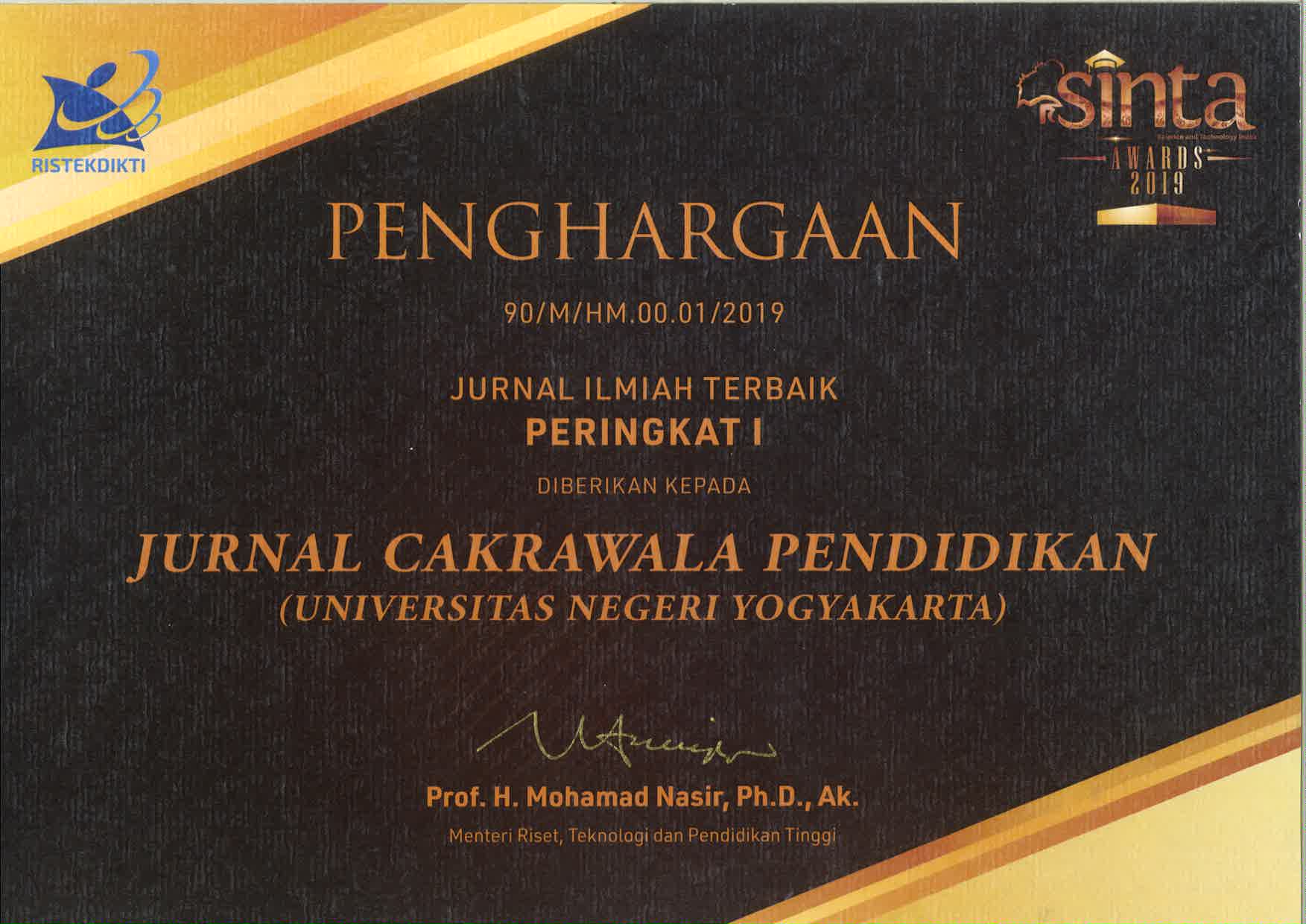
Jurnal Cakrawala Pendidikan, Jurnal Ilmiah Pendidikan, with ISSN: 0216-1370, is published by the Institute of Education Development and Quality Assurance (LPPMP UNY). Cakrawala Pendidikan has been recently has been re-accredited by Indonesian Ministry of Education and Culture decision Number 230/E/KPT/2022 which is valid for five years since enacted on 30 December 2022.