- Amis & Scope
- Editorial Board
- Reviewers
- Peer Review Process
- Publication Ethics
- Generative AI Policy
- Author Guidelines
- Author Fees (APC)
- Publishing System
- Open Access Policy
- Licensing Policy
- Copyright Notice
- Plagiarism & Research Integrity Policy
- Archiving Policy
- Journal Indexing & Title Listing
- Journal Metrics
- Contact
Peer Review Process
Jurnal Pendidikan Vokasi is committed to maintaining the highest standards of scholarly publishing through a rigorous, transparent, and fair peer-review process. Every submitted manuscript undergoes editorial screening and independent peer review to ensure its originality, scientific quality, methodological rigor, and contribution to the field of vocational education.
Review Model
Jurnal Pendidikan Vokasi applies a double-blind peer-review process. The identities of both authors and reviewers are concealed throughout the review process to ensure impartiality, objectivity, and academic integrity.
Initial Editorial Screening
Upon submission, each manuscript is first evaluated by the Editor-in-Chief or an assigned editor. The editorial screening assesses whether the manuscript:
- falls within the journal's aims and scope;
- demonstrates originality and scientific contribution;
- complies with the Author Guidelines and manuscript template;
- meets ethical publishing standards;
- passes similarity screening using plagiarism detection software;
- demonstrates sound research methodology and academic writing quality.
Manuscripts that do not satisfy these criteria may be rejected without external peer review (desk rejection).
Reviewer Assignment
Manuscripts that successfully pass the editorial screening are assigned to at least two independent reviewers with expertise relevant to the manuscript's subject area.
Reviewers are selected based on their academic qualifications, research experience, publication record, and absence of conflicts of interest.
Review Criteria
Reviewers are requested to evaluate manuscripts based on the following criteria:
- originality and novelty of the research;
- significance and contribution to vocational education research;
- theoretical foundation and literature review;
- methodological rigor and research design;
- validity and reliability of findings;
- quality of data analysis and interpretation;
- clarity, organization, and academic writing;
- relevance of references and citation practices;
- implications for vocational education policy and practice.
Reviewers are encouraged to provide constructive comments and recommendations to improve the quality of the manuscript.
Editorial Decision
Based on the reviewers' recommendations, the Editor-in-Chief makes the final editorial decision. Possible editorial decisions include:
- Accept
- Minor Revision
- Major Revision
- Reject
In cases where reviewers provide substantially conflicting recommendations, the editor may invite an additional reviewer before making the final decision.
Revision Process
Authors receiving a revision decision are required to:
- revise the manuscript according to reviewers' comments;
- submit a detailed response letter explaining how each comment has been addressed;
- resubmit the revised manuscript within the specified revision period.
Revised manuscripts may be returned to the original reviewers for further evaluation when necessary.
Copyediting and Production
Once a manuscript is accepted, it proceeds through the following publication stages:
- Copyediting
- Layout Editing
- Author Proofreading
- Final Quality Check
- Online Publication
Peer Review Timeline
Jurnal Pendidikan Vokasi strives to complete the peer-review process as efficiently as possible. Under normal circumstances, the review process is completed within 6–8 weeks, although the duration may vary depending on reviewer availability, manuscript complexity, and the extent of revisions required.
Confidentiality
All submitted manuscripts are treated as confidential documents.
Editors and reviewers must:
- maintain the confidentiality of all manuscript information;
- not disclose manuscript contents to unauthorized parties;
- not use unpublished data or ideas for personal research or advantage;
- declare any potential conflicts of interest before accepting a review assignment.
Publication Ethics
Editors, reviewers, and authors are expected to adhere to the journal's Publication Ethics and the principles established by the Committee on Publication Ethics (COPE).
Any suspected cases of plagiarism, duplicate publication, fabricated data, unethical research practices, or conflicts of interest will be handled in accordance with the journal's ethical policies.
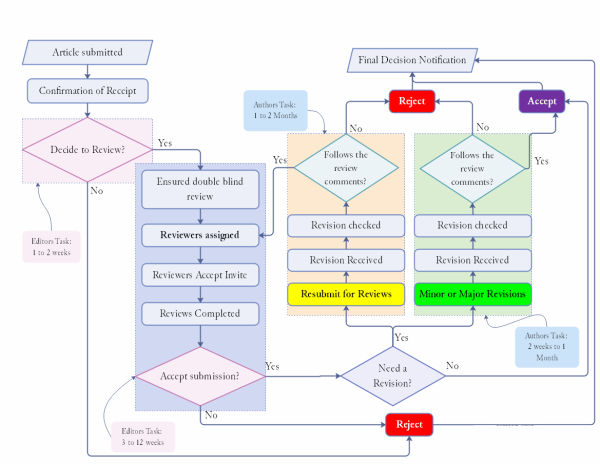
Peer Review Workflow
The peer-review workflow of Jurnal Pendidikan Vokasi is illustrated below.