Bridging Control System Education and Industrial Practice through a Real-Time Control System Architecture
Downloads
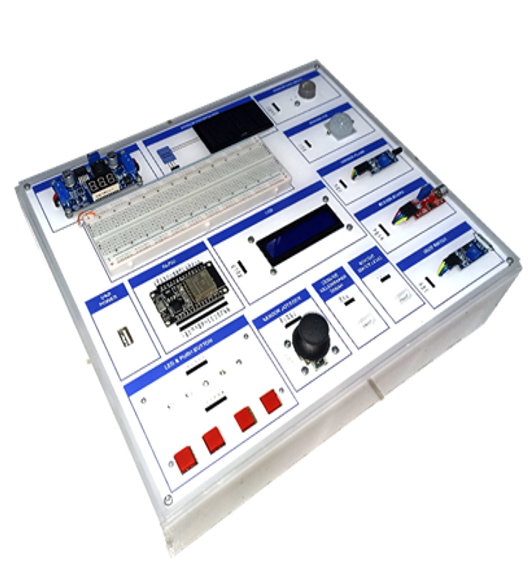
The limited accessibility, high cost, and low scalability of industrial control platforms constrain hands-on learning in automation education. This study presents a real-time control system architecture that bridges instructional requirements with industrial control principles through deterministic execution and structured logic representation. The system integrates ladder-based programming with cyclic scan execution and direct I/O mapping to ensure consistent real-time operation. A design and development methodology based on the adopted-ADDIE framework was employed to guide system realization and validation. The system was evaluated through expert-based assessment using a four-point Likert scale, followed by feasibility, content validity, and reliability analyses. Results indicate high technical feasibility, with technical quality reaching 83.04% and display quality 84.38% (very feasible), while instructional aspects range from 75.00% to 79.55% (feasible). Content validity achieved Aiken’s V values of 0.852 (very high) and 0.716 (high), with reliable expert agreement (Sig. > 0.05). These findings validate the proposed architecture as a scalable and reliable control system platform for automation learning.
Downloads
[1] X. Wang, M. Chen, and N. Chen, “How artificial intelligence affects the labour force employment structure from the perspective of industrial structure optimisation,” Heliyon, vol. 10, no. 5, p. e26686, Mar. 2024, doi: 10.1016/j.heliyon.2024.e26686.
[2] B. M. Szeszák, I. G. Kerékjártó, L. Soltész, and P. Galambos, “Industrial Revolutions and Automation: Tracing Economic and Social Transformations of Manufacturing,” Societies, vol. 15, no. 4, p. 88, Mar. 2025, doi: 10.3390/soc15040088.
[3] C. Anwar, N. Kholifah, M. Nurtanto, and H. R. Nur, “The capability of vocational education students in industrial practice learning programs,” J. Technol. Sci. Educ., vol. 13, no. 3, p. 657, Jun. 2023, doi: 10.3926/jotse.1960.
[4] L. Ghosh and R. Ravichandran, “Emerging Technologies in Vocational Education and Training,” J. Digit. Learn. Educ., vol. 4, no. 1, pp. 41–49, Apr. 2024, doi: 10.52562/jdle.v4i1.975.
[5] S. Rahmawati, S. Prestridge, A. G. Abdullah, and I. Widiaty, “Unpacking the digital competence challenge in vocational education: A case from Indonesia,” Soc. Sci. Humanit. Open, vol. 12, p. 101803, 2025, doi: 10.1016/j.ssaho.2025.101803.
[6] D. Zamora-Arranz, P. Garcia-Bringas, J. J. Gude, and J. Del Ser, “Leveraging programmable logic controllers for machine learning applications in industrial setups,” Results Eng., vol. 30, p. 110194, Jun. 2026, doi: 10.1016/j.rineng.2026.110194.
[7] M. Al-Yaman, D. Alswaiti, A. Alsharkawi, and M. Al-Taee, “A cost-effective modular laboratory solution for industrial automation and applied engineering education,” MethodsX, vol. 14, p. 103388, Jun. 2025, doi: 10.1016/j.mex.2025.103388.
[8] F. Fronchetti et al., “Language impact on productivity for industrial end users: A case study from Programmable Logic Controllers,” J. Comput. Lang., vol. 69, p. 101087, Apr. 2022, doi: 10.1016/j.cola.2021.101087.
[9] A. A. P. Cattaneo, C. Antonietti, and M. Rauseo, “How digitalised are vocational teachers? Assessing digital competence in vocational education and looking at its underlying factors,” Comput. Educ., vol. 176, p. 104358, Jan. 2022, doi: 10.1016/j.compedu.2021.104358.
[10] A. Haleem, M. Javaid, M. A. Qadri, and R. Suman, “Understanding the role of digital technologies in education: A review,” Sustain. Oper. Comput., vol. 3, pp. 275–285, 2022, doi: 10.1016/j.susoc.2022.05.004.
[11] J. Feng, B. Yu, W. H. Tan, Z. Dai, and Z. Li, “Key factors influencing educational technology adoption in higher education: A systematic review,” PLOS Digit. Heal., vol. 4, no. 4, p. e0000764, Apr. 2025, doi: 10.1371/journal.pdig.0000764.
[12] E. E. Abu Bakar, N. D. Abd Halim, M. F. Abdul Hanid, and R. Inderawati, “The Challenges of Teaching and Learning Programming in Schools: Insights from A Systematic Literature Review,” Karya J. Emerg. Technol. Hum. Serv., vol. 1, no. 1, pp. 48–63, Apr. 2025, doi: 10.37934/kjeths.1.1.4863.
[13] L. Sun and L. Zhou, “Does text-based programming improve K-12 students’ CT skills? Evidence from a meta-analysis and synthesis of qualitative data in educational contexts,” Think. Ski. Creat., vol. 49, p. 101340, Sep. 2023, doi: 10.1016/j.tsc.2023.101340.
[14] L. Silva, A. J. Mendes, A. Gomes, and G. Fortes, “Investigating Programming Students Problem Comprehension Ability and its Association With Learning Performance,” IEEE Trans. Educ., vol. 66, no. 2, pp. 156–162, Apr. 2023, doi: 10.1109/TE.2022.3204906.
[15] V. Godase, “Comparative Study of Ladder Logic and Structured Text Programming for PLC,” SSRN Electron. J., 2025, doi: 10.2139/ssrn.5383802.
[16] K.-C. Yao, C.-L. Lin, and C.-H. Pan, “Industrial Sustainable Development: The Development Trend of Programmable Logic Controller Technology,” Sustainability, vol. 16, no. 14, p. 6230, Jul. 2024, doi: 10.3390/su16146230.
[17] M. A. Márquez-Vera, M. Martínez-Quezada, R. Calderón-Suárez, A. Rodríguez, and R. M. Ortega-Mendoza, “Microcontrollers programming for control and automation in undergraduate biotechnology engineering education,” Digit. Chem. Eng., vol. 9, p. 100122, Dec. 2023, doi: 10.1016/j.dche.2023.100122.
[18] P. D. Widayaka, U. T. Kartini, N. R. Windayani, B. Sisephaputra, A. L. Wardani, and A. R. Zulfikar, “Arduino Based Microcontroller Learning Media on Improving Electrical Engineering Student Skills,” 2024, pp. 561–564. doi: 10.2991/978-2-38476-198-2_77.
[19] S. Hadiati, K. Bely, A. Pramuda, and L. Angraeni, “Bibliometric Analysis of Microcontroller-Based Learning Media,” J. Pendidik. Fis. dan Keilmuan, vol. 9, no. 2, p. 152, Aug. 2024, doi: 10.25273/jpfk.v9i2.20945.
[20] P. Ranganathan and C. Caduff, “Designing and validating a research questionnaire - Part 1,” Perspect. Clin. Res., vol. 14, no. 3, pp. 152–155, Jul. 2023, doi: 10.4103/picr.picr_140_23.
[21] M. Koo and S.-W. Yang, “Likert-Type Scale,” Encyclopedia, vol. 5, no. 1, p. 18, Feb. 2025, doi: 10.3390/encyclopedia5010018.
[22] L. R. Aiken, “Three Coefficients for Analyzing the Reliability and Validity of Ratings,” Educ. Psychol. Meas., vol. 45, no. 1, pp. 131–142, Mar. 1985, doi: 10.1177/0013164485451012.
[23] M. L. McHugh, “Interrater reliability: the kappa statistic,” Biochem. Medica, pp. 276–282, 2012, doi: 10.11613/BM.2012.031.
[24] P. W. Rusimamto, E. Endryansyah, R. Harimurti, and N. Nurkholis, “The Effect of the PLC Training Kit on Critical Thinking Ability in PLC Programming for Electrical Engineering,” TEM J., p. 3099, Nov. 2025, doi: 10.18421/TEM144-19.
[25] B. A. IYAOMOLERE, O. O. OLUWASEGUN, E. A. EKSON, and C. A. ADEGOKE, “DEVELOPMENT OF A LOW-COST PROGRAMMABLE LOGIC CONTROLLER TRAINER FOR INDUSTRIAL AUTOMATION EDUCATION,” OAUSTECH J. Eng. Intell. Technol., vol. 1, no. 1, May 2025, doi: 10.36108/ojeit/5202.10.0140.
[26] S. Qi, X. Mi, M. Niu, and D. Huang, “Enhancing engineering education: the impact of college experience, interpersonal interaction, and student engagement on developing practice-oriented competencies,” Eur. J. Eng. Educ., pp. 1–28, Jun. 2025, doi: 10.1080/03043797.2025.2522952.
[27] Y. Hu, C.-H. Chen, and C.-Y. Su, “Exploring the Effectiveness and Moderators of Block-Based Visual Programming on Student Learning: A Meta-Analysis,” J. Educ. Comput. Res., vol. 58, no. 8, pp. 1467–1493, Jan. 2021, doi: 10.1177/0735633120945935.
[28] N. E. Adams, “Bloom’s taxonomy of cognitive learning objectives,” J. Med. Libr. Assoc., vol. 103, no. 3, pp. 152–153, Jul. 2015, doi: 10.3163/1536-5050.103.3.010.
[29] A. Nurhuda, M. F. Al Khoiron, Y. Syafi’i Azami, and S. J. Ni’mah, “CONSTRUCTIVISM LEARNING THEORY IN EDUCATION: CHARACTERISTICS, STEPS AND LEARNING MODELS,” Res. Educ. Rehabil., vol. 6, no. 2, pp. 234–242, Dec. 2023, doi: 10.51558/2744-1555.2023.6.2.234.

This work is licensed under a Creative Commons Attribution-ShareAlike 4.0 International License.
The Authors submitting a manuscript do so on the understanding that if accepted for publication, copyright publishing of the article shall be assigned to Journal.