Simulation-Based Optimization of Indoor Lighting Systems for Simultaneous Illuminance Compliance and Energy Efficiency in a Higher Education Digital Library
Downloads
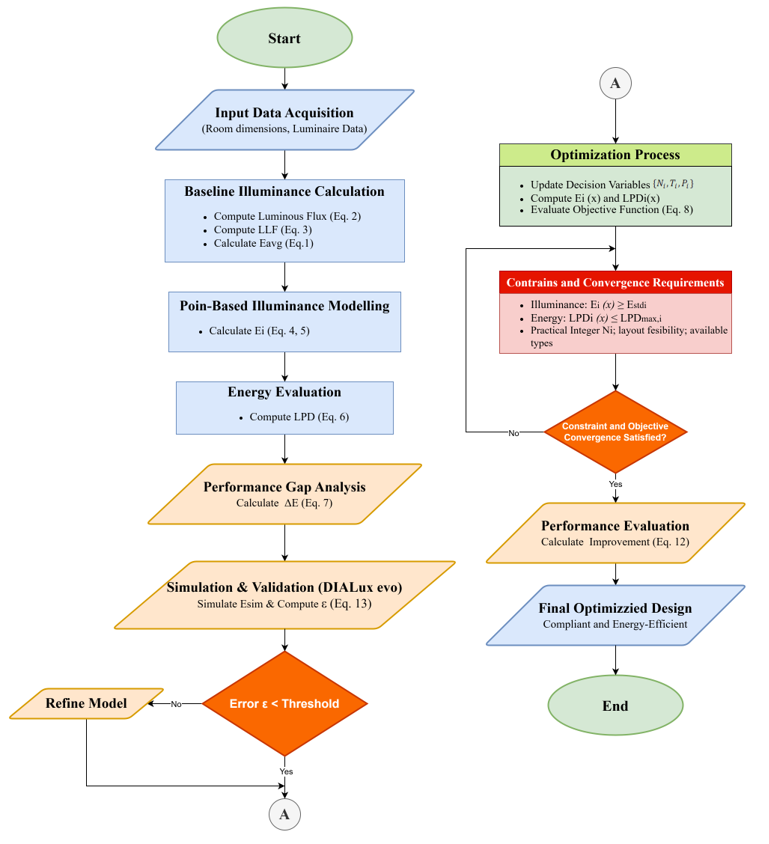
Indoor lighting systems must satisfy illuminance standards while maintaining energy efficiency; however, achieving this balance remains challenging in practice. This study evaluates and optimizes lighting performance in a higher education digital library based on SNI 6197:2020. A quantitative framework integrating analytical modeling and DIALux evo simulation is developed. The problem is formulated as a constrained optimization to minimize illuminance deviation under lighting power density (LPD) limits, using field measurements for validation. Initial results show that only 48.3% of rooms meet illuminance standards, while 93.1% operate below allowable LPD limits. Severe under-illumination is observed in critical spaces, with deviations up to −60.3%, despite low LPD values (2.15 - 2.95 W/m²), while some rooms exhibit over-illumination. Statistical analysis indicates a weak and non-significant relationship between LPD and illuminance (Pearson r = 0.239, p = 0.212, R² = 0.057), with a moderate monotonic trend (Spearman ρ = 0.459), confirming that installed power is not a reliable predictor of performance. These findings reveal that increasing installed power does not guarantee compliance. After optimization, all rooms achieve 100% compliance with an average illuminance improvement of 82.5%. These results demonstrate that lighting performance is primarily governed by spatial distribution rather than installed power.
Downloads
[1] L. V. González, A. S. Melenchón, D. B. Moyano, and R. A. González‐Lezcano, “Towards Sustainable Indoor Lighting Design: Ensuring Energy Efficiency, Health and Human Wellbeing—A Review,” Sustain. Dev., vol. 34, no. S1, pp. 1067–1095, Jan. 2026, doi: 10.1002/sd.70201.
[2] S. Hammes et al., “Concepts of user-centred lighting controls for office applications: A systematic literature review,” Build. Environ., vol. 254, p. 111321, Apr. 2024, doi: 10.1016/j.buildenv.2024.111321.
[3] K. Kim and K. Lee, “Indoor Light Environment Factors That Affect the Psychological Satisfaction of Occupants in Office Facilities,” Buildings, vol. 14, no. 5, p. 1248, Apr. 2024, doi: 10.3390/buildings14051248.
[4] N. Makaremi, S. Yildirim, G. T. Morgan, M. F. Touchie, J. A. Jakubiec, and J. B. Robinson, “Impact of classroom environment on student wellbeing in higher education: Review and future directions,” Build. Environ., vol. 265, p. 111958, Nov. 2024, doi: 10.1016/j.buildenv.2024.111958.
[5] M. Çelik, A. Didikoğlu, and T. Kazanasmaz, “Optimizing lighting design in educational settings for enhanced cognitive performance: A literature review,” Energy Build., vol. 328, p. 115180, Feb. 2025, doi: 10.1016/j.enbuild.2024.115180.
[6] The Indonesian standard (SNI), SNI 6197:2020. Jakarta: The Indonesian standard (SNI), 2020.
[7] A. Zhou and Y. Pan, “Effects of indoor lighting environments on paper reading efficiency and brain fatigue: an experimental study,” Front. Built Environ., vol. 9, Dec. 2023, doi: 10.3389/fbuil.2023.1303028.
[8] T. M. Brown et al., “Recommendations for daytime, evening, and nighttime indoor light exposure to best support physiology, sleep, and wakefulness in healthy adults,” PLOS Biol., vol. 20, no. 3, p. e3001571, Mar. 2022, doi: 10.1371/journal.pbio.3001571.
[9] A. S. J. Wardhana, Zamtinah, T. Sukisno, N. Yuniarti, and M. A. A. Bachrun, “Power Consumption Analysis and Evaluation of Energy Saving Potential of Lighting System in DEF Building,” J. Edukasi Elektro, vol. 9, no. 1, pp. 55–65, May 2025, doi: 10.21831/jee.v9i1.85443.
[10] Y. Zeng, H. Sun, and B. Lin, “Optimized lighting energy consumption for non-visual effects: A case study in office spaces based on field test and simulation,” Build. Environ., vol. 205, p. 108238, Nov. 2021, doi: 10.1016/j.buildenv.2021.108238.
[11] J. L. Reyna and M. V. Chester, “Energy efficiency to reduce residential electricity and natural gas use under climate change,” Nat. Commun., vol. 8, no. 1, p. 14916, May 2017, doi: 10.1038/ncomms14916.
[12] C. Skandali and Y. S. Lambiri, “Optimization Of Urban Street Lighting Conditions Focusing On Energy Saving, Safety And Users’ Needs,” J. Contemp. Urban Aff., vol. 2, no. 3, pp. 112–121, Dec. 2018, doi: 10.25034/ijcua.2018.4726.
[13] R. A. Tobeishat and W. Sheta, “Impact of Innovative Lighting Strategies on the Performance of Workplace Environment,” 2024, pp. 282–300. doi: 10.1007/978-3-031-56121-4_28.
[14] C. Jettanasen et al., “An approach to energy conservation in lighting systems using luminaire-based sensor for automatic dimming,” Sci. Rep., vol. 15, no. 1, p. 3302, Jan. 2025, doi: 10.1038/s41598-025-87813-y.
[15] S. Shojaee Barjoee and S. Gendler, “Sustainable illumination: Experimental and simulation analysis of illumination for workers wellbeing in the workplace,” Heliyon, vol. 10, no. 24, p. e40745, Dec. 2024, doi: 10.1016/j.heliyon.2024.e40745.
[16] T. Kruisselbrink, R. Dangol, and A. Rosemann, “Photometric measurements of lighting quality: An overview,” Build. Environ., vol. 138, pp. 42–52, Jun. 2018, doi: 10.1016/j.buildenv.2018.04.028.
[17] D. Czyżewski and I. Fryc, “The Influence of Luminaire Photometric Intensity Curve Measurements Quality on Road Lighting Design Parameters,” Energies, vol. 13, no. 13, p. 3301, Jun. 2020, doi: 10.3390/en13133301.
[18] Kemahasiswaan Universitas Negeri Yogyakarta, “GEDUNG DIGITAL LIBRARY UNY DIRESMIKAN,” kemahasiswaan.uny.ac.id.
[19] M. Jakubowsky and J. de Boer, “Façade elements for room illumination with integrated microstructures for daylight redirection and LED lighting,” Energy Build., vol. 266, p. 112106, Jul. 2022, doi: 10.1016/j.enbuild.2022.112106.
[20] S. Masoud, Z. Zamani, S. M. Hosseini, and S. Attia, “A Review of Factors Affecting the Lighting Performance of Light Shelves and Controlling Solar Heat Gain,” Buildings, vol. 14, no. 6, p. 1832, Jun. 2024, doi: 10.3390/buildings14061832.
[21] L. Dębska and A. Białek, “Lighting conditions as the occupational health related issue – case study,” MATEC Web Conf., vol. 354, p. 00059, Jan. 2022, doi: 10.1051/matecconf/202235400059.
[22] N. Nasrollahi and E. Shokry, “Parametric Analysis of Architectural Elements on Daylight, Visual Comfort, and Electrical Energy Performance in the Study Spaces,” J. Daylighting, vol. 7, no. 1, pp. 57–72, Mar. 2020, doi: 10.15627/jd.2020.5.
[23] S. S. Korsavi, Z. S. Zomorodian, and M. Tahsildoost, “Visual comfort assessment of daylit and sunlit areas: A longitudinal field survey in classrooms in Kashan, Iran,” Energy Build., vol. 128, pp. 305–318, Sep. 2016, doi: 10.1016/j.enbuild.2016.06.091.
[24] S. Attia, M. Hamdy, W. O’Brien, and S. Carlucci, “Assessing gaps and needs for integrating building performance optimization tools in net zero energy buildings design,” Energy Build., vol. 60, pp. 110–124, May 2013, doi: 10.1016/j.enbuild.2013.01.016.
[25] C. Velásquez, F. Espín, M. Á. Castro, and F. Rodríguez, “Energy Efficiency in Public Lighting Systems Friendly to the Environment and Protected Areas,” Sustainability, vol. 16, no. 12, p. 5113, Jun. 2024, doi: 10.3390/su16125113.
[26] J. A. Lobão, T. Devezas, and J. P. S. Catalão, “Energy efficiency of lighting installations: Software application and experimental validation,” Energy Reports, vol. 1, pp. 110–115, Nov. 2015, doi: 10.1016/j.egyr.2015.04.001.
[27] L. Bellia, F. Diglio, and F. Fragliasso, “Office workers’ performance and satisfaction with the luminous environment under standard and daylight mimicking LEDs,” J. Build. Eng., vol. 97, p. 110942, Nov. 2024, doi: 10.1016/j.jobe.2024.110942.
[28] Zumtobel, The Lighting Handbook. Dornbirn: Zumtobel Lighting, 2018.
[29] P. Pracki, M. Dziedzicki, and P. Komorzycka, “Ceiling and Wall Illumination, Utilance, and Power in Interior Lighting,” Energies, vol. 13, no. 18, p. 4744, Sep. 2020, doi: 10.3390/en13184744.
[30] L. Akimov, G. De Michele, U. Filippi Oberegger, V. Badenko, and A. G. Mainini, “Evaluation of EN15193-1 on energy requirements for artificial lighting against Radiance-based DAYSIM,” J. Build. Eng., vol. 40, p. 102698, Aug. 2021, doi: 10.1016/j.jobe.2021.102698.

This work is licensed under a Creative Commons Attribution-ShareAlike 4.0 International License.
The Authors submitting a manuscript do so on the understanding that if accepted for publication, copyright publishing of the article shall be assigned to Journal.