Developing Learning Media on Solar Power Generation to Enhance Practical Learning of Renewable Energy Competency for Undergraduate Students in The Electrical Engineering Education Study Program
Downloads
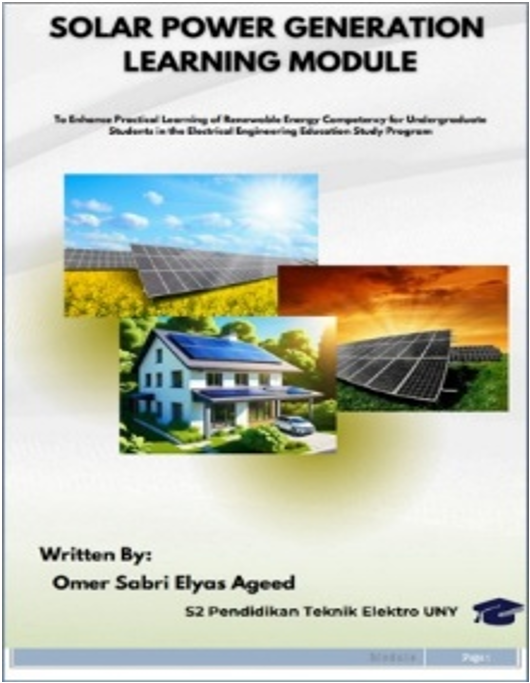
The increasing demand for renewable energy expertise requires practical, competency-based education, particularly in electrical engineering programs. This study aimed to address the lack of effective learning media for solar power generation, which influences student preparedness and the overall quality of renewable energy education. Using the ADDIE model (Analysis, Design, Development, Implementation, and Evaluation), instructional media were developed to enhance students’ practical understanding of solar power generation. The study involved 29 sixth-semester undergraduate students enrolled in an electrical engineering education program. A quantitative approach was employed, utilizing pretests and posttests to measure learning outcomes, along with students’ feedback. The results indicated a strong need for improved solar power generation tools and revealed significant competency gaps among students. The developed media included concept maps, diagrams, case studies, and interactive exercises, received very high feasibility ratings: 91.67% from media experts, 89.57% from material experts, and 91.40% from users. Following implementation, students demonstrated a significant improvement in understanding (p = 0.012) with high test reliability (Cronbach’s Alpha = 0.891). These findings demonstrate that the developed instructional media provide a validated, and practical solution to strengthen renewable energy education and support workforce readiness for the global energy transition.
Downloads
[1.] Ang, T., Salem, M., Kamarol, M., Das, H. S., Nazari, M. A., & Prabaharan, N. (2022). A comprehensive study of renewable energy sources: Classifications, challenges and suggestions. Energy Strategy Reviews, 43, 100939. https://doi.org/10.1016/j.esr.2022.100939
[2.] IEA (International Energy Agency). (2022). Annual Report 2022. Retrieved from https://iea-pvps.org/wp-content/uploads/2023/04/PVPS_Annual_Report_2022_v7-1.pdf
[3.] ESDM. (2021). Indonesia to Invest More in Solar Energy. Retrieved from https://www.esdm.go.id/en/media-center/news-archives/indonesia-to-invest-more-in-solar-energy
[4.] Ukoba, K., Yoro, K. O., Eterigho-Ikelegbe, O., Ibegbulam, C., & Jen, T. (2024). Adaptation of solar energy in the Global South: Prospects, challenges and opportunities. Heliyon, 10(7), e28009. https://doi.org/10.1016/j.heliyon.2024.e28009
[5.] Yoana., Auwalin, I., Rumayya, R. (2024). The role of Undergraduate Education on unemployment in Indonesia. Cogent Education, 11. 10.1080/2331186X.2024.2340858.
[6.] Shahzad, T., Mazhar, T., Tariq, M.U. et al. (2025). A comprehensive review of large language models: issues and solutions in learning environments. Discov Sustain, 6, 27. https://doi.org/10.1007/s43621-025-00815-8
[7.] Wijaya, R. B. M. O., & Utami, E. D. (2020). Determinants of Unemployment of Undergraduate Graduates in Indonesia in 2020. Seminar Nasional Official Statistics 2021.
[8.] Dixit-Bajpai, Preeti & Ravichandran, R. (2023). The impact of Undergraduate education on Economic Growth and Development across the G20 Countries. Indian Journal of Undergraduate Education, 35, 57-68.
[9.] Shaker, L. M., A., A., Hanoon, M. M., K., W., & Kadhum, A. A. (2024). Examining the influence of thermal effects on solar cells: A comprehensive review. Sustainable Energy Research, 11(1), 1-30. https://doi.org/10.1186/s40807-024-00100-8
[10.] Kanellopoulou, C., Kermanidis, K. L., & Giannakoulopoulos, A. (2019). The Dual-Coding and Multimedia Learning Theories: Film Subtitles as a Vocabulary Teaching Tool. Education Sciences, 9(3), 210. https://doi.org/10.3390/educsci9030210
[11.] Pan, H., Wang, G., Gao, W., & Liu, X. (2024). Undergraduate Education, Skill Formation, and Social Development. Education Sciences, 15(1), 107. https://doi.org/10.3390/educsci15010107
[12.] Kotsifakos, D., Kiriakos, D., Kalovrektis, K., Psaromiligkos, Y., & Douligeris, C. (2024). Research and Analysis in the Cognitive Principles of Undergraduate Education and Training in Greece at the Beginning of the 21st Century. Applied System Innovation, 7(5), 98. https://doi.org/10.3390/asi7050098
[13.] Yuen, S., Luo, Z., & Wan, S. W. (2023). Challenges and Opportunities of Implementing Differentiated Instruction amid the COVID-19 Pandemic: Insights from a Qualitative Exploration. Education Sciences, 13(10), 989. https://doi.org/10.3390/educsci13100989
[14.] Hermans, S., Neutens, T., Wyffels, F., & Van Petegem, P. (2024). Empowering Undergraduate Students: A Research-Based Framework for Computational Thinking Integration. Education Sciences, 14(2), 206. https://doi.org/10.3390/educsci14020206
[15.] Sher, F., Curnick, O., & Azizan, M. T. (2020). Sustainable Conversion of Renewable Energy Sources. Sustainability, 13(5), 2940. https://doi.org/10.3390/su13052940
[16.] Yaakop, Z., Teh, H., Venugopal, V., & Ma, Z. (2024). Assessment of Tidal and Wave Energy Resource Potential in Malaysia with Sea Level Rise Effects. Journal of Marine Science and Engineering, 13(1), 84. https://doi.org/10.3390/jmse13010084
[17.] Ananda, P. N., & Usmeldi. (2023). Validity and Practicality of E-Module Model Inquiry Based Online Learning to Improve Student Competence. Journal of Research in Science Education, 9(4).
[18.] Dirma, V., Neverauskienė, L. O., Tvaronavičienė, M., Danilevičienė, I., & Tamošiūnienė, R. (2023). The Impact of Renewable Energy Development on Economic Growth. Energies, 17(24), 6328. https://doi.org/10.3390/en17246328
[19.] Santos, E. (2024). Renewable Energy and Socio-Economic Transformation: Three Case Studies. Sustaina-bility, 17(3), 1196. https://doi.org/10.3390/su17031196
[20.] Kacprzak, M., Król, A., Wielewska, I., Milewska, A., & Ciekanowski, Z. (2021). Employment and Com-petencies of Employees in the Energy Sector in Poland. Energies, 15(19), 6941. https://doi.org/10.3390/en15196941
[21.] Yaseen, H., Mohammad, A. S., Ashal, N., Abusaimeh, H., Ali, A., & Sharabati, A. (2024). The Impact of Adaptive Learning Technologies, Personalized Feedback, and Interactive AI Tools on Student Engage-ment: The Moderating Role of Digital Literacy. Sustainability, 17(3), 1133. https://doi.org/10.3390/su17031133
[22.] Chen, C., & Lin, J. (2020). An Action Research on the Long-Term Implementation of an Engineering-Centered PjBL of Sustainable Energy in a Rural Middle School. Sustainability, 13(19), 10626. https://doi.org/10.3390/su131910626
[23.] Harkins-Brown, A. R., Gillon, N., & Schanbacher, A. (2024). Results of a Competency-Based Approach to Prepare General Educators to Effectively Include Students with Disabilities. Education Sciences, 14(5), 475. https://doi.org/10.3390/educsci14050475
[24.] Machaca, A. T., Ccoa, D. M. C., Castillo, F. G., Quispe Gomez, F., Arroyo Beltrán, M., Zirena Cano, M. G., Manrique Chavez, C. P., Romualdo Rosario, A., Andrés, W., & Montes Salcedo, M. (2024). Public Policy for Human Capital: Fostering Sustainable Equity in Disadvantaged Communities. Sustainability, 17(2), 535. https://doi.org/10.3390/su17020535
[25.] Spatioti, A. G., Kazanidis, I., & Pange, J. (2022). A Comparative Study of the ADDIE Instructional De-sign Model in Distance Education. Information, 13(9), 402. https://doi.org/10.3390/info13090402
[26.] Namora., Army, W. L., Anita, S., Nugroho, A. (2025). Analisis Technology Acceptance Model (TAM) dalam Penggunaan Aplikasi ECommerce. Jurnal Pendidikan Sains dan Komputer, 5(1).
[27.] Sujito., Aripriharta., Faiz, M. R., Falah, M. Z., Syah, A. I. (2022). Development of Teaching Modules for Operation and System Stability Courses as a Pilot Project for the Electrical Engineering Study Program Towards Independent Learning. International Journal Of Research In Vocational Studies (IJRVOCAS), 1(4), 41-45.
[28.] Mulyadinata, M. A., Joko., Rijanto, T., Harimurti, R. (2025). Pengembangan Modul Ajar Training Kit Pembangkit Listrik Tenaga Surya Pada Elemen Pembelajaran Instalasi Tenaga Listrik. Jurnal Pendidikan Teknik Elektro, 14(03), 183-189.
[29.] Nopriana, T., Herman, T., Martadiputra, B. A. P. (2023). Digital Didactical Design: The Role of Learning Obstacles in Designing Combinatorics Digital Module for Vocational Students. International Journal of In-teractive Mobile Technologies (iJIM), 17, 4-23. 10.3991/ijim.v17i02.34293.
[30.] Altassan, A. (2022). Sustainable Integration of Solar Energy, Behavior Change, and Recycling Practices in Educational Institutions: A Holistic Framework for Environmental Conservation and Quality Education. Sustainability, 15(20), 15157. https://doi.org/10.3390/su152015157
[31.] Rahmawati, Yuni & Afandi, A.N. & Arengga, D & Sendari, Siti & Agustin, Wanda & Matsumoto, Toru & Rahman, Ishfaq. (2018). Developing a simulator of renewable energy as a learning media of energy conversion. IOP Conference Series: Earth and Environmental Science, 105. 012079. 10.1088/1755-1315/105/1/012079.
[32.] Levent, İ., Şahin, G., Işık, G., & Van Sark, W. G. (2025). Comparative Analysis of Advanced Machine Learning Regression Models with Advanced Artificial Intelligence Techniques to Predict Rooftop PV So-lar Power Plant Efficiency Using Indoor Solar Panel Parameters. Applied Sciences, 15(6), 3320. https://doi.org/10.3390/app15063320
[33.] Widyaningsih, Sri & Yusuf, Irfan & Prasetyo, Zuhdan & Istiyono, Edi. (2020). Online Interactive Multi-media Oriented to HOTS through E-Learning on Physics Material about Electrical Circuit. JPI (Jurnal Pendidikan Indonesia), 9. 10.23887/jpi-undiksha.v9i1.17667.
[34.] Vijayan, D. S., Koda, E., Sivasuriyan, A., Winkler, J., Devarajan, P., Kumar, R. S., Jakimiuk, A., Osinski, P., Podlasek, A., & Vaverková, M. D. (2022). Advancements in Solar Panel Technology in Civil Engi-neering for Revolutionizing Renewable Energy Solutions A Review. Energies, 16(18), 6579. https://doi.org/10.3390/en16186579
[35.] Geeksforgeeks. (2023). Solar Cell. Retrieved from https://www.geeksforgeeks.org/solar-cell/
[36.] Schmidt, J., Wollermann, L., Abele, S., & Müller, R. (2024). Concept Maps to Assess System Under-standing: Are Graphical Explanations More Accurate than Verbal Ones? Behavioral Sciences, 14(9), 807. https://doi.org/10.3390/bs14090807
[37.] Ponomariovienė, J., & Torterat, F. (2025). Implementing Competency-Based Education Through the Per-sonalized Monitoring of Primary Students’ Progress and Assessment. Education Sciences, 15(2), 252. https://doi.org/10.3390/educsci15020252
[38.] Huang, Z., Peng, A., Yang, T., Deng, S., & He, Y. (2020). A Design-Based Learning Approach for Fos-tering Sustainability Competency in Engineering Education. Sustainability, 12(7), 2958. https://doi.org/10.3390/su12072958
[39.] Errabo, D. D., & Ongoco, A. A. (2024). Effects of interactive-mobile learning modules in students’ en-gagement and understanding in genetics. Journal of Research in Innovative Teaching & Learning, 17(2), 327-351. https://doi.org/10.1108/JRIT-01-2024-0023
[40.] Boateng, S., Gilbert, G., Duedu, C. (2024). Augmenting Academic Efficiency: The Integration of Assess-ments Within the Addie Model for Pedagogical Development. Proceedings of The International Conference on Advanced Research in Education, Teaching, and Learning, 1, 1-12. 10.33422/aretl.v1i1.186

This work is licensed under a Creative Commons Attribution-ShareAlike 4.0 International License.
The Authors submitting a manuscript do so on the understanding that if accepted for publication, copyright publishing of the article shall be assigned to Journal.