Development of an ESP32-Based Internet of Things Trainer for Sensor and Transducer Learning in Electrical Engineering Education
Downloads
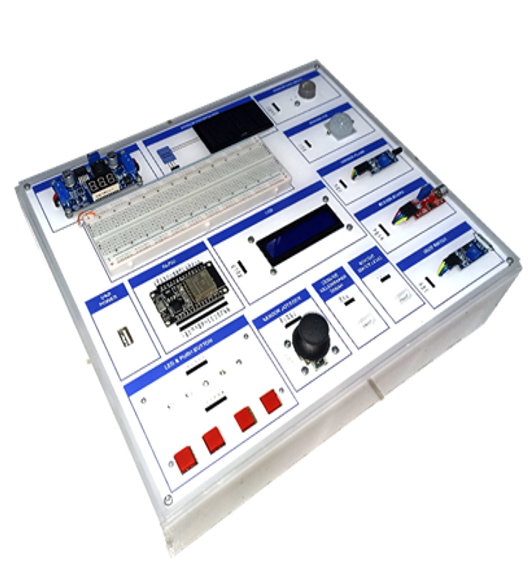
Low student motivation and the absence of integrated IoT-based learning media in the Sensor and Transducer Practicum course represent a critical gap that limits students' ability to connect theoretical concepts with industrial practice. This study aimed to realize an ESP32-based IoT Trainer, evaluate its technical performance, and assess its feasibility as a learning medium. The Research and Development method with the ADDIE model was employed. The developed product consists of an integrated trainer unit with nine sensors, a learning module, and jobsheet. Testing involved two content experts, two media experts, and 30 students using a 5-point Likert scale instrument. All trainer components functioned stably across all test conditions. Validation results showed 92.5% feasibility from content experts, 93.75% from media experts, and 90.5% from users, with an overall average of 92.25%, all categorized as "Very Feasible." These findings indicate that the trainer effectively enhances students' hands-on engagement with IoT-integrated sensor systems, bridging the gap between classroom theory and real-world industrial competencies.
Downloads
[1] M. Mansour et al., “Internet of Things: A Comprehensive Overview on Protocols, Architectures, Technologies, Simulation Tools, and Future Directions,” Energies, vol. 16, no. 8, p. 3465, 2023, doi: 10.3390/en16083465.
[2] L. Babun, K. Denney, Z. B. Celik, P. McDaniel, and A. S. Uluagac, “A survey on IoT platforms: Communication, security, and privacy perspectives,” Comput. Networks, vol. 192, p. 108040, 2021, doi: 10.1016/j.comnet.2021.108040.
[3] L. Shi, J. Yu, and L. He, “Construction of practical training system for new engergy IoT in higher vocational under the integration of ‘post, course, competition and certificate,’” Exp. Technol. Manag., vol. 42, no. 12, pp. 230–237, 2025, doi: 10.16791/j.cnki.sjg.2025.12.028.
[4] C. Rodriguez-Sanchez, R. Orellana, P. R. Fernandez Barbosa, S. Borromeo, and J. Vaquero, “Insights 4.0: Transformative learning in industrial engineering through problem-based learning and project-based learning,” Comput. Appl. Eng. Educ., vol. 32, no. 4, pp. 1–11, 2024, doi: 10.1002/cae.22736.
[5] S. Amador Nelke et al., “Enhancing Lessons on the Internet of Things in Science, Technology, Engineering, and Medical Education with a Remote Lab,” Sensors, vol. 24, no. 19, p. 6424, Oct. 2024, doi: 10.3390/s24196424.
[6] J. H. Kleinschmidt, “Teaching Internet of Things for Engineering Courses: A Project-Based Cooperative Approach,” Int. J. Electr. Eng. Educ., vol. 58, no. 4, pp. 858–873, 2021, doi: 10.1177/0020720919867437.
[7] P. Purnamawati, M. Akil, and N. Nuridayanti, “Analysis of needs for the development of trainer sensor and transducer learning media based on Internet of Things (IoT),” J. Pendidik. Vokasi, vol. 11, no. 3, pp. 231–242, 2021, doi: 10.21831/jpv.v11i3.43833.
[8] W. Mustakim, H. Effendi, Aswardi, M. Giatman, Hariyadi, and W. Dwi Pratiwi, “Development of Internet of Things Trainer Kit as a Learning Media for Digital Circuit Subjects in Higher Education,” Int. J. Online Biomed. Eng., vol. 20, no. 9, pp. 4–16, Jun. 2024, doi: 10.3991/ijoe.v20i09.48349.
[9] Purnamawati, M. Akil, and Nuridayanti, “A feasibility study of sensor and transducer trainers as a learning media towards electronics engineering’s students,” J. Phys. Conf. Ser., vol. 1810, no. 1, p. 012051, 2021, doi: 10.1088/1742-6596/1810/1/012051.
[10] F. Eliza, O. Candra, R. Mukhaiyar, R. Fadli, and Y. E. Wibowo, “Development of a Microcontroller Training Kit to Increase Student Learning Motivation,” Eng. Technol. Appl. Sci. Res., vol. 15, no. 3, pp. 22319–22326, Jun. 2025, doi: 10.48084/etasr.10142.
[11] R. Ariza, I. W. S. Nirawana, and Rusdiana, “Development of a Microcontroller E-Module Based on Grove Beginner Kit for Arduino Informatics Subject,” J. Teknol. Pendidik. J. Penelit. Dan Pengemb. Pembelajaran, vol. 10, no. 1, pp. 141–153, 2025, doi: 10.33394/jtp.v10i1.13899.
[12] P. Jacko et al., “Remote IoT Education Laboratory for Microcontrollers Based on the STM32 Chips,” Sensors, vol. 22, no. 4, p. 1440, 2022, doi: 10.3390/s22041440.
[13] D. Hercog, T. Lerher, M. Truntič, and O. Težak, “Design and Implementation of ESP32-Based IoT Devices,” Sensors, vol. 23, no. 15, p. 6739, 2023, doi: 10.3390/s23156739.
[14] R. M. Branch, Instructional Design: The ADDIE Approach. Springer, 2009.
[15] S. I. Shakeel, M. A. Al Mamun, and M. F. A. Haolader, “Instructional design with ADDIE and rapid prototyping for blended learning: validation and its acceptance in the context of TVET Bangladesh,” Educ. Inf. Technol., vol. 28, pp. 7601–7630, Jun. 2023, doi: 10.1007/s10639-022-11471-0.
[16] A. G. Spatioti, I. Kazanidis, and J. Pange, “A Comparative Study of the ADDIE Instructional Design Model in Distance Education,” Information, vol. 13, no. 9, p. 402, 2022, doi: 10.3390/info13090402.
[17] A. Arsyad, Media pembelajaran, Revised ed. Jakarta: PT Rajagrafindo Persada, 2020.
[18] Sugiyono, Metode Penelitian dan Pengembangan (Research and Development/R&D). Bandung: Alfabeta, 2022.
[19] I. W. E. D. Rahmanu, I. N. R. Aryana, and I. B. A. Adnyana, “Exploring English as a Foreign Language (EFL) Learning Media in Vocational Higher Education,” in Prosiding Seminar Nasional Riset Bahasa dan Pengajaran Bahasa, 2023, pp. 92–100. doi: 10.31940/senarilip.v5i1.92-100.
[20] A. Maier, A. Sharp, and Y. Vagapov, “Comparative analysis and practical implementation of the ESP32 microcontroller module for the internet of things,” in 2017 Internet Technologies and Applications (ITA), 2017, pp. 143–148. doi: 10.1109/ITECHA.2017.8101926.
[21] S. S. Shanto, M. Rahman, J. M. Oasik, and H. Hossain, “Smart Greenhouse Monitoring System Using Blynk IoT App,” J. Eng. Res. Reports, vol. 25, no. 2, pp. 94–107, May 2023, doi: 10.9734/jerr/2023/v25i2883.
[22] C. Adelia and G. D. K. Ningrum, “The Effectiveness of Project-Based Learning Assisted by the Digital IoT Blynk Simulation on Improving the Practical Skills of Grade X Mechatronics Students at SMKN 8 Malang,” J. Educ. Sci., vol. 9, no. 5, pp. 4748–4764, 2025, doi: 10.31258/jes.9.5.p.4648-4764.

This work is licensed under a Creative Commons Attribution-ShareAlike 4.0 International License.
The Authors submitting a manuscript do so on the understanding that if accepted for publication, copyright publishing of the article shall be assigned to Journal.