Prototype of Wind Power Plant Using a Laboratory-Scale Vertical Axis Savonius Turbine
Downloads
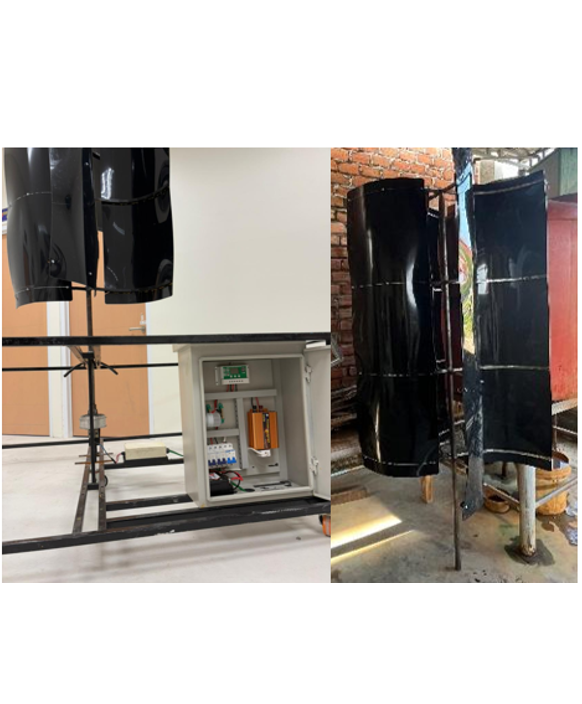
This study investigates the performance of a laboratory-scale vertical-axis Savonius wind turbine prototype developed based on a simple and robust mechanical design for small-scale renewable energy applications. The prototype frame was constructed using angle steel with a cross-section of 40 × 40 mm and a thickness of 1.8 mm, forming a rectangular structure with overall dimensions of 150 cm × 150 cm and a height of 50 cm. The Savonius rotor employed a solid steel shaft with a diameter of 2.5 cm and acrylic blades measuring 100 cm in height and 40 cm in width. Performance data were collected over a six-month observation period from August 2025 to January 2026 under low to moderate wind speed conditions. The measured wind speed ranged from approximately 3.5 to 6.5 m/s, resulting in power outputs between 0.77 W and 9.44 W. The calculated power coefficient (Cp) varied from 0.18 to 0.34, indicating a typical efficiency range for drag-based Savonius turbines. The results show a consistent increase in rotor speed and electrical power output with rising wind speed, while Cp values tend to stabilize at higher wind velocities, reflecting aerodynamic performance limitations inherent to Savonius turbines. These findings demonstrate that the developed prototype exhibits stable and predictable behavior, making it suitable for laboratory experimentation, educational purposes, and preliminary assessment of small-scale wind energy systems operating in low wind speed environments.
Downloads
[1] S. F. Dorel, G. A. Mihai, and D. Nicusor, “Review of Specific Performance Parameters of Vertical Wind Turbine Rotors Based on the SAVONIUS Type,” Energies, 2021, doi: 10.3390/en14071962.
[2] A. Dewan, A. Gautam, and R. Goyal, “Materials Today : Proceedings Savonius wind turbines : A review of recent advances in design and performance enhancements,” Mater. Today Proc., 2021, doi: 10.1016/j.matpr.2021.05.205.
[3] I. Ross and A. Altman, “Journal of Wind Engineering Wind tunnel blockage corrections : Review and application to Savonius vertical-axis wind turbines,” Jnl. Wind Eng. Ind. Aerodyn., vol. 99, no. 5, pp. 523–538, 2011, doi: 10.1016/j.jweia.2011.02.002.
[4] J. Vicente, H. Antonio, and A. Prisco, “A review on the performance of Savonius wind turbines,” Renew. Sustain. Energy Rev., vol. 16, no. 5, pp. 3054–3064, 2012, doi: 10.1016/j.rser.2012.02.056.
[5] T. Zhipeng, Y. Yingxue, Z. Liang, and Y. Bowen, “A review on the new structure of Savonius wind turbines,” Adv. Mater. Res., vol. 609, pp. 467–478, 2013, doi: 10.4028/www.scientific.net/AMR.608-609.467.
[6] A. G. Chitura and P. Mukumba, “Enhancing the Performance of Savonius Wind Turbines : A Review of Advances Using Multiple Parameters,” Energies, 2024, doi: 10.3390/en17153708.
[7] W. Topics, “A Review on State-of-the-Art Reviews in Wind-Turbine- and Wind-Farm-Related Topics,” Energies, pp. 1–30, 2021, doi: 1996-1073/14/8/2041.
[8] D. Vahidi and F. Porté-agel, “A physics-based model for wind turbine wake expansion in the atmospheric boundary layer,” J. Fluid Mech, pp. 1–28, 2022, doi: 10.1017/jfm.2022.443.
[9] K. A. H. Al-gburi, B. A. J. Al-quraishi, F. Basim, I. Alnaimi, E. S. Tan, and A. H. S. Al-safi, “Experimental and Simulation Investigation of Performance of Scaled Model for a Rotor of a Savonius Wind Turbine,” Energies, 2022, doi: 1996-1073/15/23/8808.
[10] Z. Alomar, G. Khoury, J. Rishmany, and M. Daaboul, “NUMERICAL AND EXPERIMENTAL STUDY ON THE EFFECT OF OVERLAP ON SAVONIUS WIND TURBINE,” Int. J. Power Energy Syst., vol. 43, no. 10, pp. 1–9, 2023, doi: 10.2316/J.2023.203-0450.
[11] N. Hoyle and E. Flow, “Wind Turbine Power Calculations,” npower, 2003.
[12] N. Riyaz, C. Yee, and E. Oguz, “A review of the optimization studies for Savonius turbine considering hydrokinetic applications,” Energy Convers. Manag., vol. 226, no. October, p. 113495, 2020, doi: 10.1016/j.enconman.2020.113495.
[13] S. Roy and U. K. Saha, “Review of experimental investigations into the design , performance and optimization of the Savonius rotor,” vol. 227, no. 4, pp. 528–542, 2013, doi: 10.1177/0957650913480992.
[14] M. A. Kamoji, S. B. Kedare, and S. V Prabhu, “Experimental investigations on single stage modified Savonius rotor,” Appl. Energy, vol. 86, no. 7–8, pp. 1064–1073, 2009, doi: 10.1016/j.apenergy.2008.09.019.
[15] U. K. Saha, S. Thotla, and D. Maity, “Journal of Wind Engineering Optimum design configuration of Savonius rotor through wind tunnel experiments,” J. Wind Eng. Ind. Aerodyn., vol. 96, pp. 1359–1375, 2008, doi: 10.1016/j.jweia.2008.03.005.
[16] M. H. Pranta, M. S. Rabbi, and M. M. Roshid, “Results in Engineering A computational study on the aerodynamic performance of modi fi ed savonius wind turbine,” Results Eng., vol. 10, no. May, p. 100237, 2021, doi: 10.1016/j.rineng.2021.100237.
[17] Z. Mu et al., “Study on Aerodynamic Characteristics of a Savonius Wind,” Energies, 2022, doi: 10.3390/en15186661.
[18] B. D. Altan and M. At, “The use of a curtain design to increase the performance level of a Savonius wind rotors,” Renew. Energy, vol. 35, pp. 821–829, 2010, doi: 10.1016/j.renene.2009.08.025.
[19] M. H. Nasef, W. A. El-askary, A. A. Abdel-hamid, and H. E. Gad, “Journal of Wind Engineering Evaluation of Savonius rotor performance : Static and dynamic studies,” Jnl. Wind Eng. Ind. Aerodyn., vol. 123, pp. 1–11, 2013, doi: 10.1016/j.jweia.2013.09.009.
[20] K. N. Morshed, M. Rahman, G. Molina, and M. Ahmed, “Wind tunnel testing and numerical simulation on aerodynamic performance of a three-bladed Savonius wind turbine,” Int. J. Energy Enviromental Eng., pp. 1–14, 2013, doi: 10.1186/2251-6832-4-18.

This work is licensed under a Creative Commons Attribution-ShareAlike 4.0 International License.
The Authors submitting a manuscript do so on the understanding that if accepted for publication, copyright publishing of the article shall be assigned to Journal.