Call for Papers Focus & Scope Author Guidelines Template: Title Page Template: Anonymised Manuscript Template: Statement of Originality Online Submission Peer Review Process Publication Ethics Generative AI Policy Plagiarism Policy Authorship Policy Conflict of Interest Correction and Retraction Post-Publication Discussions Research Misconduct Open Access Policy Archiving Policy Author Fees Copyright Notice Ownership and Management Editorial Team Reviewers Journal History Abstracting & Indexing Helpdesk Editor 1 Helpdesk Editor 2 Editor-in-Chief
| Journal title | Efisiensi: Kajian Ilmu Administrasi |
| Abbreviation | Efisiensi |
| Frequency | Two issues per year, in February and August |
| DOI prefix | 10.21831 |
| ISSN | p-ISSN 1412-1131 (print) | e-ISSN 2528-5750 (online) |
| Editor-in-Chief | Umar Yeni Suyanto |
| Publisher | Jurusan Pendidikan Administrasi Fakultas Ekonomi Universitas Negeri Yogyakarta |
| Partner | Asosiasi Sarjana dan Praktisi Administrasi Perkantoran Indonesia (ASPAPI), since 7 March 2020 |
| Language | English from Volume 24 Number 1 (February 2027) |
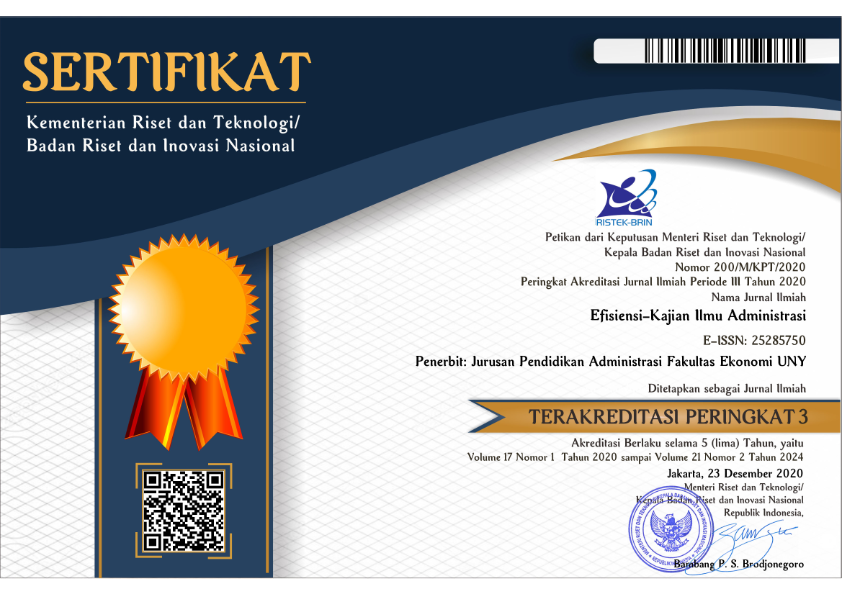
| Accreditation | Previously accredited by the Ministry of Education, Culture, Research, and Technology (Decree No. 200/M/KPT/2020) for Vol. 17 No. 1 (2020) to Vol. 21 No. 2 (2024). Re-accreditation under the 2026 national guidelines is in preparation. |
| Indexing | Sinta | Google Scholar | Garuda | Dimensions |
| License | CC BY-NC-SA 4.0 |
Efisiensi: Kajian Ilmu Administrasi publishes research on administrative science, covering administration education and administrative practice in organisations: office administration education, office information technology and automation, office and resource management, secretarial work and correspondence, records management, communication and public relations, event management and service excellence, organisation and leadership, human resource management, and business and public administration. It publishes research articles, systematic literature reviews, and conceptual articles (Focus and Scope).
On 7 March 2020, at Universitas Negeri Jakarta, the journal signed a cooperation agreement on its management and publication with the Asosiasi Sarjana dan Praktisi Administrasi Perkantoran Indonesia (ASPAPI) (memorandum of agreement). ASPAPI has no role in editorial decisions.
Lecturers, researchers, practitioners, teachers, and students are invited to submit manuscripts online. Please read the Author Guidelines and submit three files prepared from the Efisiensi 2026 templates: the Title Page, the Anonymised Manuscript, and the signed Statement of Originality. Manuscripts are reviewed under double-blind peer review by at least one reviewer, and by at least two reviewers from Volume 24 Number 1, February 2027 (Peer Review Process).
Journal policies: Publication Ethics · Peer Review Process · Author Guidelines · Generative AI Policy · Plagiarism Policy · Authorship Policy · Conflict of Interest Policy · Correction and Retraction · Post-Publication Discussions and Corrections · Research Misconduct · Open Access Policy · Archiving Policy · Author Fees · Ownership and Management.



Current Issue
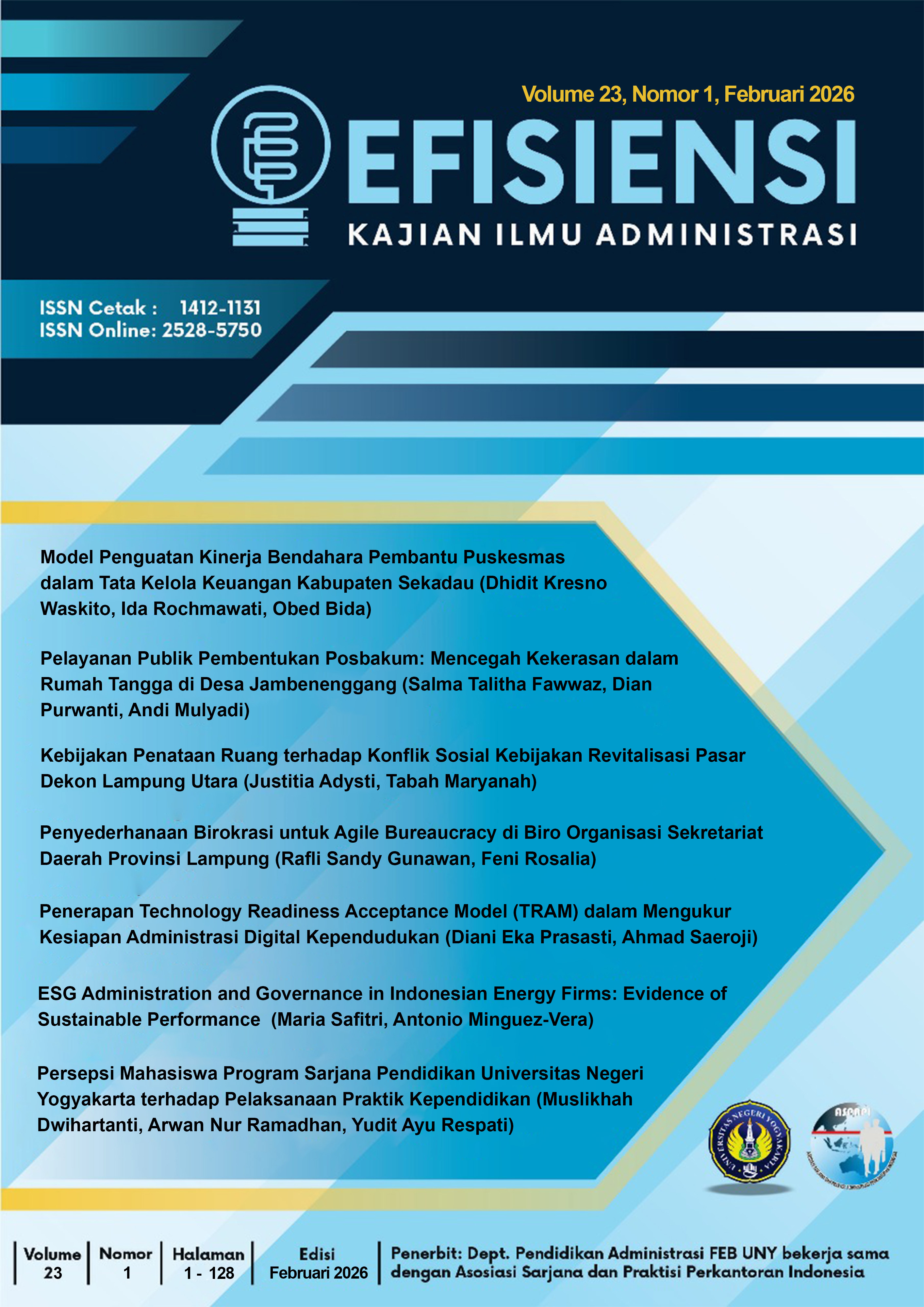
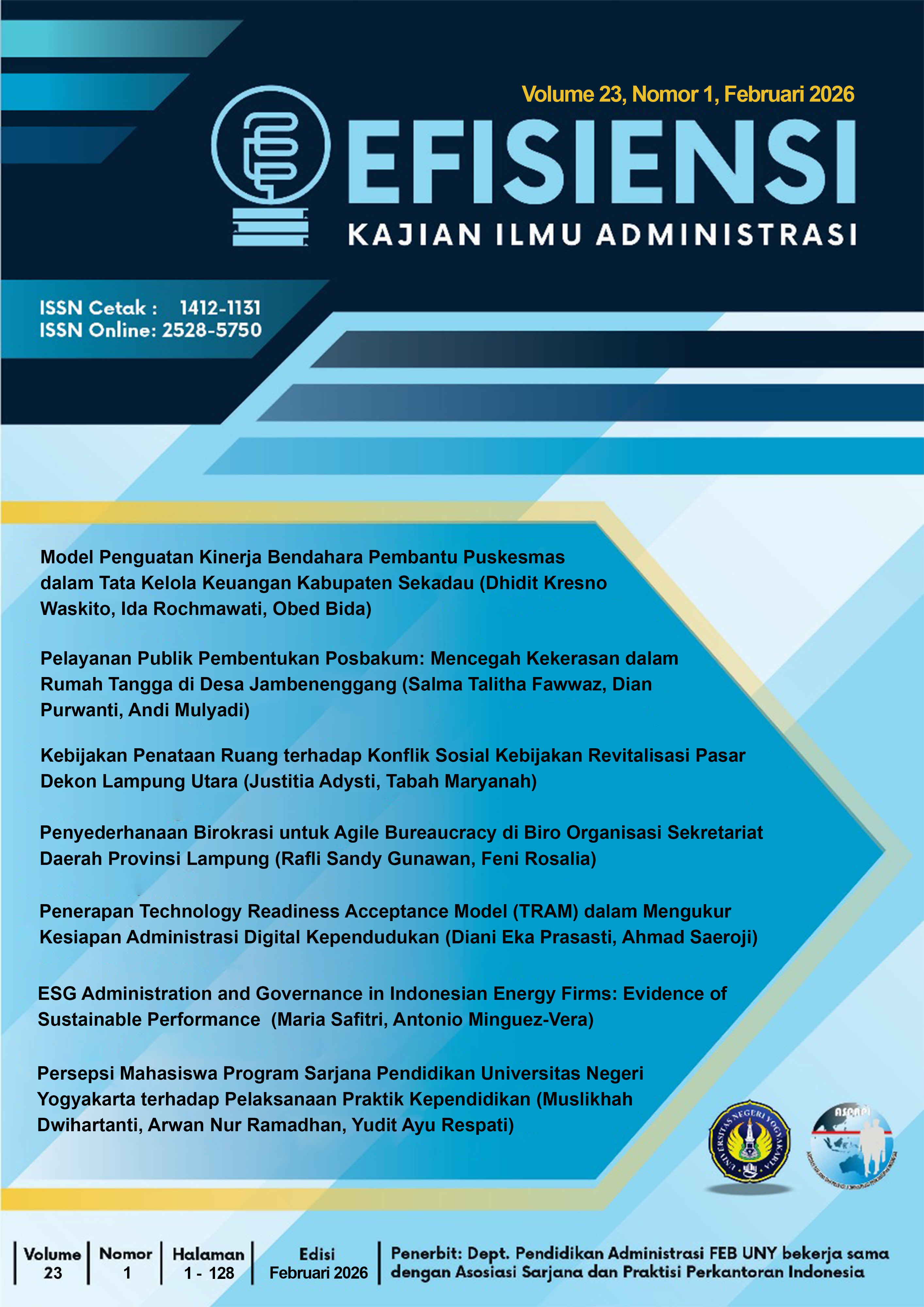
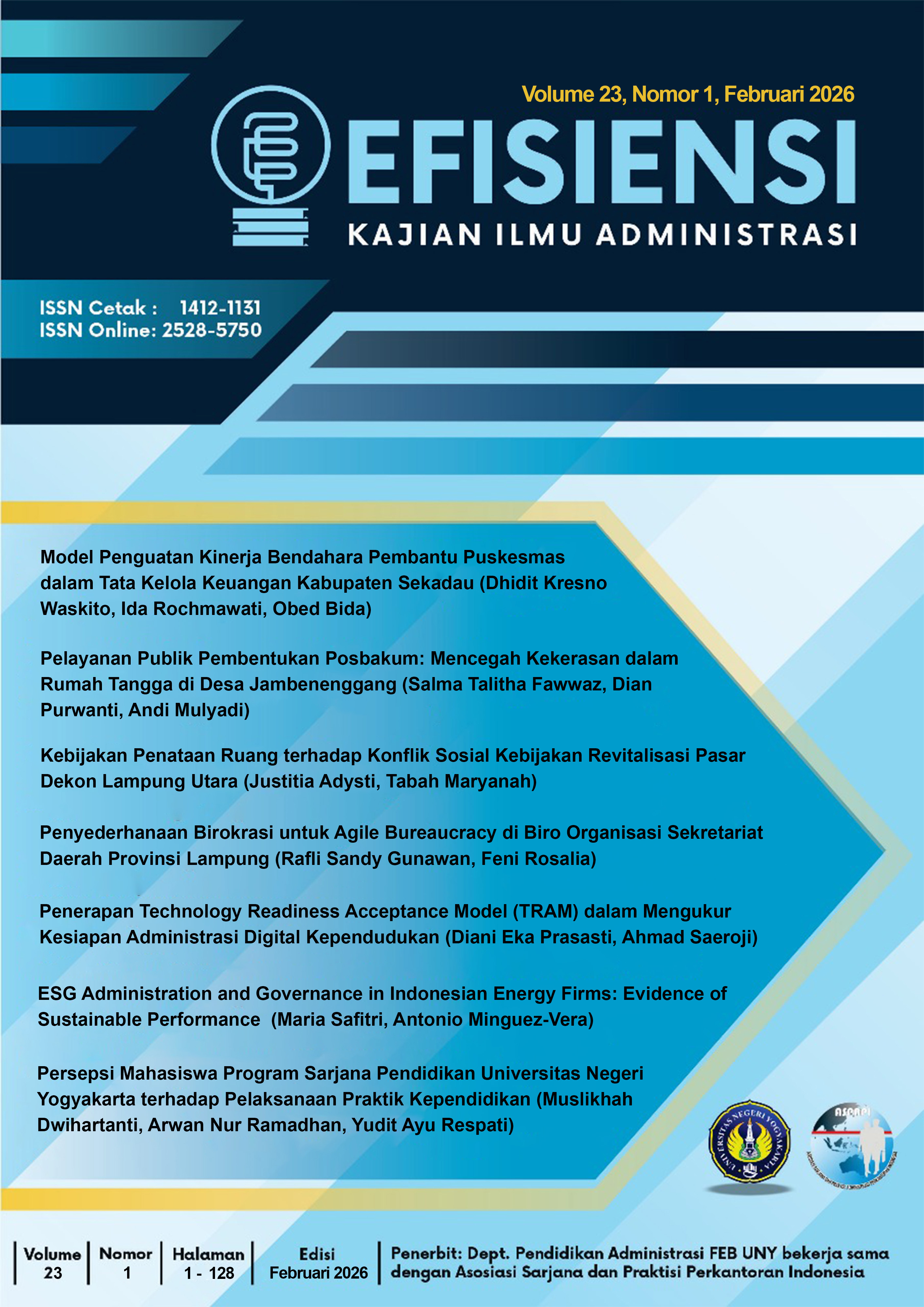
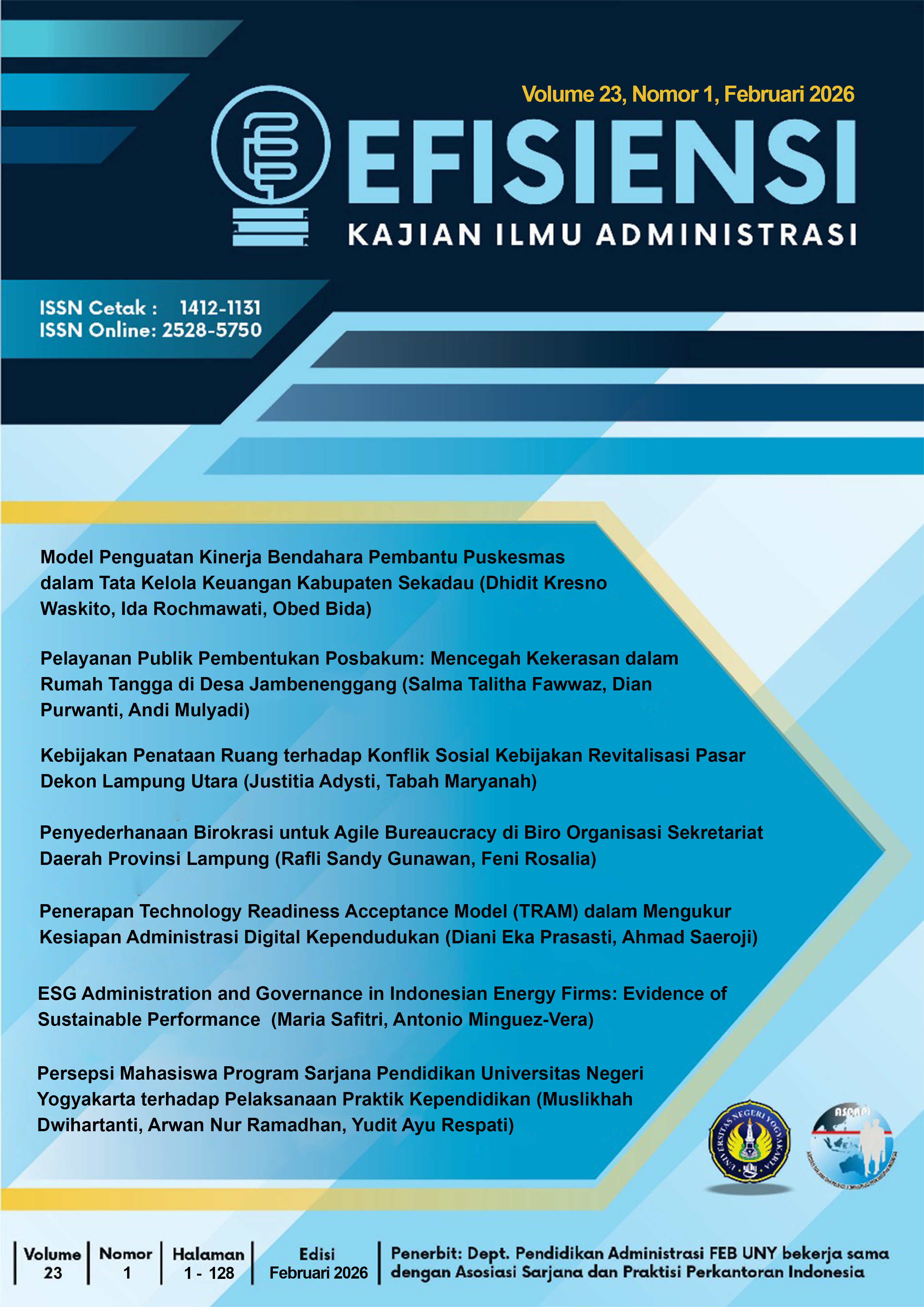
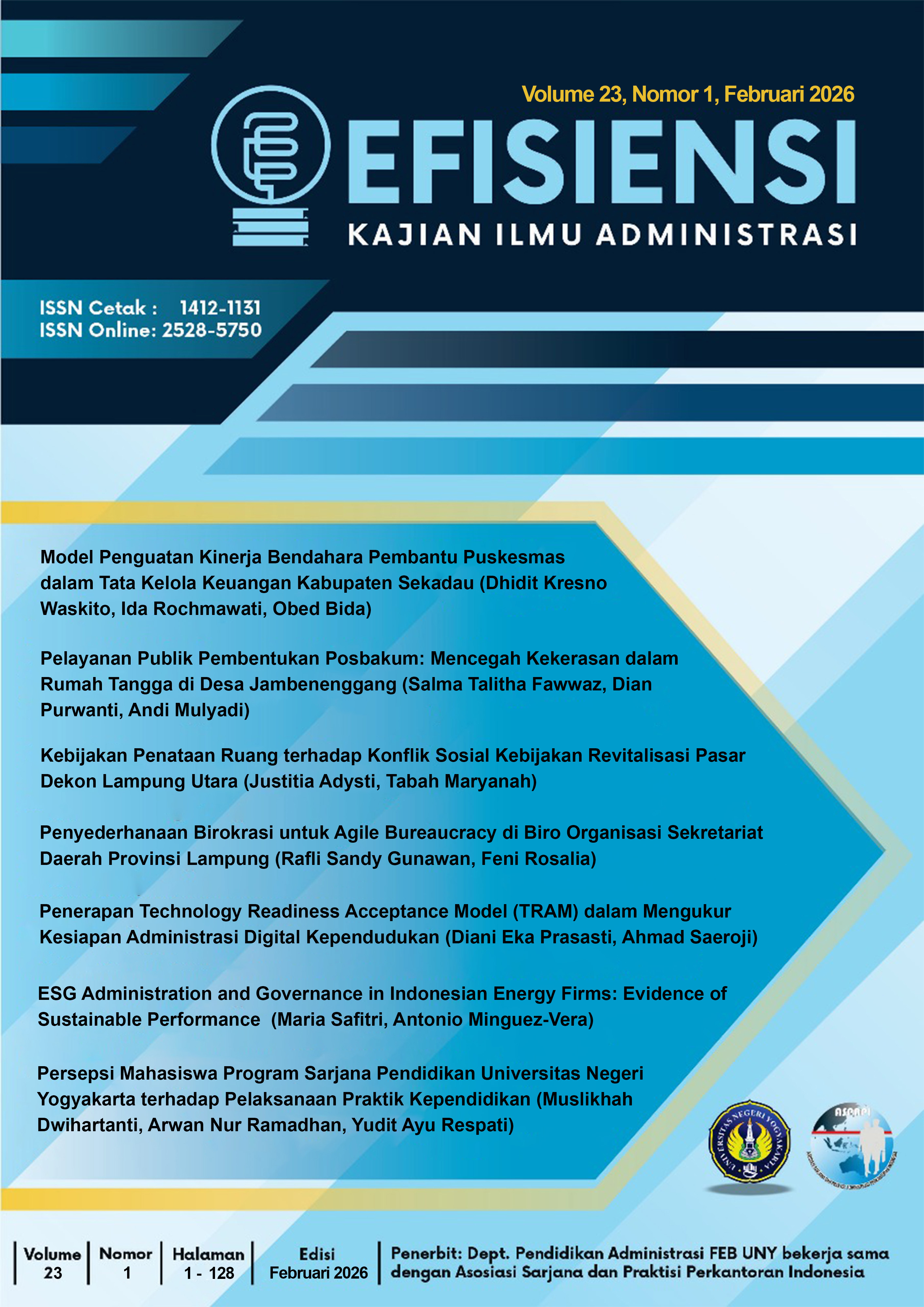
Efisiensi Vol. 23 No. 1 February 2026
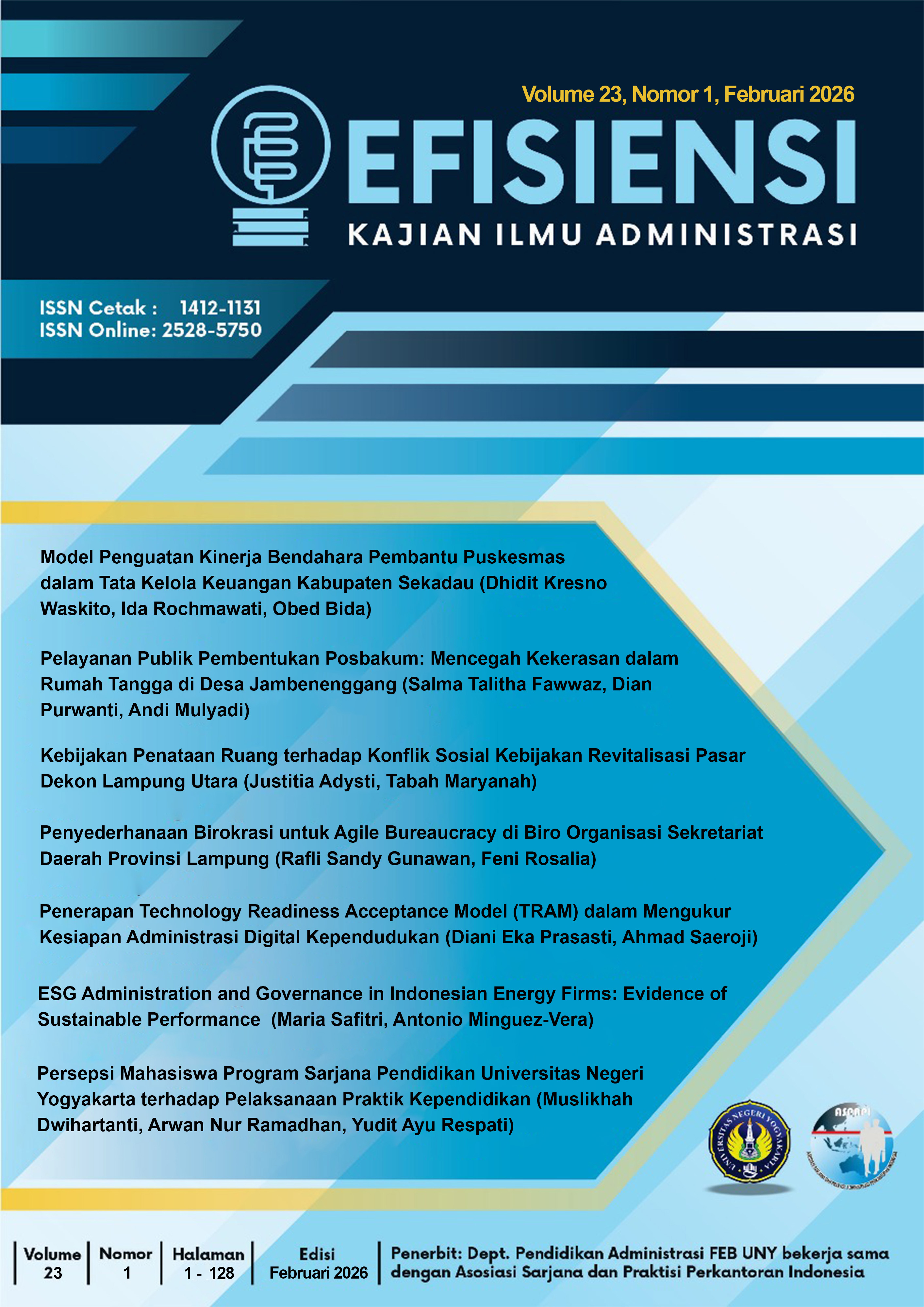
The February 2026 issue of Journal of Efisiensi: Kajian Ilmu Administrasi presents seven articles that highlight innovations in governance, bureaucratic reform, digitalization of public administration, and the strengthening of human resource capacity within the contexts of public administration and education. The articles in this issue explore a range of strategic issues, including the strengthening of assistant treasurers’ performance in community health centers in supporting regional financial governance, the improvement of public service quality through the establishment of Legal Aid Posts (Pos Bantuan Hukum/Posbakum) as a preventive measure against domestic violence, and the dynamics of spatial planning policies that may generate social conflict in the process of local market revitalization. Bureaucratic transformation also becomes an important focus through a study on bureaucratic simplification aimed at achieving agile bureaucracy, which is expected to enhance the flexibility and responsiveness of governmental institutions. In line with the advancement of digital governance, research on the application of the Technology Readiness Acceptance Model (TRAM) examines the readiness of the public to adopt digital population administration as part of technology-based public service transformation. The perspective of sustainable governance is also addressed through a study on Environmental, Social, and Governance (ESG) practices and their relationship with the performance of energy firms in Indonesia, highlighting the importance of integrating sustainability principles into organizational management. Meanwhile, from an educational perspective, a study on students’ perceptions of the implementation of teaching practicum at Universitas Negeri Yogyakarta emphasizes the importance of practical field experience in developing the professional competencies of prospective educators. Overall, this issue underscores that the integration of bureaucratic reform, public policy innovation, administrative digitalization, and the strengthening of sustainable governance constitutes a strategic pathway toward the development of an effective, responsive, and inclusive system of public administration.
Published:
2026-03-12