Reconceptualizing ethnomathematical knowledge: A recursive framework of culture, practice, cognition, and mathematization
DOI:
https://doi.org/10.21831/ej.v7i1.96461Abstract
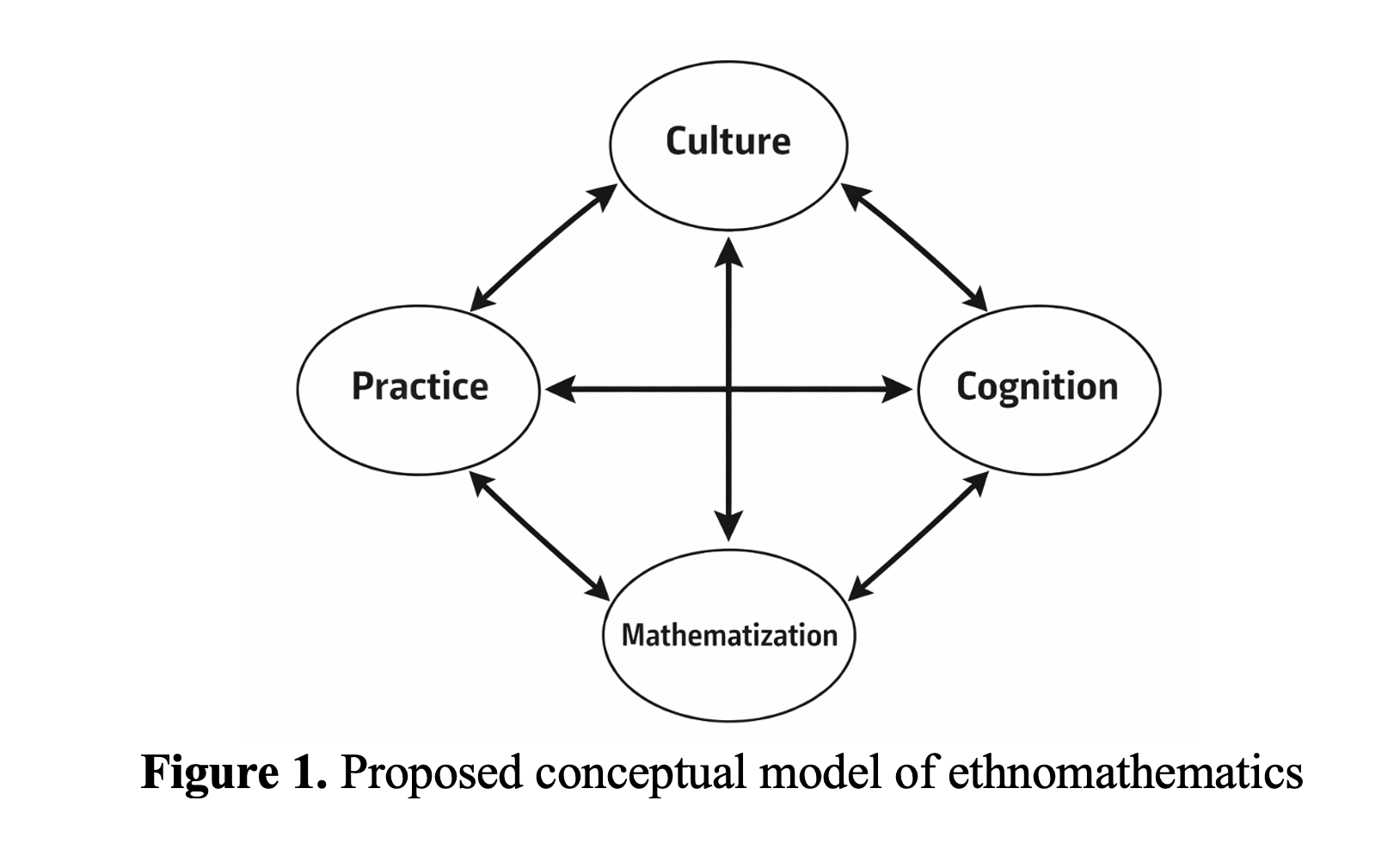
Ethnomathematics still lacks integrative theoretical models. To help fill this gap, this article proposes the Culture–Practice–Cognition–Mathematization (CPCM) framework as a culturally grounded approach for interpreting ethnomathematical knowledge. The framework conceptualizes ethnomathematical knowledge as a decentralized system of relations among culture, practice, cognition, and mathematization, shifting attention from the identification of isolated mathematical elements toward the processes through which knowledge is constituted, transmitted, and transformed within culturally situated activities. Culture is understood as the epistemological ground that shapes the meaning and legitimacy of knowledge; practice as the domain in which knowledge is enacted; cognition as the process through which knowledge is interpreted and generalized; and mathematization as the process through which relationships become represented, modelled, and systematized. Rather than treating mathematization as a final stage leading toward formal mathematics, the framework views it as one dimension within a broader system of knowledge formation. The explanatory potential of the framework is illustrated through an analytical vignette of the Mongolian ger. The CPCM framework can be used to examine ethnomathematical knowledge in many cultural contexts and may guide future empirical and educational research.
References
Ascher, M. (1991). Ethnomathematics: A multicultural view of mathematical ideas. Chapman & Hall.
Baatarkhuu, B. S. & Odsuren, D. (2015). Encyclopedia of Gers, The Dwelling House of Mongolia. Ulaanbaatar.
Badamkhatan, S., Tserenkhand, G., Batnasan, G., Ayush, Ts., Disan, T., Tangad, D., Nansalmaa, D., & Menes, G. (1987). Ethnography of the Mongolian People's Republic. Ulaanbaatar.
Batiibwe, M. S. K. (2024). The role of ethnomathematics in mathematics education: A literature review. Asian Journal for Mathematics Education, 3(4), 383–405. https://doi.org/10.1177/27527263241300400
Bartell, T., Wager, A., Edwards, A., Battey, D., Foote, M., & Spencer, J. (2017). Toward a framework for research linking equitable teaching with the standards for mathematical practice. Journal for Research in Mathematics Education, 48(1), 7–21. https://doi.org/10.5951/jresematheduc.48.1.0007
Barton, B. (1996). Making sense of ethnomathematics: Ethnomathematics is making sense. Educational Studies in Mathematics, 31(1–2), 201–233. https://doi.org/10.1007/BF00143932
Barton, B. (2008). The language of mathematics: Telling mathematical tales. Springer.
Bishop, A. J. (1988). Mathematical Enculturation: A Cultural Perspective on Mathematics Education. Kluwer Academic Publishers.
Byambajav, E. (2025). Determining the parameters of mid-century ger components. Journal of Asian Architecture and Building Engineering, 1–12. https://doi.org/10.1080/13467581.2025.2573890
Carraher, T. N., Carraher, D. W., & Schliemann, A. D. (1985). Mathematics in the streets and in schools. British Journal of Developmental Psychology, 3(1), 21–29.
D’Ambrosio, U. (1985). Ethnomathematics and its place in the history and pedagogy of mathematics. For the Learning of Mathematics, 5(1), 44–48.
D’Ambrosio, U. (1990). Reflections on Ethnomathematics. International Study Group on Ethnomathematics Newsletter, 3(1), 1–8.
D’Ambrosio, U. (2006). Ethnomathematics: Link between traditions and modernity. Sense Publishers.
Deda, Y. N., Disnawati, H., Tamur, M., & Rosa, M. (2024). Global trend of ethnomathematics studies of the last decade: A bibliometric analysis. Infinity Journal, 13(1), 233–250. https://doi.org/10.22460/infinity.v13i1.p233-250
Eglash, R. (1999). African fractals: Modern computing and indigenous design. Rutgers University Press.
Gerdes, P. (1992). On culture, geometrical thinking and mathematics education. Educational Studies in Mathematics, 23(2), 133–154.
Gerdes, P. (1996). Ethnomathematics and mathematics education. In A. J. Bishop, K. Clements, C. Keitel, J. Kilpatrick, & C. Laborde (Eds.), International handbook of mathematics education (pp. 909–943). Kluwer Academic Publishers.
Hunter, J., & Hunter, R. (2024). Weaving together the threads of Indigenous knowledge and mathematics. Educational Studies in Mathematics, 116(3), 501–518. https://doi.org/10.1007/s10649-023-10256-7
Hunter R., & Civil, M. (2021). Collaboration in mathematics: Taking a sociocultural perspective. Avances de Investigación en Educación Matemática, (19), 7–20.
Hutchins, E. (1995). Cognition in the wild. MIT Press.
Lave, J., & Wenger, E. (1991). Situated learning: Legitimate peripheral participation. Cambridge University Press.
Maidar D. and Darisuren L. (1976). ГЭР: орон сууцны түүxэн тойм [GER: Historical outline of the housing]. Ulaanbaatar, Mongolia.
Miyejav, I., & Otgonbaatar, K. (2025). Estimating probabilities through the Mongolian Shagai game: A culturally responsive approach to teaching statistics. Journal on Mathematics Education, 16(3), 1043–1062. https://doi.org/10.22342/jme.v16i3.pp1043-1062
Nasrum, A., Salido, A., & Chairuddin, C. (2025). Unveiling emerging trends and potential research themes in future ethnomathematics studies: A global bibliometric analysis (from inception to 2024). International Journal of Learning, Teaching and Educational Research, 24(2), 206–226. https://doi.org/10.26803/ijlter.24.2.11
Nemirovsky, R. & Ferrara, F. (2009). Mathematical Imagination and Embodied Cognition. Educational Studies in Mathematics, 70(2), 159–174. https://doi.org/10.1007/s10649-008-9150-4.
Nicol, C., Knijnik, G., Peng, A., Cherinda, M., & Bose, A. (Eds.). (2024). Ethnomathematics and mathematics education: International perspectives in times of local and global change. Springer. https://doi.org/10.1007/978-3-031-60680-9
Orey, D. C., & Rosa, M. (2021). Ethnomodelling as a glocalization process of mathematical practices through cultural dynamism. The Mathematics Enthusiast, 18(1–2), 235–266.
Permita, A. I., Nguyen, T. T., & Prahmana, R. C. I. (2022). Ethnomathematics on the Gringsing batik motifs in Javanese culture. Journal of Honai Math, 5(2), 95–108. https://doi.org/10.30862/JHM.V5I2.265
Powell, A. B., & Frankenstein, M. (1997). Ethnomathematics: Challenging Eurocentrism in Mathematics Education. SUNY Press.
Radford, L. (2017). The emergence of symbolic algebraic thinking. Educational Studies in Mathematics, 95(1), 39–65. https://doi.org/10.1007/s10649-016-9743-8
Radford, L. (2020). The theory of objectification. Brill.
Rosa, M. & Orey, D. C. (2016). Humanizing mathematics through ethnomodelling. Journal of Humanistic Mathematics, 6(2), 3–22. https://doi.org/10.5642/jhummath.201602.03
Rothman, T., & Fukagawa, H. (1998). Japanese Temple Geometry. Scientific American, 278(5), 84–91. http://www.jstor.org/stable/26057787
Rusli, R., & Safaah, T. N. (2023). Research trend on ethnomathematics from 2012 to 2022: A bibliometric analysis. Indonesian Journal of Science and Mathematics Education, 6(1), 37–47. https://doi.org/10.24042/ijsme.v6i1.14794
Saxe, G. B. (1991). Culture and Cognitive Development: Studies in Mathematical Understanding. Hillsdale, NJ: Lawrence Erlbaum Associates.
Skovsmose, O. (2022). Concerns of critical mathematics education – and of ethnomathematics. Revista Colombiana de Educación, (86), 361–378. https://doi.org/10.17227/rce.num86-13713
Skovsmose, O. (2023). Critical Mathematics Education. Springer International Publishing. https://doi.org/10.1007/978-3-031-26242-5
Stillman, G. A., Brown, J. P., & Galbraith, P. L. (2013). Research into mathematical modelling in education. In G. A. Stillman & J. P. Brown (Eds.), Lines of inquiry in mathematical modelling research in education (pp. 1–20). Springer.
https://doi.org/10.1007/978-94-007-6540-5_1
Stillman, G. A., Blum, W., & Biembengut, M. S. (2017). Mathematical modelling in education. In G. A. Stillman, W. Blum, & M. S. Biembengut (Eds.), Mathematical modelling in education. Springer. https://doi.org/10.1007/978-3-319-62968-1
Stillman, G. A. (2019). State of the art on modelling in mathematics education—Lines of inquiry. Lines of Inquiry in Mathematical Modelling Research in Education, https://doi.org/10.1007/978-3-030-14931-4_1
Tsovoodavaa, G., Shih, R. R. L., Bonjar, M. R. G., & Kistelegdi, I. (2018). A review and systemization of the traditional Mongolian yurt (GER). Pollack Periodica, 13(3), 19–30. https://doi.org/10.1556/606.2018.13.3.3
Turmuzi, M., Suharta, I. G. P., Astawa, I. W. P., & Suparta, I. N. (2024). Mapping ethnomathematical research directions and trends in the Scopus database: A bibliometric analysis. International Journal of Educational Methodology, 10(3), 431–453. https://doi.org/10.12973/ijem.10.3.431
Zaslavsky, C. (1973). Africa counts: Number and pattern in African culture. Lawrence Hill Books.
Downloads
Published
How to Cite
Issue
Section
Citation Check
License

This work is licensed under a Creative Commons Attribution-ShareAlike 4.0 International License.
Authors retain copyright and grant the journal the right of first publication.
The authors are responsible for the content of their work.