Exploring the mathematics of the Sinulog Festival
DOI:
https://doi.org/10.21831/ej.v7i1.96130Abstract
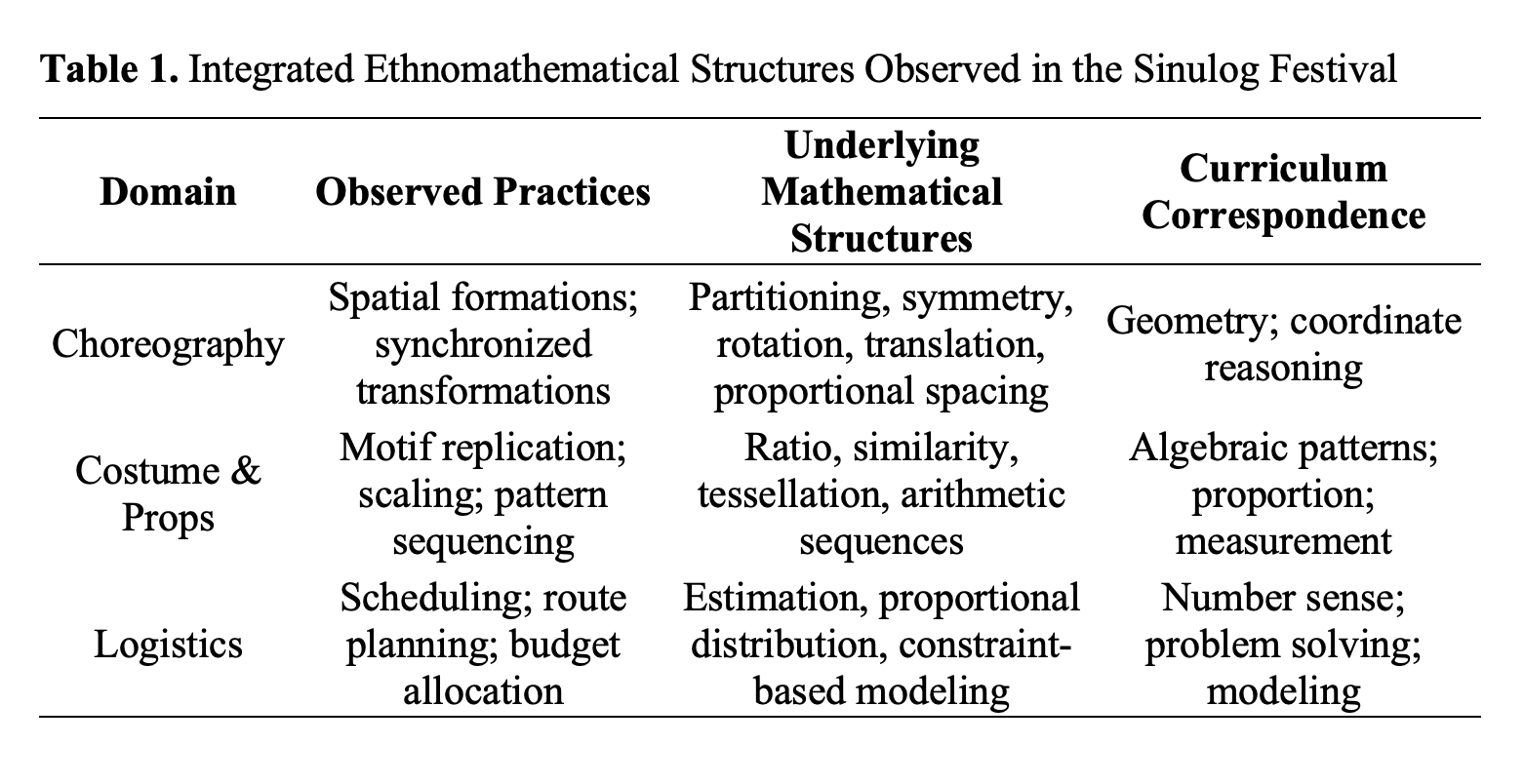
This study documents mathematical knowledge embedded in the Sinulog Festival through an ethnomathematical lens. Addressing the limited empirical documentation of cultural practices as mathematical systems, the research employed a qualitative ethnographic design over six months of fieldwork in Cebu City. Data were collected through repeated observations, semi-structured interviews with three key festival practitioners (choreographer, logistics coordinator, and historian), artifact analysis, and visual documentation. Thematic coding identified recurring mathematical domains across choreography, costume and prop design, and logistical planning. Findings reveal systematic applications of symmetry, geometric transformations, proportional reasoning, counting systems, measurement, estimation, and optimization. These practices demonstrate that mathematical reasoning operates as functional knowledge within communal cultural performance rather than solely within formal schooling. The study provides empirical evidence that large-scale festivals constitute structured mathematical environments and offers a grounded basis for integrating culturally situated contexts into mathematics education while maintaining conceptual rigor.
References
Barton, B. (1996). Making sense of ethnomathematics: Ethnomathematics is making sense. Educational Studies in Mathematics, 31(1–2), 201–233. https://doi.org/10.1007/BF00143932
Batiibwe, M. S. K. (2024). The role of ethnomathematics in mathematics education: A literature review. Asian Journal for Mathematics Education, 3(4), 383–405. https://doi.org/10.1177/27527263241300400
Creswell, J. W., & Poth, C. N. (2018). Qualitative inquiry and research design: Choosing among five approaches (4th ed.). Sage.
D’Ambrosio, U. (1985). Ethnomathematics and its place in the history and pedagogy of mathematics. For the Learning of Mathematics, 5(1), 44–48.
D’Ambrosio, U. (2001). Ethnomathematics: Link between traditions and modernity. Sense Publishers.
d’Entremont, Y. (2015). Linking mathematics, culture, and community. Procedia - Social and Behavioral Sciences, 2818–2824. https://doi.org/10.1016/j.sbspro.2015.01.973
Hein, G. E. (1991). Constructivist Learning Theory. Paper presented at the CECA (International Committee of Museum Educators) Conference, Jerusalem Israel, 15-22 October 1991, 1-10.
Ladson-Billings, G. (1995). Toward a theory of culturally relevant pedagogy. American Educational Research Journal, 32(3), 465–491. https://doi.org/10.3102/00028312032003465
Pradana, K. C., Putra, A. R., & Rahmawati, Y. (2022). Ethnomathematics on traditional culture: A bibliometric mapping analysis and systematic review on database Scopus. International Journal Corner of Educational Research (IJCER), 1(1), 1–8. https://doi.org/10.54012/ijcer.v1i1.61
Rosa, M., & Orey, D. C. (2011). Ethnomathematics: The cultural aspects of mathematics. Revista Latinoamericana de Etnomatemática, 4(2), 32–54.
Rosa, M., & Orey, D. C. (2016). State of the art in ethnomathematics. In M. Rosa et al. (Eds.), Current and future perspectives of ethnomathematics as a program (pp. 11–37). Springer. https://doi.org/10.1007/978-3-319-30120-4_2
Turmuzi, M., Suharta, I. G. P., Astawa, I. W. P., & Suparta, I. N. (2024). Meta-analysis of the effectiveness of ethnomathematics-based learning on student mathematical communication in Indonesia. International Journal of Evaluation and Research in Education (IJERE), 13(2), 903–913. http://doi.org/10.11591/ijere.v13i2.25475
Wulandari, D. U., Mariana, N., Wiryanto, W., & Amien, M. S. (2024). Integration of ethnomathematics teaching materials in mathematics learning in elementary school. International Journal of Recent Educational Research, 5(1), 204–218. https://doi.org/10.46245/ijorer.v5i1.542
Downloads
Published
How to Cite
Issue
Section
Citation Check
License

This work is licensed under a Creative Commons Attribution-ShareAlike 4.0 International License.
Authors retain copyright and grant the journal the right of first publication.
The authors are responsible for the content of their work.