A A Holistic Inclusive Education Approach to Character Development of Students with Special Needs
Downloads
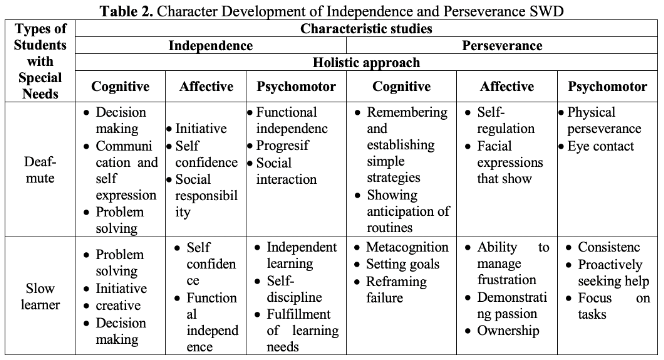
Everyone has the right to education, including children with special needs. Education aims to shape character, develop thinking skills, and foster empathy. The purpose of this study is to analyze the development of independence and perseverance in students with special needs through a holistic, inclusive education approach and to identify supporting and inhibiting factors. This study employed a qualitative descriptive approach with a case study method. The research was conducted at Kalitapen 1 Elementary School, located in Purwojati District, Banyumas Regency, selected based on specific criteria and local wisdom as a representative case reflecting the dynamics of inclusive education in the region. The research participants included classroom teachers, students with hearing and speech impairments, students with learning disabilities, and parents. The object of the study was the educational ecosystem involved in implementing the holistic inclusive approach. Qualitative data were collected through observations and interviews. Data were analyzed using qualitative procedures, including data collection, reduction, and interpretation. The findings indicated that the holistic development of independence and perseverance among deaf students and slow learners was fostered through the synergy of prompt-based instructional methods, family partnerships, and the strengthening of self-awareness. Holistic, context- based character education was found to function as a transformative process that internalizes values into daily habits, making it particularly relevant and effective for students with special needs.
Downloads
Abdillah, H., Setyosari, P., Muslihati, M., Hambali, I., & Dewanti, S. R. (2024). Development of self
and career-understanding gamification-assisted media for students with disabilities. Konselor,
12(4), 273–289. https://doi.org/10.24036/0202312432-0-86
Adhiambo, O. E., Sharon, O., & Alfred, O. (2025). Leveraging symbolic systems to foster expressive
communication in students with hearing impairments. Social Sciences and Humanities Open,
11(February), 101376. https://doi.org/10.1016/j.ssaho.2025.101376
Ahmad, S. S., Shaari, M. F., Hashim, R., & Kariminia, S. (2015). Conducive attributes of physical
learning environment at preschool level for slow learners. Procedia - Social and Behavioral
Sciences, 201(February), 110–120. https://doi.org/10.1016/j.sbspro.2015.08.138
Alshuayl, M. S. (2025). Transition services for secondary students with moderate intellectual disability
in Saudi Arabia: What parents and special education teachers say. Research in Developmental
Disabilities, 167(October), 105139. https://doi.org/10.1016/j.ridd.2025.105139
Ariffudin, I., Hudha, M. N., Zaini, A., & Rahmawati, A. I. N. (2024). Development of metaverse-based
virtual reality counseling: technology-assisted psychological services for students with disabilities. Jurnal Kajian Bimbingan dan Konseling, 9(2), 157–165.
https://doi.org/10.17977/um001v9i22024p157-165
Ariyani, N., Nuriyyatiningrum, H., Zikrinawati, K., Aini, D. K., & Wahib, A. (2025). Resiliensi
Caregiver Anak Berkebutuhan Khusus : Pengaruh Self Awareness dan Dukungan Sosial dengan Moderator Komunikasi Interpersonal Resilience of Caregivers of Children with Special Needs :
The Influence of Self-Awareness and Social Support as Moderator. 17(1), 54–70.
Arrahman, R., Riadi, R., Gani, A. A., Habiburrahman, H., & Supratman, S. (2022). Integrative services
using the Readycation model for supporting children with special needs at the LombokCare
Senggigi Foundation. Jurnal Ilmiah Telaah, 7(2). https://doi.org/10.31764/telaah.v7i2.10816
Aryani, I. K., & Yuliarti, Y. (2023). 21st century learning values, character and moral education in an
effort to overcome student’s moral decadence. Proceedings Series on Social Sciences &
Humanities, 8, 72–84. https://doi.org/10.30595/pssh.v8i.609
Atma, B. A., Azahra, F. F., & Mustadi, A. (2021). Teaching style, learning motivation, and learning
achievement: Do they have significant and positive relationships? Jurnal Prima Edukasia, 9(1),
23–31. https://doi.org/10.21831/jpe.v9i1.33770
Badri, L. S., & Malik, A. A. (2024). Implementation of Islamic Education Values in Building Students’
Religious Character through an Affective Approach Based on the Qur’an. Jurnal Pendidikan
Agama Islam, 21(1), 217–233. https://doi.org/10.14421/jpai.v21i1.7260
Bouscaren, N., Yildiz, H., Dartois, L., Vercambre, M. N., & Boutron-Ruault, M. C. (2019). Decline in
instrumental activities of daily living over 4-year: The association with hearing, visual and dual sensory impairments among non-institutionalized women. Journal of Nutrition, Health and Aging,
23(8), 687–693. https://doi.org/10.1007/s12603-019-1231-9
Cheng, L., Liu, Y., Chen, Q., & Zhang, F. (2025). Exploring the spiritual experiences of older adults
with chronic diseases: a qualitative study in a multicultural context. BMC Psychology, 13(1).
https://doi.org/10.1186/s40359-025-02710-3
Cholilah, M., Tatuwo, A. G. P., Komariah, & Rosdiana, S. P. (2023). Development of the Merdeka
Curriculum in educational institutions and its implementation in 21st-century learning. Sanskara
Pendidikan Dan Pengajaran, 1(02). https://doi.org/10.58812/spp.v1i02.110
Cooper, L., Fuzesi, P., Jacob, S. A., Kamalakannan, S., Lennon, M., Macaden, L., Smith, A., Welsh, T.,Broadfoot, K., & Watson, M. C. (2023). Assistive technologies and strategies to support the medication management of individuals with hearing and/or visual impairment: A scoping review.
Disability and Health Journal, 16(4), 101500. https://doi.org/10.1016/j.dhjo.2023.101500
Darwanto, A., Prahmana, R. C. I., Susanti, A., & Khalil, I. A. (2024). Transformation of boarding school
management models in enhancing student accessibility and educational quality. Jurnal Pendidikan
Agama Islam, 21(1), 145–164. https://doi.org/10.14421/jpai.v21i1.8632
Devi, R. A., Rahayu, G., & Dhani, A. R. (2022). Learning strategies for slow learner students at SD
Inpres Oeba 1 Kupang City. Abdi Masyarakat, 4(2), 196–200.
http://dx.doi.org/10.58258/abdi.v4i2.4409
Dewi, R. A. K., & Rukmini, P. (2019). The effect of thematic learning by using a scientific approach to
increase the multiple intelligence of students. Jurnal Prima Edukasia, 7(1), 40–46.
https://doi.org/10.21831/jpe.v7i1.24326
Dewi, S., & Jasmina, T. (2023). The effect of school operational assistance on school participation rates
of children with disabilities in Indonesian districts and cities. Jurnal Pendidikan dan Kebudayaan,
8(2), 120–137. https://doi.org/10.24832/jpnk.v8i2.4238
Eseadi, C., & Ogbuabor, S. E. (2023). Career transitioning among students with visual impairments:
educational and public policy perspectives. Jurnal Kajian Bimbingan dan Konseling, 8(3), 191–
198. https://doi.org/10.17977/um001v8i32023p191-198
Faizah, N., Nur, D., Auliana, S., Kartika, I., Pendidikan, P., Anak, I., Dini, U., Ilmu, F., Universitas, T.,
Mas, R., & Surakarta, S. (n.d.). Behavioral and emotional disorders in children with special needs.
Lentera Anak, 5(1), 39–46. https://doi.org/10.34001/jla.v5i1.7586
Fatmawiyati, J., & Permata, R. S. R. E. (2023). Implementation of inclusive education in early childhood
education institutions. Flourishing Journal, 2(8), 567–582.
https://doi.org/10.17977/um070v2i82022p567-582
Fatonah, N., Damaianti, V. S., & Syaodih, E. (2025). Analysis of early reading difficulties in second
grade elementary school students. Jurnal Prima Edukasia, 13(1), 15–26.
https://doi.org/10.21831/jpe.v13i1.69965
Fitri, L. N., & Abduh, M. (2024). Innovative teacher strategies in supporting speech-impaired students’
learning and communication in elementary schools. Didaktika: Jurnal Kependidikan, 13(3), 3847-
3860. https://jurnaldidaktika.org/contents/article/download/912/599/
Gal, C., & Ryder, C. H. (2025). Unlocking potential: Comparing collaborative and traditional learning
methods for students with learning disabilities in special education classrooms. Social Sciences and Humanities Open, 11(September 2024), 101521. https://doi.org/10.1016/j.ssaho.2025.101521
Guan, W., Wang, S., & Liu, C. (2023). Influence of perceived discrimination on problematic smartphone
use among Chinese deaf and hard-of-hearing students: Serial mediating effects of sense of security and social avoidance. Addictive Behaviors, 136(1), 107470.
https://doi.org/10.1016/j.addbeh.2022.107470
Hermawan, S., & Hariyanto, W. (2022). Textbook of Business Research Methods (Quantitative and
Qualitative). Umsida Press.
Imtinan, S. N., Diani, D. I., Anisa, P. S., Dewi, R. A., Wahyudin, D., & Caturiasari, J. (2022). The
urgency of character education based on cultural values. Judikdas: Jurnal Ilmu Pendidikan Dasar
Indonesia, 2(1). https://doi.org/10.51574/judikdas.v2i1.795
Irshad, S., & Amjad, A. I. (2026). Bullying experiences and coping strategies of special needs students
in inclusive education: A qualitative study from a resource-constrained country. ActaPsychologica, 262(November 2025), 106101. https://doi.org/10.1016/j.actpsy.2025.106101
Kamil, N., Sholihah, M., Dewi, U. K., Hadijah, H., & Putro, K. Z. (2023). Provision of educational
services for children with autism: The prompting instructional approach. Murhum: Jurnal
Pendidikan Anak Usia Dini, 4(2), 211-221. https://doi.org/10.37985/murhum.v4i2.187
Kencana, D., Supriatna, M., & Yudha, E. S. (2020). A review of expressive visual learning in inclusive
education programs. Jurnal Ilmiah Pendidikan Citra Bakti, 7(2), 149–158.
https://doi.org/10.38048/jipcb.v7i2.96
Kistoro, H. C. A., Benny, Warnis, Ulfah, S., & Zuhrah, F. (2024). Character learning model based on
traditional songs in Indonesia. International Journal of Evaluation and Research in Education,
13(6), 4201–4211. https://doi.org/10.11591/ijere.v13i6.25877
Kooli, C., & Chakraoui, R. (2025). AI-driven assistive technologies in inclusive education: benefits,
challenges, and policy recommendations. Sustainable Futures, 10(September 2024), 101042.
https://doi.org/10.1016/j.sftr.2025.101042
Lapidot-Lefler, N. (2025). Teacher Responsiveness in Inclusive Education: A Participatory Study of
Pedagogical Practice, Well-Being, and Sustainability. Sustainability (Switzerland), 17(7), 1–19.
https://doi.org/10.3390/su17072919
Lestari, S., & Azizah, N. N. (2023). The implementation of social emotional learning approach in
elementary school. Jurnal Prima Edukasia, 11(2), 266–275.
https://doi.org/10.21831/jpe.v11i2.62179
Lin, T. H., & Riccomini, P. (2025). Inclusive education in rural settings: Leveraging technology for
improved math learning outcomes among students with disabilities. Journal of Special Education
Technology, 40(2), 219–226. https://doi.org/10.1177/01626434241263045
Mansouri, N., Javanbakht, M., Jahan, A., Bakhshi, E., & Shaabani, M. (2025). Improve the behavioral
auditory attention training effects on the Speech-In-Noise perception with simultaneous electrical stimulation in children with hearing loss: A randomized clinical trial. International Journal of Pediatric Otorhinolaryngology, 188(July 2024), 112197.
https://doi.org/10.1016/j.ijporl.2024.112197
Maulyda, M. A., Rosyidah, A. N. K., & Erfan, M. (2021). Elementary school teachers’ understanding
of inclusive learning: A case study at SD N Repok Puyung, Central Lombok. Didaktik: Jurnal
Ilmiah PGSD STKIP Subang, 7(02). https://doi.org/10.36989/didaktik.v7i02.217
Miftakhi, D. R. (2020). Implementation of skills-based extracurricular activities in enhancing students’
independence at SLB YPAC Pangkalpinang. Diklus: Jurnal Pendidikan Luar Sekolah, 4(1), 78-
87. https://doi.org/10.21831/diklus.v4i1.30940
Minsih, M., Mujahid, I., Uslan, U., Fauzana, N., Marpuah, S., & Helzi, H. (2025). Analysis of Social-
emotional behavior in students with autism spectrum disorder, ADHD, and anxiety in inclusive schools. Indonesian Journal on Learning and Advanced Education (IJOLAE), 7(3), 553–565.
https://doi.org/10.23917/ijolae.v7i3.8728
Munawar, M., Alfiah, A., & Nur Aini, A. (2025). Teachers’ understanding and constraints of global
diversity character learning in early childhood education. Edukasia: Jurnal Pendidikan dan
Pembelajaran, 6(1), 57–70. https://doi.org/10.62775/edukasia.v6i1.1383
Nicodemus, B., Formentelli, M., Cagle, K. M., & Pittman, J. (2021). Address practices of Deaf
undergraduate students and faculty: A study of language, identity, and community. Journal of
Pragmatics, 176, 110–123. https://doi.org/10.1016/j.pragma.2021.01.024
Nugraini, E. D., Mulawarman, M., & Sugiharto, D. (2024). Exploring the impact of attachment to school counselors on moral emotion development in slow learners: A case study in Central Java inclusive
schools. Konselor, 12(4), 230–244. https://doi.org/10.24036/0202312434-0-86
Nzuza, Z. D. (2023). Strategies for creating inclusive learning for learners experiencing barriers to
learning. REID (Research and Evaluation in Education), 9(2), 130–140.
Pare, A., & Sihotang, H. (2023). Pendidikan Holistik untuk Mengembangkan Keterampilan Abad 21
dalam Menghadapi Tantangan Era Digital. Jurnal Pendidikan Tambusai, 7(3), 27778–27787.
Pramudia Trisnani, R., Hidayah, N., Ramli, M., & Indreswari, H. (2024). Play therapy using Ajining
Dhiri puppet media to improve the self-esteem of slow learners. Konselor, 13(3), 264–270.
https://doi.org/10.24036/0202413337-0-86
Pratiwi, L., Wuryandani, W., & Wibowo, S. E. (2025). Analysis of interactive multimedia needs in
strengthening character responsibility in pancasila education learning in elementary schools.
Jurnal Prima Edukasia, 13(3). https://doi.org/10.21831/jpe.v13i3.86152
Primaestri, W., Akhyar, M., & Sutimin, L. A. (2023). Bibliometric analysis of game research trends in
elementary learning and self-regulated learning skill. Jurnal Prima Edukasia, 11(2), 225–234.
https://doi.org/10.21831/jpe.v11i2.60264
Pujaningsih, P., & Haryanto, H. (2025). Improving appropriate behaviour of a student with emotional
and behavioural problems through SWPBS and LST collaboration. Jurnal Prima Edukasia, 13(3).
https://doi.org/10.21831/jpe.v13i3.77502
Rachmadyanti, P., Bintang Nusantara, A., Setiawan, R., Suprayitno, S., & Kiettikunwong, N. (2024).
Gangster Si Cantik program: The implementation of character building for elementary school
students. Jurnal Prima Edukasia, 12(2), 315–324. https://doi.org/10.21831/jpe.v12i2.63155
Rahayu, R. S., & Nur, L. (2022). Analysis of the characteristics of slow learner students at Cimindi State
Elementary School. Pedadidaktika: Jurnal Ilmiah Pendidikan Guru Sekolah Dasar, 9(3), 429-
440. https://doi.org/10.17509/pedadidaktika.v9i3.53448
Rasito, R., Suyitno, Y., & Purwandari, R. D. (2022). The effect of project-based learning model using
youtube social media on students’ emotional intelligence. Dinamika Jurnal Ilmiah Pendidikan
Dasar, 14(2), 140. https://doi.org/10.30595/dinamika.v14i2.15278
Rofiah, N. H., & Kawai, N. (2025). Integrating disability-inclusive disaster education in primary
schools: A case from Yogyakarta, Indonesia. Progress in Disaster Science, 28(19).
https://doi.org/10.1016/j.pdisas.2025.100482
Rumatumia, H., Kempa, R., & Rumfot, S. (2024). Management of learning for children with special
needs at SD Negeri 8 Bula, Bula District, East Seram Regency. Edukasia: Jurnal Pendidikan dan
Pembelajaran, 5(1), 1577–1588. https://doi.org/10.62775/edukasia.v5i1.1084
Sartinah, E. P., Purwoko, B., Wahyuni, E. N., Irmawati, N., Budiati, E. F. R., & Oktafiolita, A. (2024).
Improving self-regulated learning skills of students with special needs: Strategies and outcomes.
Konselor, 13(2), 213–221. https://doi.org/10.24036/0202413289-0-86
Shi, Y. R., Sin, K. F. K., & Wang, Y. Q. (2025). Teacher professional development of digital pedagogy
for inclusive education in post-pandemic era: Effects on teacher competence, self-efficacy, and work well-being. Teaching and Teacher Education, 168(August), 105230.
https://doi.org/10.1016/j.tate.2025.105230
Thaibah, H., & Arsyad, M. (2023). The effectiveness of online learning on psychology education courses
of children with special needs in special education students. Ijorer: International Journal of Recent
Educational Research, 4(1), 68–78. https://doi.org/10.46245/ijorer.v4i1.269Tsabitah, N., & Fitria, N. (2021). The effect of teachers’ professional competence on the quality of
learning at Raudhatul Athfal Tangerang. Jurnal Anak Usia Dini Holistik Integratif (AUDHI), 1(1),
10. https://doi.org/10.36722/jaudhi.v1i1.563
Wangid, M. N., & Purwanti, I. Y. (2020). Implementation of group activity to solve academic burnout
elementary school students. Jurnal Prima Edukasia, 8(2), 135–144.
https://doi.org/10.21831/jpe.v8i2.33267
Wei, L., Aman, M. S., Abidin, N. E. Z., & Qian, W. (2025). Exploring the relationship between sports
media use, sports participation behavior, and sport commitment: A mixed-methods study using structural equation modeling and qualitative insights. BMC Psychology, 13(1).
https://doi.org/10.1186/s40359-025-02964-x
Wijayanti, T., Irawan, H., Nugroho, D. A., & Utama, N. J. (2025). Addressing the challenges of the
times through the concept of character education by Ki Hajar Dewantara. IJORER: International Journal of Recent Educational Research, 6(6), 1911-1924.
https://doi.org/10.46245/ijorer.v6i6.1030
Zeng, Z., Wang, D., Yuan, Y., He, Z., Tan, R., Cao, Y., Meng, Y., Shen, Y., Hu, Y., Du, F., & Koole,
S. L. (2025). Associations between child maltreatment and depressive symptoms among deaf and hearing adolescent students: A moderated mediation model. Child Abuse and Neglect,
167(February). https://doi.org/10.1016/j.chiabu.2025.107613
Copyright (c) 2026 Neysa Dika Putri, Wakhudin

This work is licensed under a Creative Commons Attribution-ShareAlike 4.0 International License.
The copyright of the received article shall be assigned to the journal as the publisher of the journal. The intended copyright includes the right to publish the article in various forms (including reprints). The journal maintains the publishing rights to the published articles.

Jurnal Prima Edukasia by http://journal.uny.ac.id/index.php/jpe/index is licensed under a Creative Commons Attribution-ShareAlike 4.0 International License.