Developing a TPACK-based science module through project-based learning to enhance elementary students’ 4Cs skills
Downloads
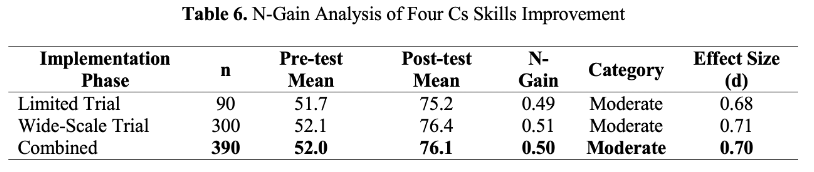
Science education in elementary schools in Pinrang Regency is still dominated by conventional approaches. There is low integration of technology and limited development of 21st-century skills such as critical thinking, communication, collaboration, and creativity. This study aims to develop and implement a Science teaching module based on TPACK and integrated with the Project-Based Learning (PjBL) model. The goal is to enhance students' Four Cs skills. The research used a Research and Development (R&D) approach with the ADDIE model (Analyze, Design, Develop, Implement, Evaluate) within a Mixed Methods design. Data were collected through expert validation questionnaires (Aiken’s V coefficient), teacher and student practicality questionnaires, structured classroom observation protocols (17 indicators, inter-rater reliability = 0.87), and semi-structured interviews with 12 teachers and 12 school principals. Pre-test and post-test instruments measured Four Cs competencies. Quantitative data were analyzed using normalized gain (N-Gain) calculations and paired-samples t-tests (SPSS v. 28). Qualitative data underwent thematic analysis following Braun and Clarke’s (2006) six-phase framework in NVivo 12. The results showed that the developed module had high validity and practicality. It achieved average validity and practicality scores of 90%. The module effectively improved students' Four Cs skills, with an average N-Gain score ranging from 0.49 in the limited trial to 0.51 in the wide-scale trial. This study contributes to the development of a teaching model that integrates technology and project-based methods to improve 21st-century skills in elementary education, especially in regions with limited infrastructure. The findings also suggest that improving teacher training and providing adequate infrastructure support are essential for the sustainability of the model's implementation.
Downloads
Aiken, L. R. (1985). Three coefficients for analyzing the reliability and validity of ratings. Educational and Psychological Measurement, 45(1), 131–142. DOI: https://doi.org/10.1177/0013164485451012
Amini, R., Amini, R., Handayani, S. E., Fitria, Y., Lena, S. M., & Helsa, Y. (2019). Development of integrated thematic teaching materials using problem-based learning model in elementary school. Proceedings of the 5th International Conference on Education and Technology (ICET 2019). DOI: https://doi.org/10.2991/icet-19.2019.111
Aulia, V., Hakim, L., & Sangka, K. B. (2023). The impact of TPACK on teacher professional development in technology integration practices. SINAMU, 4(1). DOI: https://doi.org/10.31000/sinamu.v4i1.7894
Barus, P. (2024). The effect of technology-based learning models on 21st-century skills of elementary school students. Jurnal Pendidikan Teknologi, 10(3), 221–234. DOI: https://doi.org/10.1016/j.jpte.2024.03.001
Branch, R. M. (2021). Instructional Design: The ADDIE Approach (3rd ed.). Springer.
Braun, V., & Clarke, V. (2006). Using thematic analysis in psychology. Qualitative Research in Psychology, 3(2), 77–101. DOI: https://doi.org/10.1191/1478088706qp063oa
Care, E., Kim, H., Vista, A., & Anderson, K. (2018). Education System Alignment for 21st Century Skills: Focus on Assessment. Brookings Institution. https://www.brookings.edu/articles/education-system-alignment-for-21st-century-skills-focus- on-assessment/
Connell, R. (2007). Southern Theory: The Global Dynamics of Knowledge in Social Science. Allen & Unwin.https://www.taylorfrancis.com/books/mono/10.4324/9781003117346/southern-theory- raewyn-connell
Creswell, J. W. (2014). Research Design: Qualitative, Quantitative, and Mixed Methods Approaches (4th ed.). SAGE Publications. https://www.ucg.ac.me/skladiste/blog_609332/objava_105202/fajlovi/Creswell.pdf
Firdaus, F. M., Rahmawati, S., Afandi, A., & Prasetyo, T. (2024). Liveworksheet interactive e-module effect on equal fractions comprehension at 4th grade elementary school. Jurnal Prima Edukasia, 12(1), 156–164. DOI: https://doi.org/10.21831/jpe.v12i1.64526
Gay, G. (2018). Culturally Responsive Teaching: Theory, Research, and Practice (3rd ed.). Teachers College Press. https://eric.ed.gov/?id=ED581130
Griffin, P., McGaw, B., & Care, E. (Eds.). (2012). Assessment and Teaching of 21st Century Skills. Springer. DOI: https://doi.org/10.1007/978-94-007-2324-5
Hake, R. R. (1998). Interactive-engagement versus traditional methods: A six-thousand-student surveyof mechanics test data for introductory physics courses. American Journal of Physics, 66(1), 64– 74. DOI: https://doi.org/10.1119/1.18809
Harris, J. B., Hofer, M., & Koehler, M. J. (2021). TPACK and project-based learning in elementary education: A practical framework for technology integration. Journal of Educational Technology & Society, 24(4), 77–90. DOI: https://doi.org/10.1016/j.jests.2021.09.003
Herrington, J., Reeves, T. C., & Oliver, R. (2014). Authentic learning environments. In J. M. Spector, M. D. Merrill, J. Elen, & M. J. Bishop (Eds.), Handbook of Research on Educational Communications and Technology (4th ed., pp. 401–412). Springer. DOI: https://doi.org/10.1007/978-1-4614-3185-5_32
Islami, S., Ambiyar, A., Sukardi, S., Candra, O., Wulansari, R. E., & Zaus, M. A. (2024). The role of artificial intelligence in flipped interactive learning: Building a generation of critical thinkers, skilled communicators, effective collaborators, and creative innovators. Salud Ciencia y Tecnología, 4. DOI: https://doi.org/10.56294/saludcyt2024.1311
Jang, S. J., & Tsai, M. F. (2012). Exploring the TPACK of Taiwanese elementary mathematics and science teachers with respect to use of interactive whiteboards. Computers & Education, 59(2), 327–338. DOI: https://doi.org/10.1016/j.compedu.2012.02.003
Koehler, M. J., & Mishra, P. (2009). What is technological pedagogical content knowledge (TPACK)? Contemporary Issues in Technology and Teacher Education, 9(1), 60–70. DOI: https://doi.org/10.1177/002205741319300303.
Krajcik, J. S., & Shin, N. (2014). Project-based learning. In R. K. Sawyer (Ed.), The Cambridge Handbook of the Learning Sciences (2nd ed., pp. 275–297). Cambridge University Press. DOI: https://doi.org/10.1017/CBO9781139519526.018
Maryuningsih, Y., Hidayat, T., Riandi, R., & Rustaman, N. (2020). Developing performance assessment instruments to measure 4C skills in online discussion activities of science learning. Scientiae Educatia, 9(1), 109. DOI: https://doi.org/10.24235/sc.educatia.v9i1.7500
Masnur, H., Gani, A., & Mustafa. (2024). TPACK-based project-based model development to improve the four C’s students’ skills. Asian Journal of Education and Social Studies, 50(8), 538–546. DOI: https://doi.org/10.9734/ajess/2024/v50i81552
Mat, H., Mustakim, S. S., Razali, F., Ghazali, N., & Minghat, A. D. (2024). Effectiveness of digital learning on students’ higher order thinking skills. International Journal of Evaluation and Research in Education (IJERE), 13(5), 2817. DOI: https://doi.org/10.11591/ijere.v13i5.29449
Miles, M. B., Huberman, A. M., & Saldaña, J. (2014). Qualitative Data Analysis: A Methods Sourcebook (3rd ed.). SAGE Publications. DOI: https://eric.ed.gov/?id=ED565763.
Mishra, P., & Koehler, M. J. (2006). Technological pedagogical content knowledge: A framework for teacher knowledge. Teachers College Record, 108(6), 1017–1054. DOI: https://doi.org/10.1177/016146810610800612
Musa, F., Mufti, N., Latif, R. A., & Amin, M. M. (2012). Project-based learning (PjBL): Inculcating soft skills in 21st century workplace. Procedia - Social and Behavioral Sciences, 59, 565–573. DOI: https://doi.org/10.1016/j.sbspro.2012.09.315
Muskitta, M., Tuaputty, H., & Latupeirissa, L. (2023). Implementation of TPACK approach integrated with Project Based Learning (PjBL) model to improve students’ critical and creative thinking skills in teacher professional development course. Biopendix: Jurnal Biologi, Pendidikan dan Terapan, 10(1), 141–147. DOI: https://doi.org/10.30598/biopendixvol10issue1page141-147.m
Mustadi, A., Wibowo, S. E., Zubaidah, E., Supartinah, S., Sugiarsih, S., & Sayekti, O. M. (2024). Needs analysis of project-based teaching module development in the independent curriculum. Jurnal Prima Edukasia, 12(1), 52–60. DOI: https://doi.org/10.21831/jpe.v12i1.66933
Nurhidayah, L., & Suyanto, S. (2021). Integrated of technological pedagogical and content knowledge (TPACK) for pre-service science teachers: Literature review. Proceedings of the 6th International Seminar on Science Education (ISSE 2020). DOI: https://doi.org/10.2991/assehr.k.210326.014
OECD. (2019). Trends Shaping Education 2019. OECD Publishing. DOI: https://doi.org/10.1787/trends_edu-2019-en
Pangestu, K., Malagola, Y., Robbaniyah, I., & Rahajeng, D. (2024). The influence of project-based learning on learning outcomes, creativity and student motivation in science learning at elementary schools. Jurnal Prima Edukasia, 12(2), 194–203. DOI: https://doi.org/10.21831/jpe.v12i2.63208
Patton, M. Q. (2015). Qualitative Research and Evaluation Methods (4th ed.). SAGE Publications. https://books.google.co.id/books?id=- CM9BQAAQBAJ&printsec=copyright&hl=id#v=onepage&q&f=false
Prastiyan, R., Purwaningsih, E., & Handayanto, S. K. (2023). Developing students’ critical thinking skills through STEM-PjBL integrated with TPACK in static fluid topics. AIP Conference Proceedings, 2569, 050009. DOI: https://doi.org/10.1063/5.0117324
Rahayu, G. D. S., Altaftazani, D., & Wardani, D. S. (2023). Development of TPACK-based teaching materials to enhance creative thinking skills in elementary school teacher education. ELEMENTARY: Islamic Teacher Journal, 10(2), 145–157. DOI: https://doi.org/10.21043/elementary.v10i2.14052
Richey, R. C., & Klein, J. D. (2014). Design and Development Research: Methods, Strategies, and Issues. Routledge. DOI: https://doi.org/10.4324/9780203053381
Rofiah, N. H., Restiana, & Dewi, R. (2024). Promoting digital literacy: Assessing teachers' readiness in utilizing information and communication technology for learning in rural areas. Jurnal Prima Edukasia, 12(1), 41–51. DOI: https://doi.org/10.21831/jpe.v12i1.63968
Rukmi, D. A., Nisa, A. F., & Zulfiati, H. M. (2025). Innovation of project module based on Ajak Temani Mandiri learning model integrated with local wisdom to improve creative dimension of elementary school students. Jurnal Prima Edukasia, 13(1), 181–190. DOI: https://doi.org/10.21831/jpe.v13i1.78206
Saavedra, A. R., & Opfer, V. D. (2012). Teaching and learning 21st century skills: Lessons from the learning sciences. OECD Education Working Papers, 75. DOI: https://doi.org/10.1787/5k9fdfq6v8fv-en
Saparuddin, S., & Patongai, D. D. P. U. S. (2012). Strengthening lesson study in supporting learning digitalization for pioneer schools at SMA Negeri 9 Makassar. SMART, 2(1). DOI: https://doi.org/10.35580/smart.v2i1.33764
Satria, T. G., Syaefuddin, U., Riyana, C., & Hajani, T. J. (2025). The influence of project-based learning model on learning outcome and students’ critical thinking. Jurnal Prima Edukasia, 13(1), 146– 158. DOI: https://doi.org/10.21831/jpe.v13i1.72446
Schmidt, D. A., Baran, E., Thompson, A. D., Mishra, P., Koehler, M. J., & Shin, T. S. (2009). Technological pedagogical content knowledge (TPACK): The development and validation of an assessment instrument for preservice teachers. Journal of Research on Technology in Education, 42(2), 123–149. DOI: https://doi.org/10.1080/15391523.2009.10782544
Thornhill-Miller, B., Camarda, A., Mercier, M., Burkhardt, J., Morisseau, T., Bourgeois-Bougrine, S., Vinchon, F., Hayek, S. E., Augereau-Landais, M., Mourey, F., Feybesse, C., Sundquist, D., & Lubart, T. (2023). Creativity, critical thinking, communication, and collaboration: Assessment, certification, and promotion of 21st century skills for the future of work and education. Journal of Intelligence, 11(3), 54. DOI: https://doi.org/10.3390/jintelligence11030054
Wahyudi, W., Kartowagiran, B., Haryanto, H., Kusuma, M., Santoso, P. H., & Bahri, S. (2022). Developing a test based on the 21st century skills. Advances in Social Science, Education and Humanities Research. DOI: https://doi.org/10.2991/assehr.k.220129.022
Waluyo, A. (2023). The impact of technology integration on collaborative skills in elementary science classrooms. Journal of Education in Science, 14(1), 102–118. DOI: https://doi.org/10.1016/j.jedusci.2023.01.015
World Economic Forum. (2016). The Future of Jobs: Employment, Skills and Workforce Strategy for the Fourth Industrial Revolution. World Economic Forum. https://www.weforum.org/reports/the- future-of-jobs
World Economic Forum. (2020). The Future of Jobs Report 2020. World Economic Forum. https://www.weforum.org/reports/the-future-of-jobs-report-2020
Yu, P., & Golden, J. (2019). Developing TPACK in elementary mathematics education. In M. J. Koehler & P. Mishra (Eds.), Handbook of Research on TPACK in the Digital Age (pp. 45–60). IGI Global. DOI: https://doi.org/10.4018/978-1-5225-7001-1.ch003
Zulnaidi, H. (2024). Development and validation of a teaching module based on the traditional approach of the Japanese Bansho Plan towards the mastery of quadratic equations. International Journal of Information and Education Technology, 14(3), 411. DOI: https://doi.org/10.18178/ijiet.2024.14.3.2062
Copyright (c) 2026 Saleha Saleha, Nadar Nadar, Masnur Masnur

This work is licensed under a Creative Commons Attribution-ShareAlike 4.0 International License.
The copyright of the received article shall be assigned to the journal as the publisher of the journal. The intended copyright includes the right to publish the article in various forms (including reprints). The journal maintains the publishing rights to the published articles.

Jurnal Prima Edukasia by http://journal.uny.ac.id/index.php/jpe/index is licensed under a Creative Commons Attribution-ShareAlike 4.0 International License.