Teachers' perspectives on implementing microlearning in numeracy literacy in elementary schools
Downloads
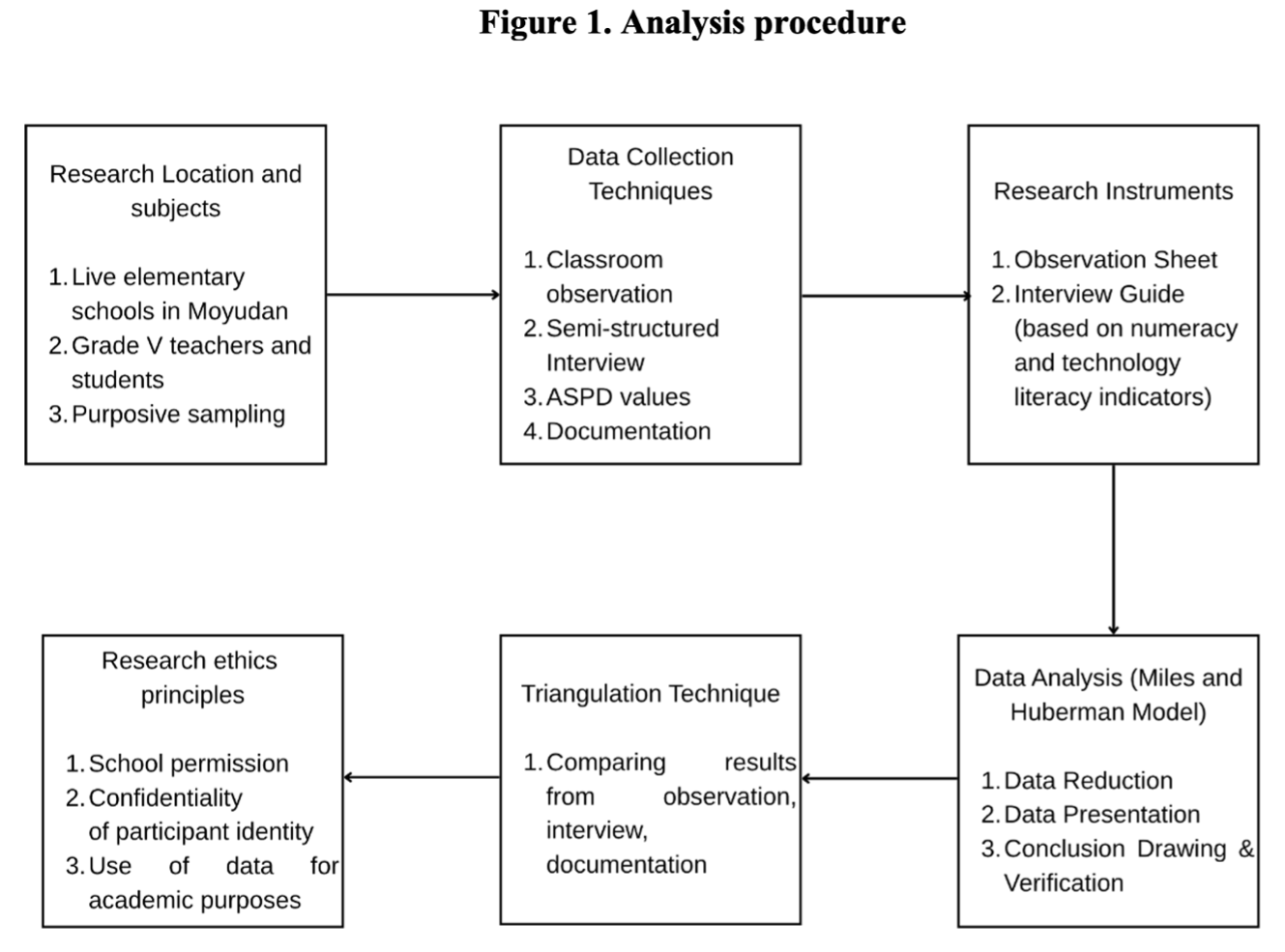
This study aims to describe the current conditions of numeracy literacy learning in elementary schools and analyze the needs for developing microlearning-based e-modules as an innovative solution to support the implementation of the Merdeka Curriculum. The study was motivated by the fact that numeracy instruction in schools remains dominated by traditional approaches, with limited integration of contextual digital media and minimal innovation in teaching practices. A descriptive qualitative approach was applied, involving five elementary schools in the Moyudan District, Sleman Regency, Yogyakarta Special Region. Participants consisted of five fifth-grade teachers and 83 students selected through purposive sampling. Data were collected through classroom observations, semi-structured interviews, and documentation, and analyzed using the Miles and Huberman interactive model. The findings revealed that while teachers recognize the importance of strengthening numeracy literacy as a 21st-century competence, they face various challenges, including limited time, insufficient digital pedagogical training, and the unavailability of relevant learning materials. The results highlight that the microlearning approach is pedagogically relevant because it provides concise, contextual, and interactive learning experiences that enhance students’ conceptual understanding and engagement. The study concludes that developing microlearning-based e-modules has significant potential to improve the quality of numeracy literacy learning in elementary schools, supporting a more adaptive, participatory, and technology-integrated learning environment.
Downloads
Aagaard, T., Amdam, S. H., Nagel, I., Vika, K. S., Andreasen, J. K., Pedersen, C., & Røkenes, F. M. (2024). Teacher preparation for the digital age: Is it still an instrumental endeavor? Scandinavian Journal of Educational Research, 69(3), 651–665. DOI: https://doi.org/10.1080/00313831.2024.2330927
Abidin, Z., Herman, T., Farojah, L., Febriandi, R., & Penehafo, A. E. (2022). Why did elementary students have difficulty working in mathematical literacy questions? ELEMENTARY: Islamic Teacher Journal, 10(1), 121. DOI: https://doi.org/10.21043/elementary.v10i1.14006
Adelia, V., Putri, R. I. I., & Zulkardi. (2024). A systematic literature review: How do we support students to become numerate? International Journal of Evaluation and Research in Education, 13(3), 1816–1824. DOI: https://doi.org/10.11591/ijere.v13i3.26849
Afifah, D. S. N., Nafi’an, M. I., & Manggar, D. A. (2023). The development of Adobe Flash CS6-based interactive media to improve numerical literacy skills for Madrasah Ibtidaiyah students. Kreano: Jurnal Matematika Kreatif-Inovatif, 14(1), 75–85. DOI: https://doi.org/10.15294/kreano.v14i1.38825
Alali, N. N., Carson, H. J., & Collins, D. (2024). A pragmatic approach to skill acquisition for physical education: Considering cognitive and ecological dynamics perspectives. Quest, 76(2), 227–246. DOI: https://doi.org/10.1080/00336297.2023.2298931
Alias, N. F., & Razak, R. A. (2024). Malaysian journal of learning. Malaysian Journal of Learning and Instruction, 21(1), 217–247. DOI: https://doi.org/10.32890/mjli2023.20.2.3
Alyusfitri, R., Gistituati, N., Yerizon, Fauzan, A., & Yarman. (2024). The effectiveness and relationship of student responses toward learning outcomes using interactive multimedia-based e-modules in elementary schools. International Electronic Journal of Elementary Education, 16(5), 573–584. DOI: https://doi.org/10.26822/iejee.2024.354
Anggraeni, U., Amir, M. F., & Wardana, M. D. K. (2025). How can learning motivation and problem- solving predict the mathematical disposition of primary students? Jurnal Prima Edukasia, 13(2), 375–388. DOI: https://doi.org/10.21831/jpe.v13i2.83008
Arifin, S., Wahyudin, W., & Herman, T. (2020). The effects of contextual group guided discovery learning on students’ mathematical understanding and reasoning. Jurnal Prima Edukasia, 8(2), 106–114. DOI: https://doi.org/10.21831/jpe.v8i2.33059
Ayuningtyas, I. N., Amir, M. F., & Wardana, M. D. K. (2024). Elementary school students’ layers of understanding in solving literacy problems based on Sidoarjo context. Infinity Journal, 13(1), 157–174. DOI: https://doi.org/10.22460/infinity.v13i1.p157-174
Balasundaram, S., Mathew, J., & Nair, S. (2024). Microlearning and learning performance in higher education: A post-test control group study. Journal of Learning for Development, 11(1), 1–14. DOI: https://doi.org/10.56059/jl4d.v11i1.752
Berisha, V., & Bytyqi, R. (2020). Types of mathematical tasks used in secondary classroom instruction. International Journal of Evaluation and Research in Education, 9(3), 751–758. DOI: https://doi.org/10.11591/ijere.v9i3.20617
Blinov, V. I., Sergeev, I. S., & Rodichev, N. F. (2022). The microlearning – from business to education: A promising direction for the development of didactics. Obrazovanie i Nauka, 24(9), 43–68. DOI: https://doi.org/10.17853/1994-5639-2022-9-43-68
Buabeng, I., & Amo-Darko, B. (2025). Curriculum reforms without foundation: The effects of inadequate preparation in curriculum reforms on Ghanaian teachers and the education system. Curriculum Perspectives, 45(2), 133–147. DOI: https://doi.org/10.1007/s41297-025-00309-7
Bulkani, B., Riadin, A., Ni’mah, N., & Setiawan, M. A. (2025). Impact of holistic learning models on character development: A systematic review. Obrazovanie i Nauka, 27(5), 111–141. DOI: https://doi.org/10.17853/1994-5639-2025-5-111-141
Campillo-Ferrer, J. M., Miralles-Martínez, P., & Sánchez-Ibáñez, R. (2020). Gamification in higher education: Impact on student motivation and the acquisition of social and civic key competencies. Sustainability, 12(12), 4822. DOI: https://doi.org/10.3390/su12124822
Pasani, C. F., & Amelia, R. (2025). Smart mobile technologies in math education. International Journal of Interactive Mobile Technologies, 19(7), 159–177. DOI: https://doi.org/10.3991/ijim.v19i07.51921
Coccoli, M., Torre, I., & Galluccio, I. (2024). User experience evaluation of Edurell interface for video augmentation. Multimedia Tools and Applications, 83(12), 36695–36717. DOI: https://doi.org/10.1007/s11042-023-15912-x
Dey, A., & Munshi, S. A. (2025). Fun with images: An analysis of the role of visual literacy in facilitating easy and enjoyable learning with a focus on future prospects. Libri, 1–19. DOI: https://doi.org/10.1515/libri-2024-0143
Dikdik, A., Suryana, A., Triana, C., Rahyasih, Y., & Oktaviani, F. F. (2025). Improving teachers’ numeracy skills at Cisarua State Elementary School, West Java, Indonesia. Jurnal Prima Edukasia, 13(1), 111–127. DOI: https://doi.org/10.21831/jpe.v13i1.82453
Fauzan, A., Harisman, Y., Yerizon, Suherman, Tasman, F., Nisa, S., Sumarwati, Hafizatunnisa, & Syaputra, H. (2024). Realistic Mathematics Education (RME) to improve literacy and numeracy skills of elementary school students based on teachers’ experience. Infinity Journal, 13(2), 301– 316. DOI: https://doi.org/10.22460/infinity.v13i2.p301-316
Firdaus, F. M., Fadhilah, N., Wuryandari, I. T., & Fadhli, R. (2024). Liveworksheet interactive e-module effect on equal fractions comprehension at 4th grade elementary school. Jurnal Prima Edukasia, 12(1), 156–164. DOI: https://doi.org/10.21831/jpe.v12i1.64526
Firdaus, F. M., Safitri, A. D., Amanah, D. N., Fadhli, R., & Hassan, N. M. (2024). Evaluating the effectiveness of the iPusnas in enhancing elementary students’ numeracy skills. Record and Library Journal, 10(1), 93–102. DOI: https://doi.org/10.20473/rlj.V10-I1.2024.93-102
Getenet, S. (2024). Understanding how pre-service teachers design numeracy-rich activities in non-mathematic curriculum areas. Journal of Research in Innovative Teaching & Learning. DOI: https://doi.org/10.1108/JRIT-05-2024-0124
Getenet, S. T. (2022). Teachers’ knowledge framework for designing numeracy rich tasks across non- mathematics curriculum areas. International Journal of Education in Mathematics, Science and Technology, 10(3), 663–680. DOI: https://doi.org/10.46328/ijemst.2137
Ghazali, M., & Ashari, Z. M. (2020). Development of a framework to assess preschool children’s numeracy. Journal of Physics: Conference Series, 1460(1), 012002. DOI: https://doi.org/10.1088/1742-6596/1460/1/012002
Ha, C., Zhang, Q., & Roehrig, A. D. (2025). Early adolescents’ motivational regulation and academic achievement: Using multi-level modeling analysis based on self-determination theory. Social Psychology of Education, 28(1). DOI: https://doi.org/10.1007/s11218-024-10013-5
Hastomo, A. (2024). The development of educational practice lecture models to prepare adaptive and innovative 21st-century primary school teachers. Jurnal Prima Edukasia, 12(2), 177–182. DOI: https://doi.org/10.21831/jpe.v12i2.51053
Hatamian, M. (2024). Supplementary learning: Toward enriching microlearning from a design perspective. Proceedings of International Conference on Smart Systems and Technologies (SST 2024), 77–82. DOI: https://doi.org/10.1109/SST61991.2024.10755267
Hurst, C. (2007). Improving mathematical learning through contextualisation. AARE Annual Conference. https://www.aare.edu.au/data/publications/2007/hur07221.pdf
Kolar, V. M., & Hodnik, T. (2021). Mathematical literacy from the perspective of solving contextual problems. European Journal of Educational Research, 10(1), 467–483. DOI: https://doi.org/10.12973/eu-jer.10.1.467
Kurejsepi, E., Jusufi, J., Mujo, D., Dilji, A., Pupe, E., & Skenderi, N. (2025). Misalignment of inter-curricular areas in the second stage of education in Kosovo. Human Research in Rehabilitation, 15(2), 360–370. DOI: https://doi.org/10.21554/hrr.092510
Kurniawan, A., Kuswanto, H., Naba, S. D., & Syar, N. I. (2024). Trends of computational thinking research in science and technology area: A systematic literature review. SCIENCE: Jurnal Inovasi Pendidikan Matematika Dan IPA, 4(4), 477–491. DOI: https://doi.org/10.51878/science.v4i4.3572
Meriza, D., Hiltrimartin, C., & Hartono, Y. (2024). Development of problem based differentiated learning comparison materials in junior high school. Jurnal Pendidikan Matematika, 18(3), 447–468. DOI: https://doi.org/10.22342/jpm.v18i3.pp447-468
Monib, W. K., Qazi, A., Apong, R. A., & Mahmud, M. M. (2024). Investigating learners’ perceptions of microlearning: Factors influencing learning outcomes. IEEE Access, 12, 178251–178266. DOI: https://doi.org/10.1109/ACCESS.2024.3472113
Moro R. S. (2024). Canva as a tool to promote meaningful learning in the teaching of English as a foreign language. European Public and Social Innovation Review, 9. DOI: https://doi.org/10.31637/EPSIR-2024-869
Mues, A., Wirth, A., Birtwistle, E., & Niklas, F. (2022). Associations between children’s numeracy competencies, mothers’ and fathers’ mathematical beliefs, and numeracy activities at home. Frontiers in Psychology, 13, 835433. DOI: https://doi.org/10.3389/fpsyg.2022.835433
Murtafiah, W., Setyansah, R. K., & Nurcahyani, D. A. (2021). Kemampuan komunikasi matematis dalam menyelesaikan circle problem berdasarkan self-confidence siswa SMP. Jurnal Elemen, 7(1), 130–145. DOI: https://doi.org/10.29408/jel.v7i1.2785
Ngatirin, N. R., & Zainol, Z. (2021). Automatic detection of learning styles: A decade review on data-driven approaches. Journal of Physics: Conference Series, 1997(1), 012001. DOI: https://doi.org/10.1088/1742-6596/1997/1/012001
Nurin, N. S., Junaedi, I., & Cahyono, A. N. (2024). Learning numeracy around school environment supported by mobile math trails using problem-based learning model. Jurnal Pendidikan Matematika, 18(3), 485–498. DOI: https://doi.org/10.22342/jpm.v18i3.pp485-498
Nurkanti, M., Riandi, & Putri, D. (2022). The improvement of student’s learning outcome on. AIP Conference Proceedings, 2638(1), 060008. DOI: https://doi.org/10.1063/5.0115708
OECD. (2019). OECD Learning Framework 2030. Springer.
Othman, H. S., Zaibon, S. B., & Abidin, A. H. Z. (2022). The significance of edutainment concept in video-based learning in proposing the elements of educational music video for children’s learning. International Journal of Interactive Mobile Technologies, 16(5), 91–106. DOI: https://doi.org/10.3991/ijim.v16i05.23711
Putri, D. A. P., Fatmawati, A., Haryanti, Y., Minalloh, A. N., & Wijaya, P. P. (2025). Development of an augmented reality mobile application for interactive geometry learning in children. Proceedings of the 22nd International Conference on Electrical Engineering/Electronics, Computer, Telecommunications and Information Technology (ECTI-CON 2025). DOI: https://doi.org/10.1109/ECTI-CON64996.2025.11101056
Rahayu, W. N., & Firdaus, F. M. (2025). Increased motivation and ability student numeracy through the application of a contextual approach to mathematics learning. Jurnal Prima Edukasia, 13(2), 361–374. DOI: https://doi.org/10.21831/jpe.v13i2.75555
Rahmawati, R. D., Sulistyani, N., Purnomo, Y. W., Fitriya, Y., & Ramadhani, D. (2023). Relationship between elementary school students’ numeracy and number sense. The New Educational Review, 74, 73–88. DOI: https://doi.org/10.15804/tner.23.74.4.06
Rakhmawati, Y., & Mustadi, A. (2022). The circumstances of literacy numeracy skill: Between notion and fact from elementary school students. Jurnal Prima Edukasia, 10(1), 9–18. DOI: https://doi.org/10.21831/jpe.v10i1.36427
Rofiah, N. H., Restiana, R., & Dewi, R. (2024). Promoting digital literacy: Assessing teachers readiness in utilizing information and communication technology for learning in rural area. Jurnal Prima Edukasia, 12(1), 41–51. DOI: https://doi.org/10.21831/jpe.v12i1.63968
Sa’diyah, M., Sa’dijah, C., & Susiswo, S. (2024). Students’ ability to formulate situation mathematically from context-based mathematics problems. TEM Journal, 13(2), 1443–1451. DOI: https://doi.org/10.18421/TEM132-58
Santosa, I., Iskandar, I., & Setiadi, S. (2025). Adapting language learning materials for digital native: Infusing CEFR standards in English procedural texts on microlearning apps. World Journal of English Language, 15(4), 171–183. DOI: https://doi.org/10.5430/wjel.v15n4p171
Schiefner-Rohs, M., & Krein, U. (2023). Media-related practices of student teachers: Insights from a student perspective. Unterrichtswissenschaft, 51(4), 623–642. DOI: https://doi.org/10.1007/s42010-023-00187-w
Silva, E. S., Costa, W. P. da, Lima, J. C. de, & Ferreira, J. C. (2025). Contribution of microlearning in basic education: A systematic review. Education Sciences, 15(3), 302. DOI:https://doi.org/10.3390/educsci15030302
Srinivas, K., Bhattacharyya, H., Banoo, H., Touthang, N., & Bika, S. L. (2025). Parental support for foundational literacy and numeracy skills among schoolchildren: A case study from India. Social Sciences & Humanities Open, 12, 101998. DOI: https://doi.org/10.1016/j.ssaho.2025.101998
Stanković, Z., Maksimović, J., & Osmanović, J. (2018). Cognitive theories and paradigmatic research posts in the function of multimedia teaching and learning. International Journal of Cognitive Research in Science, Engineering and Education, 6(2), 107–114. DOI: https://doi.org/10.5937/ijcrsee1802107S
Suharja, S., Mustadi, A., & Oktari, V. (2024). Examining the brain-based learning model assisted by an open-ended approach to understanding mathematical concepts. Jurnal Prima Edukasia, 12(1), 19–29. DOI: https://doi.org/10.21831/jpe.v12i1.67303
Susanta, A., Sumardi, H., Susanto, E., & Retnawati, H. (2023). Mathematics literacy task on number pattern using Bengkulu context for junior high school students. Journal on Mathematic Education, 14(1), 85–102. DOI: https://doi.org/10.22342/jme.v14i1.pp85-102
Suwandayani, B. I., Fakhruddin, Y., & Astutik, L. S. (2020). Implementation of the numeracy literacy program in learning mathematics remaining Class IV in Muhammadiyah elementary schools. Proceeding International Webinar On Education 2020, 285–293.
Vitantri, C. A., & Syafrudin, T. (2022). Kemampuan literasi matematika siswa sekolah dasar pada pemecahan masalah soal cerita. AKSIOMA: Jurnal Program Studi Pendidikan Matematika, 11(3), 2108–2119. DOI: https://doi.org/10.21427/ajpm.v11i3.5091
Wathani, D. H., Irawati, R., & Iswara, P. D. (2022). Development of meme learning media with PMRI to implement mathematics literacy in students elementary school. Jurnal Pendidikan Matematika, 16(3), 339–350. DOI: https://doi.org/10.22342/jpm.16.3.15249.339-350
Widjajanti, D. B. (2019). Making mathematics classes more humanistic. Journal of Physics: Conference Series, 1320(1), 012096. DOI: https://doi.org/10.1088/1742-6596/1320/1/012096
Winarni, S., Kamid, Marzal, J., & Asrial. (2025). Numeracy skill development in prospective mathematics teachers: Challenges and opportunities in real-world contexts. Journal on Mathematics Education, 16(1), 91–110. DOI: https://doi.org/10.22342/jme.v16i1.pp91-110
Yuliana, Y., Usodo, B., & Riyadi, R. (2022). The new way improve mathematical literacy in elementary school: Ethnomathematics module with realistic mathematics education. AL-ISHLAH: Jurnal Pendidikan, 15(1), 33–44. DOI: https://doi.org/10.35445/alishlah.v15i1.2591
Zambrano Verdesoto, G. J., & Caicedo, M. F. (2025). The importance of microlearning in higher education. European Public and Social Innovation Review, 10, 1–14. DOI: https://doi.org/10.31637/epsir-2025-2075
Copyright (c) 2026 Theresa Dwita Haliem, Rahayu Condro Murti, Setiawan Edi Wibowo, Lilis Suryani

This work is licensed under a Creative Commons Attribution-ShareAlike 4.0 International License.
The copyright of the received article shall be assigned to the journal as the publisher of the journal. The intended copyright includes the right to publish the article in various forms (including reprints). The journal maintains the publishing rights to the published articles.

Jurnal Prima Edukasia by http://journal.uny.ac.id/index.php/jpe/index is licensed under a Creative Commons Attribution-ShareAlike 4.0 International License.