Development of Engklek smart quiz based on education through art to improve learning outcome
Downloads
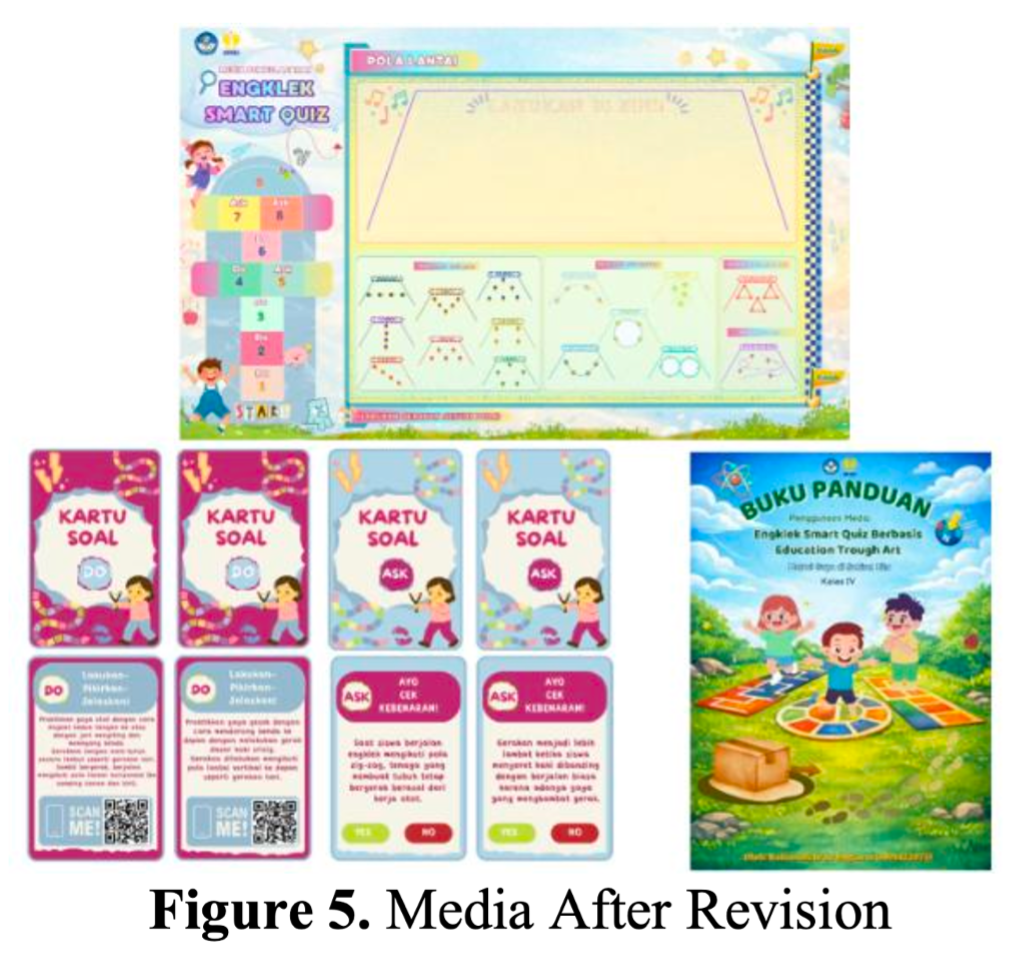
This study aims to develop the Engklek Smart Quiz learning medium based on Education Through Art and to determine its feasibility and effectiveness in improving the science learning outcomes of fourth-grade students on the topic of “Forces Around Us” at SD Negeri 1 Pendem. The method used is Research and Development (R&D) based on the ADDIE model. Data collection techniques included both tests and non-tests; tests were conducted via pre-tests and post-tests to measure improvements in student learning outcomes, while non-tests consisted of observations, interviews, questionnaires, and documentation. Data analysis utilized validity, reliability, and normality tests, paired t-tests, and N-Gain. The media was developed as a banner-based game integrating physical activities, art, “Do” and “Ask” question cards, floor patterns, and music barcodes. The validation results indicate that the teaching material is highly suitable, with an 89% approval rate from subject matter experts and a 96% approval rate from media experts. The material is also considered highly practical, based on a 92.65% approval rate from teachers and a 94.20% approval rate from students. The effectiveness test showed a significant improvement in learning outcomes with a significance level of <0.05. The N-Gain values of 0.5634 for the small group and 0.6083 for the large group fall into the moderate category. Thus, this medium is considered appropriate, practical, and effective for IPAS learning, and the use of game- and art-based learning media can serve as an effective alternative learning strategy in creating active, creative, and enjoyable learning experiences for elementary school students.
Downloads
Alotaibi, M. S., et al. (2024). Game-based learning in early childhood education: a systematic review and meta-analysis. Frontiers in Psychology, 15, 1307881. https://doi.org/10.3389/fpsyg.2024.1307881
Amiruddin, Baharuddin, F. R., Takbir, & Setialaksana, W. (2023). May student-centered principles affect active learning and its counterpart? An empirical study of Indonesian curriculum implementation. SAGE Open, 13(4). https://doi.org/10.1177/21582440231214375
Anwar, Y., Khoiri, A., & Sumarni, W. (2023). Improving students’ conceptual understanding through active learning in science education. International Journal of Science Education, 45(12), 987–1005. https://doi.org/10.1080/09500693.2023.2178456
Arifah, F. D. N., & Ary, D. da. (2025). GERIBEL book assisted learning media. Journal of Educational Innovation, 1(1), 1–10. https://doi.org/10.23887/jppp.v9i1.92455
Auranisa, J. D., & Nuryanto, S. (2025). The Development of Smart Apps Creator Learning Media to Improve Narrative Writing Skills of Students. Jurnal Prima Edukasia, 13(2), 201–212. https://doi.org/10.21831/jpe.v13i2.84629
Badawi, A., Kurniawan, A. R., & Setyawati, H. (2023). Efforts to Improve Learning Motivation and Learning Outcomes Throw in the Game Softball through Traditional Games. Journal of Education Action Research, 7(3). https://doi.org/10.23887/jear.v7i3.62542
Bestari, N., Hendra, R., & Habibi, A. (2025). A Structured ADDIE Approach to Multimedia Learning Development with Lectora Inspire. Tekno - Pedagogi : Jurnal Teknologi Pendidikan, 15(2), 229–239. https://doi.org/10.22437/teknopedagogi.v15i2.45957
Byrne, E. M., Jensen, H., Thomsen, B. S., & Ramchandani, P. G. (2023). Educational interventions involving physical manipulatives for improving children's learning and development: A scoping review. Review of Education, 11(2), e3400. https://doi.org/10.1002/rev3.3400
Da Ary, D. (2019). Pacitanian Art-Edu (Jalan Alternatif Menuju Hakekat Tujuan Pendidikan Seni di Indonesia). MUDRA Jurnal Seni Budaya, 34(2), 177–185. https://doi.org/10.31091/mudra.v34i2.706
Da Ary, D., & Markamah. (2024). Inhibiting Factors of Dance Learning in the Higher Grades of Elementary School Students. Indonesian Journal of Educational Research and Review, 7(2), 298–307. https://doi.org/10.23887/ijerr.v7i2.80997
Dilaines, L. E., Astuti, E., & Yusdita, E. E. (2024). Improving Student Learning Outcomes Through Accurate Online Modules with the ADDIE Model. Journal of Education Technology, 8(2), 275–286. https://doi.org/10.23887/jet.v8i2.67576
Ery, N. K. D. ., Rati, N. W. ., & Agustiana, I. G. A. T. . (2024). Improving the Quality of the Learning Process through Fun Thinkers Learning Media in Elementary Schools. Jurnal Pedagogi Dan Pembelajaran, 7(2), 336–343. https://doi.org/10.23887/jp2.v7i2.71456
Fauzi, R. A., Suherman, A., Susilawati, D., Saptani, E., & Rahman, A. A. (2024). The effect of traditional games on participation of elementary school students in physical education. ACTIVE: Journal of Physical Education, Sport, Health and Recreation, 13(2), 295–300. https://doi.org/10.15294/peshr.v13i2.4520
Fitriyadi, N., & Wuryandani, W. (2021). Is educational game effective in improving critical thinking skills? Jurnal Prima Edukasia, 9(1), 107–117. https://doi.org/10.21831/jpe.v9i1.35475
Irmansyah, J., Lumintuarso, R., Sugiyanto, F. X., & Sukoco, P. (2020). Children’s Social Skills Through Traditional Sport Games in Primary Schools. Jurnal Cakrawala Pendidikan, 39(1), 39–53. https://doi.org/10.21831/cp.v39i1.28210
Kristiyawati, D., & Ary, D. da. (2024). Interactive Multimedia Utilizing Adobe Flash for Elementary School Students’ Fine Art. Sekolah Dasar: Kajian Teori Dan Praktik Pendidikan, 33(2), 147–159. https://doi.org/10.17977/um009v33i22024p147-159
Murti, R. C. (2023). Culturally Responsive Teaching to Support Meaningful Learning in Mathematics Primary School: A Content Analysis in Student’s Textbook. Jurnal Prima Edukasia, 11(2), 294–302. https://doi.org/10.21831/jpe.v11i2.63239
Mulyasari, E., Ali, M., Sukirman, D., & Hamzah, R. M. (2024). Distribution Map Analysis of Independent Living Skills through Rasch Model in Primary School Students. Jurnal Prima Edukasia, 12(1), 165–176. https://doi.org/10.21831/jpe.v12i1.63386
Nur, M. (2025). The Effectiveness of Traditional Games on Elementary School Students' Mathematics Learning Outcomes: Literature Review. Jurnal Ilmiah Matematika (JIMAT), 6(1), 265-282. https://doi.org/10.63976/jimat.v6i1.808
Prasasty, A. T. ., Handayani, Y. ., & Suharyati, H. . (2025). Constructivism Approach: Improving Learning Outcomes Through Active Learning in Schools. JIIP - Jurnal Ilmiah Ilmu Pendidikan, 8(2), 2048-2054. https://doi.org/10.54371/jiip.v8i2.7091
Primaestri, W., Akhyar, M., & Sutimin, L. A. (2023). Bibliometric analysis of game research trends in elementary learning and self-regulated learning skill. Jurnal Prima Edukasia, 11(2), 225–234. https://doi.org/10.21831/jpe.v11i2.60264
Safitri, R., & Marwanto, M. (2025). Game-based learning in science education: Effects on self-regulated learning and critical thinking. Journal of Science Education Research, 9(1), 50–62. https://doi.org/10.26811/didaktika.v9i3.2021
Sailer, M., & Homner, L. (2020). The gamification of learning: A meta-analysis. Educational Psychology Review, 32, 77–112. https://doi.org/10.1007/s10648-019-09498-w
Sari, F. F. K., & Atmojo, I. R. W. (2021). Analysis of the need for flipbook-based digital teaching materials to empower students' 21st-century skills in elementary school science learning. Jurnal Basicedu, 5(6), 6079–6085. https://doi.org/10.31004/basicedu.v5i6.1715
Schneider, V., & Rohmann, A. (2021). Arts in Education: A Systematic Review of Competency Outcomes in Quasi-Experimental and Experimental Studies. Frontiers in Psychology, 12, 623935. https://doi.org/10.3389/fpsyg.2021.623935
Sholihah, F., Sari, R. N., & Widodo, A. (2024). Students’ misconceptions in science concepts at elementary level: A diagnostic study using two-tier test. Journal of Baltic Science Education,23(1), 45–58. https://doi.org/10.33225/jbse/24.23.45
Sugiyono, P. D. (2019). Educational research methods (quantitative, qualitative, combination, R&D and educational research). Metode Penelitian Pendidikan, 67(2019), 18.
Sumindar, C. R., & Setiawan, D. (2024). Exploring the Efficacy of Creative Ice Breaking Techniques in Classroom Learning. Jurnal Prima Edukasia, 12(2), 228–241. https://doi.org/10.21831/jpe.v12i2.71477
Suryanti, S., Mariana, N., & Widodo, W. (2020). Local wisdom-based teaching material for enhancing primary students’ scientific literacy skill. Jurnal Prima Edukasia, 8(1). https://doi.org/10.21831/jpe.v8i1.32898
Tampubolon, T., Sibarani, S., Zuhri, Efendi, Zakiah, N., & Zaini, H. (2023). Ethnomathematics Learning to Improve Students' Understanding for Numeracy Concepts. JPI (Jurnal Pendidikan Indonesia), 12(2). https://doi.org/10.23887/jpiundiksha.v12i2.60716
Tirtawati, I. G. A., Wibawa, I. M. C., & Dharmayanti, P. A. (2025). Development of Problem-Solving-Based Flipbook Learning Media to Improve Science Learning Outcomes of Fifth Grade Elementary School Students. Journal of Education Technology, 9(2). https://doi.org/10.23887/jet.v9i2.91622
Tokac, U., Novak, E., & Thompson, C. G. (2019). Effects of game-based learning on students’ mathematics achievement: A meta-analysis. Journal of Computer Assisted Learning, 35(6), 706–728. https://doi.org/10.1111/jcal.12347
Widiana, I. W., Kusmariatni, N., Sedana, D. N., & Riastini, P. N. (2019). Science Learning Achievement: Three Dimension-Media Innovation in Contextual Learning Approach. Journal of Education Research and Evaluation, 3(4), 224–232. https://doi.org/10.23887/jere.v3i4.22475
Widodo, A., Nursaptini, N., & Erfan, M. (2021). Multicultural education through Sasambo dance in elementary school teacher education. Jurnal Prima Edukasia, 9(2), 227–236. https://doi.org/10.21831/jpe.v9i2.36992
Wulansari, D., & Tyas, D. N. (2025). The Development of Interactive Picture Card Media with QR Code to Improve IPAS Learning Outcomes. Jurnal Prima Edukasia. https://doi.org/10.21831/jpe.v13i2.84474
Yu, Z., Gao, M., & Wang, L. (2021). The Effect of Educational Games on Learning Outcomes, Student Motivation, Engagement and Satisfaction. Journal of Educational Computing Research, 59(3), 522–546. https://doi.org/10.1177/0735633120969214
Zhou, S., & Bakhir, N. M. (2025). Interdisciplinary Art Learning Through Artistic Digital Game-Based Learning (DGBL): Evaluating Learning Outcomes and Processes Among Science and Engineering Students. Empirical Studies of the Arts, 43(1), 584–617. https://doi.org/10.1177/02762374241246948
Copyright (c) 2026 Raihanah Sugiarto, Deasylina da Ary

This work is licensed under a Creative Commons Attribution-ShareAlike 4.0 International License.
The copyright of the received article shall be assigned to the journal as the publisher of the journal. The intended copyright includes the right to publish the article in various forms (including reprints). The journal maintains the publishing rights to the published articles.

Jurnal Prima Edukasia by http://journal.uny.ac.id/index.php/jpe/index is licensed under a Creative Commons Attribution-ShareAlike 4.0 International License.