The development of linktree-assisted e-module based on CTL to improve IPAS learning outcomes
Downloads
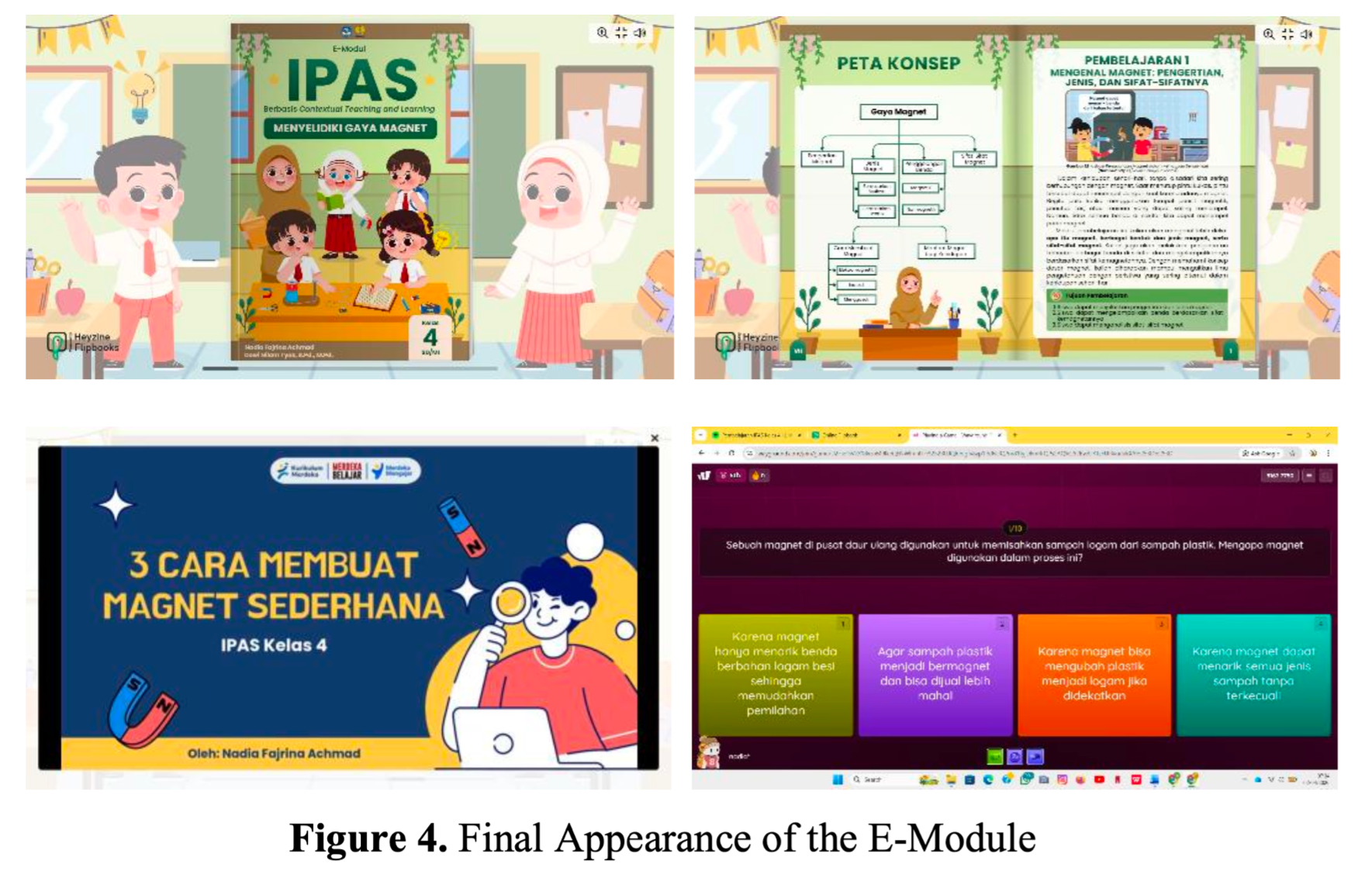
Abstract: Students’ low learning outcomes on the topic of “Magnetic Force” were caused by conventional teaching methods and limited availability of innovative and contextual teaching materials. The objective of this study is to develop and evaluate the feasibility and effectiveness of a Linktree-assisted CTL-based e-module in improving the learning outcomes of fourth-grade students in IPAS subject. A Research and Development (R&D) approach was utilized in this research, following the adaptation of the Borg and Gall model consisting of ten systematic stages in product development. The research subjects included material expert, media expert, classroom teacher, and students. To carried out the data collection process, a combination of questionnaires, documentation, and interviews was employed. To analyze the collected data, several techniques were utilized, including descriptive analysis, normality tests, t-tests, and N-gain tests. The design validation results showed a very feasible category from material expert (87%) and media expert (98%). The analysis of the response questionnaires yielded scores of 96.61% for students and 97.50% for teachers, placing both within the “very feasible” range. The effectiveness of the e-module was demonstrated by the t-test results with a significance value of 0.000, leading to the rejection of H0 and the acceptance of Ha, as well as an N-gain value of 0.5489, which considered “moderate”. Thus, the Linktree-assisted CTL-based e-module was a highly feasible and effective digital teaching material innovation to improve the learning outcomes of fourth-grade students in IPAS subject, particularly on the topic of “Magnetic Force”. Furthermore, the developed e-module serves as a highly effective digital innovation that aligns with modern educational needs.
Keywords: e-module, Linktree, CTL, learning outcomes
Downloads
Abdulrahaman, M. D., Faruk, N., Oloyede, A. A., Surajudeen-Bakinde, N. T., Olawoyin, L. A., Mejabi, O. V., Imam-Fulani, Y. O., Fahm, A. O., & Azeez, A. L. (2020). Multimedia tools in the teaching and learning processes: A systematic review. Heliyon, 6(11), e05312. https://doi.org/10.1016/j.heliyon.2020.e05312
Andika, I. P. W., & Yudiana, K. (2022). Linktree-assisted learning activities improve scientific literacy and metacognitive skills in the topic of types of forces in fourth grade science. Jurnal Edutech Undiksha, 10(1), 52–60. https://doi.org/10.23887/jeu.v10i1.47635
Aprianti, R., Naddiyah, K., Gusti, V. Y. K., & Herliana, F. (2023). Physics e-module development based on Contextual Teaching and Learning on reflection of light and refraction of light. Jurnal Penelitian & Pengembangan Pendidikan Fisika, 9(1), 23–34. https://doi.org/10.21009/1.09103
Asbah, J., Firdaus, F. M., & Fathurrohman. (2025). The influence of interactive digital learning media on improving history learning comprehension in grade IV students. Jurnal Prima Edukasia, 13(2), 339–349. https://doi.org/10.21831/jpe.v13i2.79624
Ayuningtyas, F. I., & Widodo, S. T. (2026). Development of digital pop-up book Pancasila education to improve learning outcomes. Jurnal Prima Edukasia, 14(1), 73–85. https://doi.org/10.21831/jpe.v14i1.95104
Darmawati, Y., & Mustadi, A. (2023). The effect of problem-based learning on the critical thinking skills of elementary school students. Jurnal Prima Edukasia, 11(2), 142–151. https://doi.org/10.21831/jpe.v11i2.55620
Dermawan, D. D., Wuryandani, W., Herwin, H., Eliza, F., Nurzaman, I., Giwangsa, S. F., Nurdiansah, N., Fadli, R., Sari, S., Jannah, M., & Munawarah, M. (2025). Improving critical thinking ability in elementary schools with interactive e-modules. Online Journal of Communication and Media Technologies, 15(2), e202513. https://doi.org/10.30935/ojcmt/16051
Desnita, D., Festiyed, F., Novitra, F., Ardiva, A., & Navis, M. Y. (2022). The effectiveness of CTL-based physics e-module on the improvement of the creative and critical thinking skills of senior high school students. TEM Journal, 11(2), 802–810. https://doi.org/10.18421/TEM112-38
Fauziah, A. M., & Nurita, T. (2019). Activities of students in using worksheet based on contextual teaching and learning. Journal of Physics: Conference Series, 1417(1), 012088. https://doi.org/10.1088/1742-6596/1417/1/012088
Feri, A., & Zulherman, Z. (2021). Development of nearpod-based e module on science material “energy and its changes” to improve elementary school student learning achievement. International Journal of Education and Learning, 3(2), 165–174. https://doi.org/10.31763/ijele.v3i2.400
Firdaus, F. M., Fadhilah, N., Wuryandari, I. T., & Fadhli, R. (2024). Liveworksheet interactive e-module effect on equal fractions comprehension at 4th grade elementary school. Jurnal Prima Edukasia, 12(1), 156–164. https://doi.org/10.21831/jpe.v12i1.64526
Gunawan, G., Suhardi, S., & Makawawa, J. C. (2023). Developing picture storybook learning media in terms of students’ critical and creative thinking skills. Jurnal Prima Edukasia, 11(2), 161–175. https://doi.org/10.21831/jpe.v11i2.56795
Haleem, A., Javaid, M., Qadri, M. A., & Suman, R. (2022). Understanding the role of digital technologies in education: A review. Sustainable Operations and Computers, 3, 275–285. https://doi.org/10.1016/j.susoc.2022.05.004
Idayanti, Z., & Suleman, Muh. A. (2024). E-Module as a self-instructional teaching material to improve students’ learning outcomes. Jurnal Penelitian Dan Pengembangan Pendidikan, 8(1), 127–133. https://doi.org/10.23887/jppp.v8i1.61283
Kharomah, S., Mulyati, Y., Marsuki, M. F., Fardhani, I., Hamimi, E., Ichsan, M. H. H., Hasan, S., & Sugiyanto, S. (2024). Enhancing students’ science outcomes through problem-based interactive flipbook e-module. Research and Development in Education (RaDEn), 4(2), 788–803. https://doi.org/10.22219/raden.v4i2.34572
Lasala, N. Jr. (2023). Development and validation of E-SelfIMo: e-learning self-directed interactive module in earth science. Recoletos Multidisciplinary Research Journal, 11(1), 85–101. https://doi.org/10.32871/rmrj2311.01.07
Liani, S. A., & Tyas, D. N. (2025). Development of unity-based smart board media to improve science and social studies learning outcomes. Jurnal Prima Edukasia. https://doi.org/https://doi.org/10.21831/jpe.v13i3.86268
Mahmuti, A., Hamzić, D. K., & Thaqi, X. (2025). The impact of contextual teaching and learning on improving student achievement in economic mathematics. International Electronic Journal of Mathematics Education, 20(3). https://doi.org/https://doi.org/10.29333/iejme/16233
Nafis, O. Z., & Nuryanto, S. (2025). The development of Linktree learning media to improve the understanding of main idea of narrative text. Jurnal Prima Edukasia. https://doi.org/https://doi.org/10.21831/jpe.v13i2.83635
Nurmasari, L., Budiyono, Nurkamto, J., & Ramli, M. (2023). Realistic mathematics engineering for improving elementary school students’ mathematical literacy. Journal on Mathematics Education, 15(1), 1–26. https://doi.org/10.22342/jme.v15i1.pp1-26
Perales, W., & Ulla, M. B. (2025). Technology in EFL contextual teaching and learning: Teachers’ practices and perspectives in a Thai university. Heliyon, 11(17), e44169. https://doi.org/10.1016/j.heliyon.2025.e44169
Pratiwi, K. H., Situmorang, R., & Iriani, T. (2024). The potential of interactive multimedia with contextual teaching and learning approaches in mathematics learning: A systematic literature review. Jurnal EDUCATIO: Jurnal Pendidikan Indonesia, 10(2), 69–77. https://doi.org/10.29210/1202424526
Prykhodkina, N., Tsynova, M., Kravets, H., Нrechanovska, O., & Nichyshyna, V. (2025). The role of interactive technologies in improving the quality of learning and development of scientific competences in modern education. Periodicals of Engineering and Natural Sciences (PEN), 13(1), 69–82. https://doi.org/10.21533/pen.v13.i1.253
Purwanti, I. T., Eliwarti, E., & Jismulatif, J. (2023). E-module of meaning in interpersonal context in online learning: Implementation and students’ feedback. AL-ISHLAH: Jurnal Pendidikan, 15(1), 271–286. https://doi.org/10.35445/alishlah.v15i1.2566
Qing, H., Ibrahim, R., & Nies, H. W. (2024). Analysis of web design visual element attention based on user educational background. Scientific Reports, 14(1), 4657. https://doi.org/10.1038/s41598-024-54444-8
Rahayu, W. N., & Firdaus, F. M. (2025). Increased motivation and ability student numeracy through the application of a contextual approach to mathematics learning. Jurnal Prima Edukasia, 13(2), 361–374. https://doi.org/10.21831/jpe.v13i2.75555
Saptono, B. (2023). The effectiveness of e-books in learning: An analysis of trends in elementary schools. Jurnal Prima Edukasia, 11(2), 206–214. https://doi.org/10.21831/jpe.v11i2.59484
Sariwedani, N. M. G., Werang, B. R., & Sudarma, I. K. (2025). Contextual-based interactive learning video media to improve science learning outcomes of grade VI elementary school students. MIMBAR PGSD Undiksha, 13(2), 218–228. https://doi.org/10.23887/jjpgsd.v13i2.93717
Schoenherr, J., Strohmaier, A. R., & Schukajlow, S. (2024). Learning with visualizations helps: A meta-analysis of visualization interventions in mathematics education. Educational Research Review, 45, 100639. https://doi.org/10.1016/j.edurev.2024.100639
Sidauruk, T., Delita, F., Berutu, N., Elfayetti, & Rohani. (2025). E-modules to improve learning independence, motivation and learning outcomes. Jurnal Penelitian Dan Pengembangan Pendidikan, 9(1), 171–180. https://doi.org/10.23887/jppp.v9i1.74404
Sugiyono, S. (2019). Metode penelitian kuantitatif, kualitatif, dan R&D. Alfabeta.
Susilawati, S., Supriyatno, T., Yasin, A. F., Chakim, A., & Putri, C. A. (2025). The effect of TPACK-based contextual teaching and learning model on student learning outcomes. Educational Process International Journal, 16(1). https://doi.org/10.22521/edupij.2025.16.279
Suwandi, R. A., Suciati, S., & Suranto, S. (2023). Validity and effectiveness of e-modules based on discovery learning combined with scaffolding questions to improve science literacy skills. The International Journal of Interdisciplinary Educational Studies, 19(1), 1–23. https://doi.org/10.18848/2327-011X/CGP/v19i01/1-23
Verawati, N. N. S. P., & Sarjan, M. (2023). The philosophy of critical thinking in problem-based science learning. Prisma Sains: Jurnal Pengkajian Ilmu Dan Pembelajaran Matematika Dan IPA IKIP Mataram, 11(4), 992–1001. https://doi.org/10.33394/j-ps.v11i4.9101
Wahyuni, L. T. S., & Arnyana, I. B. P. (2022). E-module based on Tri Kaya Parisudha effectively improves science learning outcomes. MIMBAR PGSD Undiksha, 10(2), 358–366. https://doi.org/10.23887/jjpgsd.v10i2.46733
Widiastuti, N. L. G. K. (2021). Contextual approach-based e-module in science learning. Jurnal Ilmiah Pendidikan Dan Pembelajaran, 5(3), 435–445. https://doi.org/10.23887/jipp.v5i3.37974
Widyaningrum, S., & Parmiti, D. P. (2024). Contextual teaching and learning-based e-worksheet on science subjects for fourth grade elementary schools. Mimbar Ilmu, 29(1), 173–184. https://doi.org/10.23887/mi.v29i1.64644
Wulansari, D., & Tyas, D. N. (2025). The development of interactive picture card media with QR code to improve IPAS learning outcomes. Jurnal Prima Edukasia. https://doi.org/https://doi.org/10.21831/jpe.v13i2.84474
Yulia, N. M., & Suttrisno, S. (2024). Developing local wisdom-based augmented reality modules for science and social studies learning in elementary schools. AL-ISHLAH: Jurnal Pendidikan, 16(4), 5549–5560. https://doi.org/10.35445/alishlah.v16i4.5987
Yusuf, I., Widyaningsih, S. W., Prasetyo, Z. K., & Istiyono, E. (2020). Higher order thinking skills (HOTS)-oriented e-module in electric circuit. Journal of Physics: Conference Series, 1521(2), 022027. https://doi.org/10.1088/1742-6596/1521/2/022027
Zaniyati, M., & Rohmani, R. (2024). Analysis of the effectiveness of pop-up book media on science learning in elementary schools. IJORER: International Journal of Recent Educational Research, 5(4), 919–934. https://doi.org/10.46245/ijorer.v5i4.641
Copyright (c) 2026 Nadia Fajrina Achmad, Dewi Nilam Tyas

This work is licensed under a Creative Commons Attribution-ShareAlike 4.0 International License.
The copyright of the received article shall be assigned to the journal as the publisher of the journal. The intended copyright includes the right to publish the article in various forms (including reprints). The journal maintains the publishing rights to the published articles.

Jurnal Prima Edukasia by http://journal.uny.ac.id/index.php/jpe/index is licensed under a Creative Commons Attribution-ShareAlike 4.0 International License.