
Diagnostic assessment of students’ numeracy ability in phase a using the finger math method: Analysis of patterns of accuracy and speed of answer
Downloads
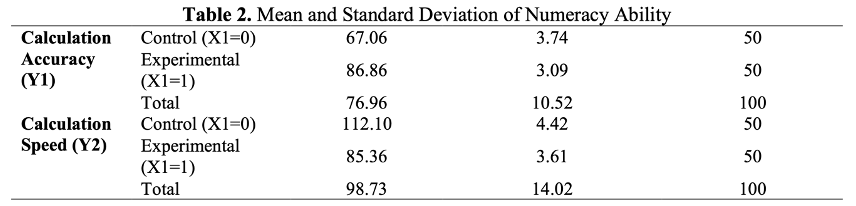
This study aims to conduct a diagnostic assessment of Phase A students' numeracy skills through multivariate analysis of the pattern of accuracy and speed of answers using the Finger Math method. This study is based on the still low numeracy skills of Madrasah Ibtidaiyah students and the dominance of conventional learning approaches that pay less attention to aspects of the student's numeracy process. This study uses a quantitative approach with a quasi-experimental design in the form of a factorial design. The research sample consisted of 100 second-grade students of Madrasah Ibtidaiyah (Phase A) in Manado who were divided into an experimental group (Finger Math) and a control group (conventional). Data were collected through a numeracy test and analyzed using One-Way MANOVA. The results of the study show that the Finger Math method has a significant simultaneous effect on the accuracy and speed of calculation (Wilks’ Lambda = 0,045; p < 0,001). Further univariate ANOVA tests showed a very significant effect on counting accuracy (F = 830,277; p < 0,001) and counting speed (F = 1.094,872; p < 0,001). Descriptively, students learning with Finger Math demonstrated higher accuracy and faster completion times than the conventional group. These findings confirm that Finger Math is effective as both a learning strategy and an initial diagnostic assessment for comprehensively mapping the numeracy profiles of Phase A students.
Downloads
Baird, J. A., Andrich, D., Hopfenbeck, T. N., & Stobart, G. (2017). Assessment and learning: Fields apart? Assessment in Education: Principles, Policy & Practice, 24(3), 317–350. https://doi.org/10.1080/0969594X.2017.1319337
Baroody, A. J. (2006). Why children have difficulties mastering the basic number combinations and how to help them. Teaching Children Mathematics, 13(1), 22–31. https://doi.org/10.5951/TCM.13.1.0022
Boussaha, K. (2025). Towards a new generation of digital games designed with the basics of psychological theories to improve primary school pupils’ psychological and technical skills in learning arithmetic. Entertainment Computing. Https://Doi.Org/10.1016/j.Entcom.2025.100927.
Carbonneau, K. J., Marley, S. C., & Selig, J. P. (2013). A meta-analysis of the efficacy of teaching mathematics with concrete manipulatives. Journal of Educational Psychology, 105(2), 380–400. https://doi.org/10.1037/a0031084
Dikdik, A., Suryana, A., Triana, C., Rahyasih, Y., & Oktaviani, F. F. (2025). Improving Teachers’ Numeracy Skills at Cisarua State Elementary School, West Java, Indonesia. Jurnal Prima Edukasia, 13(1), 111–127. https://doi.org/10.21831/jpe.v13i1.82453
Elgavi, O & H. P. (2025). Math on the brain: Seven principles from neuroscience for early childhood educators. Early Childhood Education Journal. Https://Doi.Org/10.1007/S10643-024-01656-2.
Finch, W. H. (2022). Multivariate analysis of variance for multilevel data: A simulation study comparing methods. The Journal of Experimental Education, 90(1), 173–190. https://doi.org/10.1080/00220973.2020.1718058
Fischer, U., Moeller, K., Bientzle, M., Cress, U., & Nuerk, H. C. (2011). Sensori-motor spatial training of number magnitude representation. Psychonomic Bulletin & Review, 18(1), 177–183. https://doi.org/10.3758/s13423-010-0031-3
Fischer, U., Moeller, K., Bientzle, M., Cress, U., & Nuerk, H.-C. (2020).
The implicit contribution of fine motor skills to mathematical insight. Frontiers in Psychology, 11, 1143.
https://doi.org/10.3389/fpsyg.2020.01143
Garcia-Perez, A., & Nunez-Anton, V. (2021). A comprehensive review of MANOVA procedures and their application in educational research. Mathematics, 9(15), 1811. https://doi.org/10.3390/math9151811
Geary, D. C. (2011). Cognitive predictors of achievement growth in mathematics: A 5-year longitudinal study. Developmental Psychology, 47(6), 1539–1552. Https://Doi.Org/10.1037/A0025510.
Gopalan, M., Rosinger, K., & Ahn, J. B. (2020). Use of quasi-experimental research designs in education research: Growth, promise, and challenges. Review of Research in Education, 44(1), 218–243. https://doi.org/10.3102/0091732X20903302
Haenilah, E. Y., Ridwan, & Hariri, H. (2023). Scientific method-based pedagogical competence reflection for improving teacher professionalism. Journal of Educational and Social Research, 13(5), 265–276. https://doi.org/10.36941/jesr-2023-0136
Jonas, N. (2018). Numeracy practices and numeracy skills among adults. OECD Education Working Papers, 177, 1–83. https://doi.org/10.1787/8f19fc9f-en
Karim, S., & Indra, M. (2025). Improving vocational students’ learning outcomes through an innovative instructional model: A quasi-experimental study. Jurnal Pendidikan Vokasi, 15(3). https://doi.org/10.21831/jpv.v15i3.77430
Karnes, J., B. A., & G. M. (2021). The effects of a math racetracks intervention on the single-digit multiplication facts fluency of four struggling elementary school students. Insights into Learning Disabilities, 18(1), 53–77
Kim, M., & Park, J. (2018). The effects of finger calculation strategies on students’ basic calculation ability. Journal of Educational Psychology Research, 36(2), 145–158.
Kovarsky Rotta, G., & C. E. L. (2026). A handy tool: Using fingers as a numerical representation specifically benefits lower performers in kindergarten mathematics. Developmental Psychology. Https://Doi.Org/10.1037/Dev0002032.
Krenger, M., & Thevenot, C. (2025).
Finger counting is not a dead end: It supports the development of efficient calculation strategies. Journal of Cognition and Development.
https://doi.org/10.1080/15248372.2025.2606280
Lafay, A., Osana, H. P., & Levin, J. R. (2023). Does conceptual transparency in manipulatives afford place-value understanding in children at risk for mathematics learning disabilities? Learning Disability Quarterly, 46(2), 87–101. https://doi.org/10.1177/07319487221124088
Liu, J., Bulut, O., & Johnson, M. D. (2024). Examining position effects on students’ ability and test-taking speed in the TIMSS 2019 problem-solving and inquiry tasks: A structural equation modeling approach. Psychology International, 6(2), 492–508. https://doi.org/10.3390/psycholint6020030
Moeller, K., Martignon, L., Wessolowski, S., Engel, J., & Nuerk, H. (2012). Effects of finger-based training on numerical skills in preschoolers. Developmental Science, 15(6), 875–885. Https://Doi.Org/10.1111/j.1467-7687.2012.01185.x.
Morrissey, K., Liu, Y., & Ding, M. (2020).
Finger-counting habits in arithmetic and their relation to mathematical performance. Psychological Research, 84(8), 2180–2191.
https://doi.org/10.1007/s00426-018-0990-y
Neveu, M., Geurten, M., Durieux, N., & Rousselle, L. (2023). Finger use and arithmetic skills in children and adolescents: A scoping review. Educational Psychology Review, 35(2). https://doi.org/10.1007/s10648-023-09722-8
Panadero, E., Andrade, H., & Brookhart, S. M. (2018). Fusing self-regulated learning and formative assessment: A roadmap of where we are, how we got here, and where we are going. The Australian Educational Researcher, 45(1), 13–31. https://doi.org/10.1007/s13384-018-0258-y
Patricia, F. A., & Zamzam, K. F. (2021). Development of scientific approach-based interactive multimedia for elementary school dyscalculia children. Jurnal Prima Edukasia, 9(1). https://doi.org/10.21831/jpe.v9i1.33853
Poletti, C., Krenger, M., Létang, M., & Thevenot, C. (2023). French preschool and primary teachers’ attitude towards finger counting. Acta Psychologica, 241, 104079. https://doi.org/10.1016/j.actpsy.2023.104079
Ponte, R., Viseu, F., Neto, T. B., & Aires, A. P. (2023). Revisiting manipulatives in the learning of geometric figures. Frontiers in Education, 8, 1217680. https://doi.org/10.3389/feduc.2023.1217680
Powell, S. R., Berry, K. A., & Barnes, M. A. (2022). Achievement in arithmetic and pre-algebraic reasoning: Relations with mathematics problem solving. Learning and Individual Differences, 97, 102157. https://doi.org/10.1016/j.lindif.2022.102157
Rakhmawati, Y., & Mustadi, A. (2022). The circumstances of literacy numeracy skill: Between notion and fact from elementary school students. Jurnal Prima Edukasia, 10(1), 9–18. https://doi.org/10.21831/jpe.v10i1.36427
Roy, E., Guillaume, M., Van Rinsveld, A., & McCandliss, B. D. (2025). Tablet-based arithmetic fluency assessment reveals developments in math cognition and math achievement from childhood to adolescence. npj Science of Learning, 10(19). https://doi.org/10.1038/s41539-025-00314-5
Sweller, J., A. P., & K. S. (2011). Cognitive load theory. Springer. Https://Doi.Org/10.1007/978-1-4419-8126-4.
Tout, D., Safford-Ramus, K., & Misztal, B. (2021). Numeracy, adult education, and vulnerable adults: A critical view of a neglected field. ZDM–Mathematics Education, 53(3), 475–489. https://doi.org/10.1007/s11858-021-01227-8
Voskoglou, M. G., & Salem, A. B. M. (2020). Benefits and challenges of the artificial intelligence applications in education. Advances in Intelligent Systems and Computing, 902, 804–811. https://doi.org/10.1007/978-3-030-11932-4_75
Wijaya, A., van den Heuvel‐Panhuizen, M., & Doorman, M. (2015). Opportunity-to-learn context-based tasks provided by mathematics textbooks. Educational Studies in Mathematics, 89(1), 41–65. https://doi.org/10.1007/s10649-015-9595-1
Copyright (c) 2026 Andi Asma, Muhammad Tahir

This work is licensed under a Creative Commons Attribution-ShareAlike 4.0 International License.
The copyright of the received article shall be assigned to the journal as the publisher of the journal. The intended copyright includes the right to publish the article in various forms (including reprints). The journal maintains the publishing rights to the published articles.

Jurnal Prima Edukasia by http://journal.uny.ac.id/index.php/jpe/index is licensed under a Creative Commons Attribution-ShareAlike 4.0 International License.