Development of augmented reality flashcards on cultural diversity to improve elementary students’ learning outcomes
Downloads
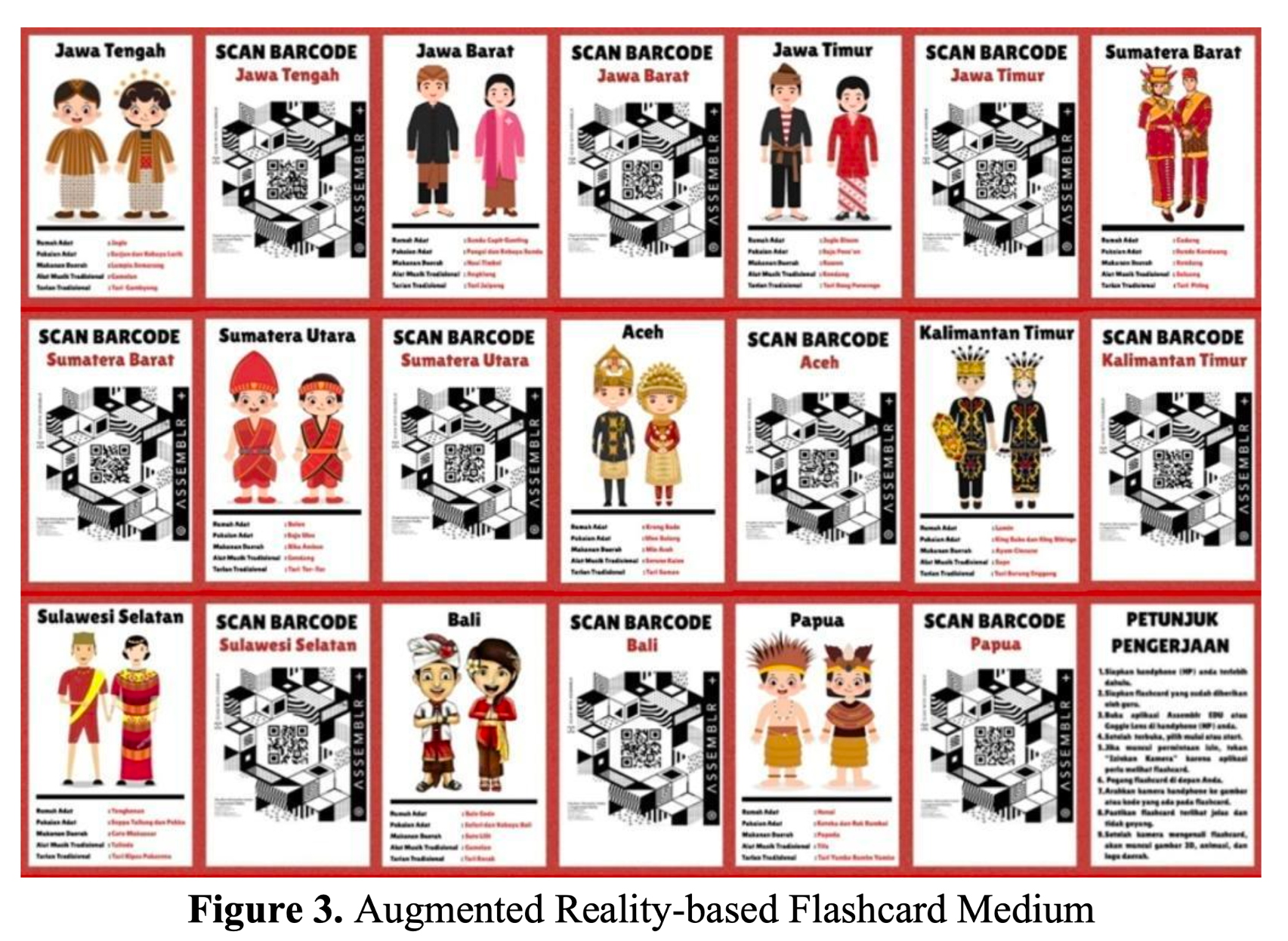
This research aims to develop, determine the feasibility, and test the effectiveness of Augmented Reality-based Flashcards on the topic of cultural diversity in improving elementary school students' learning outcomes. The research method used is Research and Development (R&D) using the Borg & Gall development model. The subjects of this research were fourth-grade students at SDN Bringin 02 Semarang. Data collection techniques included interviews, observations, questionnaires, tests, and documentation, which were conducted in November 2025. The research instruments consisted of interviews, documentation, needs and response questionnaires, pretest and posttest questions, and expert validation sheets. The pretest and posttest trial questions were analyzed using validity, reliability, item difficulty index, and item discrimination index calculations. Data analysis was performed using normality tests, T-tests, and N-gain tests. The results of this research are the creation of a feasible and effective augmented reality-based flashcard medium to improve fourth-grade students' learning outcomes in Natural and Social Sciences, specifically on the topic of Indonesian cultural diversity at SDN Bringin 02. Therefore, this medium can be recommended as an innovative learning alternative for elementary schools to support interactive and meaningful Natural and Social Sciences learning.
Downloads
Ananta, Y. B. G., & Isdaryanti, B. (2025). The development of barcode flashcard learning media for science and social studies (IPAS) to improve learning outcomes at SD Negeri Sadeng 02 Semarang. FONDATIA, 9(3), 620–637. https://doi.org/10.36088/fondatia.v9i3.5877
Arici, F. (2024). Investigating the effectiveness of augmented reality technology in science education in terms of environmental literacy, self-regulation, and motivationn to Learn Science. International Journal of Human–Computer Interaction, 40(24), 8476–8496. https://doi.org/10.1080/10447318.2024.2310921
Bang, H. J., Li, L., & Flynn, K. (2023). Efficacy of an adaptive game-based math learning app to support personalized learning and improve early elementary school students’ learning. Early Childhood Education Journal, 51(4), 717–732. https://doi.org/10.1007/s10643-022-01332-3
Chang, H.-Y., Binali, T., Liang, J.-C., Chiou, G.-L., Cheng, K.-H., Lee, S. W.-Y., & Tsai, C.-C. (2022). Ten years of augmented reality in education: A meta-analysis of (quasi-) experimental studies to investigate the impact. Computers & Education, 191, 104641. https://doi.org/10.1016/j.compedu.2022.104641
Czok, V., & Weitzel, H. (2025). Impact of augmented reality and game-based learning for science teaching: lessons from pre-service teachers. Applied Sciences, 15(5), 2844. https://doi.org/10.3390/app15052844
Fau, J. F., Mendrofa, K. J., Wau, M., & Waruwu, Y. (2023). Education is a window to the world. Jurnal Visi Pengabdian Kepada Masyarakat, 4(2), 69–77. https://doi.org/10.51622/pengabdian.v4i2.1350
Ghosh, A., Tiwari, A. K., Kumari, A., Alam, S., Das, M., & Karthik, K. (2025). Interactive augmented reality application using animal flashcard for education of children. Interactive Learning Environments, 33(9), 5184–5212. https://doi.org/10.1080/10494820.2025.2479163
Înoue, S. (2022). Interview-based qualitative descriptive study on risk factors of school withdrawal among elementary school children. Children, 9(10), 1579. https://doi.org/10.3390/children9101579
Kalemkuş, J. (2025). Technology use in primary school science education: bibliometric and descriptive analysis. E-Kafkas Eğitim Araştırmaları Dergisi, 12(2), 504–526. https://doi.org/10.30900/kafkasegt.1632067
Khatun, N. (2021). Applications of normality test in statistical analysis. Open Journal of Statistics, 11(01), 113–122. https://doi.org/10.4236/ojs.2021.111006
Khotimah, K., & Safirah, A. W. (2023). Integration of educational technology in analyzing phonological errors in Indonesian language learning at the elementary school level. INNOVATIVE: Journal Of Social Science Research, 3(5), 3580–3592.
Lai, C., & Shi, Z. (2025). Teachers’ digital initiatives to bridge students’ in‐class and out‐of‐class language learning and the influencing factors. British Journal of Educational Technology, 56(6), 2595–2622. https://doi.org/10.1111/bjet.13595
Levido, A., Rodriguez, A., Dezuanni, M., & Woods, A. (2025). Developing children’s algorithmic literacies through curatorship as media literacy. Learning, Media and Technology, 1–17. https://doi.org/10.1080/17439884.2025.2495603
Lindell, T., & Stöhr, C. (2025). Navigating generative AI in higher education – six near future scenarios. Learning, Media and Technology, 1–16. https://doi.org/10.1080/17439884.2025.2562405
Lintang, F., & Najicha, F. U. (2022). The values of the principle of “Unity of Indonesia” in the diversity of Indonesian culture. Jurnal Global Citizen : Jurnal Ilmiah Kajian Pendidikan Kewarganegaraan, 11(1), 79–85. https://doi.org/10.33061/jgz.v11i1.7469
Mahatma, M., Riyadi, R., & Arthur, R. (2025). Validation of the content of elementary school teacher competency instruments in developing student character using the Aiken’s V method. International Journal of Academic Research in Business and Social Sciences, 15(9). https://doi.org/10.6007/IJARBSS/v15-i9/26489
Maulana, A. (2025). The development of QR code-integrated flashcard learning media on the topic of cultural diversity in Indonesia to improve learning outcomes of fourth-grade students at SDI Surya Buana. In Jurnal Pendidikan Guru Madrasah Ibtidaiyah (Vol. 4, Number 1). http://urj.uin-malang.ac.id/index.php/ijpgmi
Morrell, P. D., Visnovska, J., & Miller, J. (2025). Australian primary school students’ understandings about the nature of scientific inquiry. Research in Science Education, 55(2), 383–397. https://doi.org/10.1007/s11165-024-10195-0
Musyaffa, F. I., & Isdaryanti, B. (2024). The development of the Indonesian Culture learning application (Si Budi) based on augmented reality to improve learning outcomes of fourth-grade elementary school students. Pendas: Jurnal Ilmiah Pendidikan Dasar, 9(2), 2548–6950.
Ningrum, P. S., & Sa’diyah, H. (2023). Looking to the future: library revitalization to improve literacy and realize student Nawacita at SDN Tlogotirto 1. International Journal of Elementary School Teacher, 3(2), 123. https://doi.org/10.26858/ijest.v3i2.54634
Pratiwi, K. S., & Dzakiyah, N. Q. (2024). QR code-based digital media for scientific literacy skills enhancement of elementary school students. JTP - Jurnal Teknologi Pendidikan, 26(1), 63–83. https://doi.org/10.21009/jtp.v26i1.43285
Putri, & Sofyan, H. (2020). A simulation-based interactive learning multimedia development for photosynthesis and respiration practicum in junior high schools. Journal of Educational Technology and Online Learning, 3(3), 311–339. https://doi.org/10.31681/jetol.775947
Rachmawati, A. M., & Lestari, B. A. (2025). AR-based flashcard to improve primary school students’ English vocabulary mastery: insights from vocabulary learning research. Journal of Language and Literature Studies, 5(4), 1148–1159. https://doi.org/10.36312/rxsmg853
Rahayu, B. S., Trisnantari, H. E., & Asrori, M. A. R. (2025). Augmented reality-based flashcard media development with Canva’s assistance to improve social science learning outcomes on ethnic diversity in Indonesia. JURNAL PENDIDIKAN IPS, 15(3), 798–809. https://doi.org/10.37630/jpi.v15i3.3293
Rahman, M. A., Faisal, R. R., & Tho, C. (2023). The effectiveness of augmented reality using flash card in education to learn simple English words as a secondary language. Procedia Computer Science, 227, 753–761. https://doi.org/10.1016/j.procs.2023.10.580
Riyadi, I., Prabowo, E. A., & Hakim, D. (2024). The role of Bhinneka Tunggal Ika in the diversity of cultural traditions in Indonesia. Jaksa: Jurnal Kajian Ilmu Hukum Dan Politik, 2(3), 34–39.
Saputra, R., Diandita, Y. N., & Zulfiati, H. M. (2023). Development of web-based learning media using Google Sites for social studies learning in elementary school. Didaktik : Jurnal Ilmiah PGSD STKIP Subang, 9(2), 3327–3338. https://doi.org/10.36989/didaktik.v9i2.962
Selang, Z., Tahir, M., & Zaid, M. I. (2025). The development of augmented reality flashcard learning media based on the Assemblr Edu application on the topic “Indonesian Cultural Diversity” for Grade V at SDN 29 Cakranegara. Jurnal Ilmiah Profesi Pendidikan, 10(2), 1540–1545. https://doi.org/10.29303/jipp.v10i2.3355
Sudirman, Mulianingsih, F., & Usman. (2025). The influence of social conflict, cultural diversity, and tolerance on social integration in urban societies. The Eastasouth Journal of Social Science and Humanities, 2(02), 188–198.
Sugiyono. (2023). Research Methods in Education (Quantitative, Qualitative, Mixed Methods, R&D, and Educational Research).
Tarmidzi, T., Andari, K. D. W., Sari, A., Nuryanti, M., Arfiyanti, R., & Noto, M. S. (2025). Augmented reality and its use in elementary school education: a systematic literature review. Jurnal Prima Edukasia, 13(1), 128–145. https://doi.org/10.21831/jpe.v13i1.75094
Windiyani, T., Gani, R. A., & Sarimanah, E. (2025). Emaze application based on ESD through animation media to enhance literacy movement. Jurnal Prima Edukasia, 13(1), 27–36. https://doi.org/10.21831/jpe.v13i1.71038
Copyright (c) 2026 Amelia Ellena Candra, Tri Astuti

This work is licensed under a Creative Commons Attribution-ShareAlike 4.0 International License.
The copyright of the received article shall be assigned to the journal as the publisher of the journal. The intended copyright includes the right to publish the article in various forms (including reprints). The journal maintains the publishing rights to the published articles.

Jurnal Prima Edukasia by http://journal.uny.ac.id/index.php/jpe/index is licensed under a Creative Commons Attribution-ShareAlike 4.0 International License.