The development of interactive learning media to improve music learning outcomes
Downloads
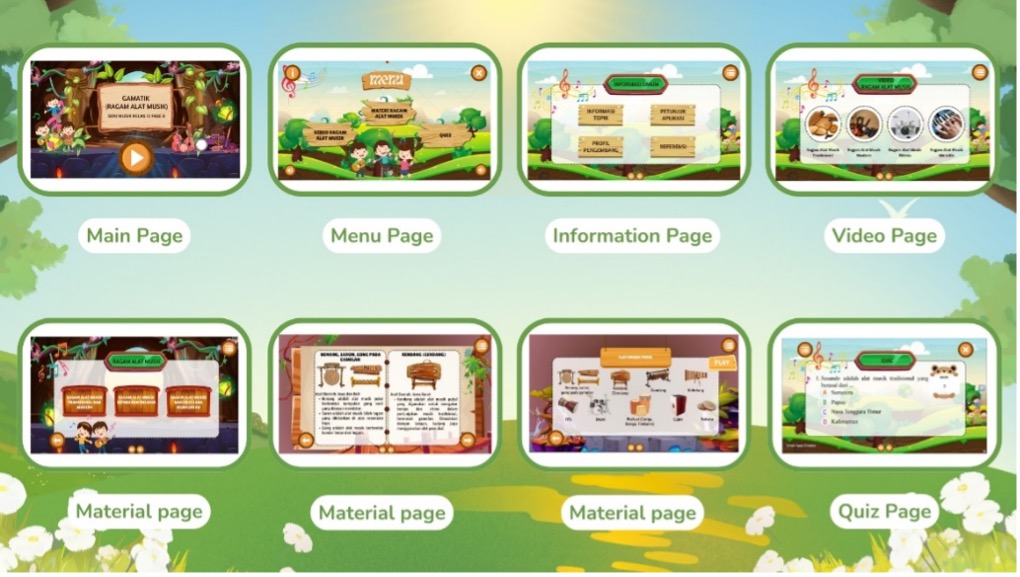
Limited use of interactive learning media in elementary schools had contributed to low student engagement and unsatisfactory music learning outcomes, particularly in learning about musical instruments diversity. Therefore, technology-based learning media appropriate to students’ characteristics were required. This study aims to develop and evaluate the feasibility and effectiveness of a musical instruments diversity application to improve students of Grade IV music learning outcomes. This research employed a Research and Development (R&D) method adapted from the Borg and Gall model. The research subjects were Grade IV students at Protomulyo 1 Elementary School, Kendal Regency. Data were collected through interviews, observations, documentation, questionnaires, and tests, then analyzed using descriptive analysis, normality testing, N-gain score, and paired sample t-test. The results showed that the application was very feasible, with media expert validation of 96.8% and material expert validation of 95.3%. The paired sample t-test showed a significant value (2-tailed) of 0.000, and the N-gain score was 0.815, indicating high effectiveness. The study concluded that the developed application was feasible and effective in improving Grade IV students’ music learning outcomes, offering a practical model for integrating technology into elementary music education. The findings imply that the strategic integration of interactive mobile applications can bridge the gap between traditional music curricula and digital-age learners, providing a scalable framework for enhancing cultural literacy through technology-driven instruction.
Downloads
Aeni, A. N., Hanifah, N., Rahimah, & Arifuddin, A. (2024). Development of Smart Apps Creator (SAC)-based android application learning media to improve students’ understanding of Islamic education materials in elementary schools. Al Ibtida: Jurnal Pendidikan Guru MI, 11(2), 359– 372. DOI: https://doi.org/10.24235/al.ibtida.snj.v11i2.18531
Aldalalah, O. M. A., Wardat, Y., Al-Omari, A. A. H., & Khodair, R. M. (2025). The effectiveness of interactive digital content based on the TPACK model in developing the skills of educational aids production and improving cognitive achievement among early childhood university students. Contemporary Educational Technology, 17(2), ep549. DOI: https://doi.org/10.30935/cedtech/16046
Aprilia, T., Ardiansyah, A. R., & Riyanti, H. (2023). The feasibility of interactive multimedia and online quiz based gamification on Learning Management System (LMS) thematic learning courses. Jurnal Prima Edukasia, 11(1), 120–133. DOI: https://doi.org/10.21831/jpe.v11i1.55533
Asbah, J., Firdaus, F. M., & Fathurrohman. (2025). The influence of interactive digital learning media on improving history learning comprehension in Grade IV students. Jurnal Prima Edukasia, 13(2), 339–349. DOI: https://doi.org/10.21831/jpe.v13i2.79624
Aziz, N., & Younes, R. (2025). Educators perception on integrating virtual reality in the classrooms. Contemporary Educational Technology, 17(4), ep574. DOI: https://doi.org/10.30935/cedtech/17407
Borrás-Gené, O., & Díez, R. M. (2025). Improving motivation in future teachers: Flipped classroom and gamification using digital badges. Journal of Information Technology Education: Innovations in Practice, 24, 1–19. DOI: https://doi.org/10.28945/5634
Camacho-Vásquez, G., Ortega-Tudela, J. M., & Díaz-Pareja, E. M. (2025). The efficacy of a web-based methodology on English teachers’ digital competence in Colombia. Contemporary Educational Technology, 17(4), ep582. DOI: https://doi.org/10.30935/cedtech/17518
Daniyati, A., Saputri, I. B., Wijaya, R., Septiyani, S. A., & Setiawan, U. (2023). Basic concepts of learning media. Journal of Student Research (JSR), 1(1), 282–294. DOI: https://doi.org/10.55606/jsr.v1i1.993
Domínguez-González, M. de los Á., Rosa, A. L. de la, Hervás-Gómez, C., & Román-Graván, P. (2025). Teacher digital competence: Keys for an educational future through a systematic review. Contemporary Educational Technology, 17(2), ep555. DOI: https://doi.org/10.30935/cedtech/16168
Esmat, M., & Amasha, N. (2025). Using mobile applications to develop the teacher’s teaching performance and professional development. Education and Information Technologies, 30, 21353–21370. DOI: https://doi.org/10.1007/s10639-025-13603-8
Firmansyah, Tafakur, Destiana, B., & Dewi, A. S. (2024). Defining technology-based learning media in science subjects for elementary schools. Jurnal Prima Edukasia, 12(2), 242–252. DOI: https://doi.org/10.21831/jpe.v12i2.71824
Fitriyadi, N., & Wuryandani, W. (2021). Is educational game effective in improving critical thinking skills? Jurnal Prima Edukasia, 9(1), 107–117. DOI: https://doi.org/10.21831/jpe.v9i1.35475
Hayadi, B. H., & Hariguna, T. (2025). Determinants of student engagement and behavioral intention towards mobile learning platforms. Contemporary Educational Technology, 17(1), ep538. DOI: https://doi.org/10.30935/cedtech/15774
Jeet, G., & Pant, D. S. (2023). Creating joyful experiences for enhancing meaningful learning and integrating 21st century skills. International Journal of Current Science Research and Review, 6(2), 900–903. DOI: https://doi.org/10.47191/ijcsrr/v6-i2-05
Kaur, H., Ahmad, B., Rajoo, M., Manan, N. Z. A., & Arshad, B. (2022). Research on the effects of mobile learning on student education. International Journal of Health Sciences, 6(S6), 1155– 1168. DOI: https://doi.org/10.53730/ijhs.v6nS6.10551
Korobkova, O. K., Galchenko, N. A., Orekhovskaya, N. A., Drozdova, E. A., Zakharova, O. V., & Lobuteva, A. V. (2025). A scoping review of contemporary frameworks, challenges, and future directions on educational technology for digital generations. Contemporary Educational Technology, 17(4), ep581. DOI: https://doi.org/10.30935/cedtech/17517
Kulkarni, R. V., Choudhari, G., Bhavik, M., Bura, R., & Bhosale, V. (2025). Gamifying early math education: An innovative AI game for children. Journal of Information Technology Education: Innovations in Practice, 24, 1–21. DOI: https://doi.org/10.28945/5595
Laumann, D., Krause, M., Kremer, F. E., Leibrock, B., Ubben, M. S., Forthmann, B., Janzik, R., Masemann, D., Reer, F., Denz, C., Greefrath, G., Heinicke, S., Marohn, A., Quandt, T., Souvignier, E., & Heusler, S. (2025). Mobile learning in the classroom – Should students bring mobile devices for learning, or should these be provided by schools? Education and Information Technologies, 30, 9463–9496. DOI: https://doi.org/10.1007/s10639-024-13213-w
Maasawet, E. T., Candra, K. P., Putra, H. P., & Kolow, J. C. (2023). Practicality and effectiveness of student learning using Smart Apps Creator media to improve critical thinking abilities and student learning outcomes. Jurnal Penelitian Pendidikan IPA, 9(Special Issue), 136–142. DOI: https://doi.org/10.29303/jppipa.v9ispecialissue.6358
Maharani, I. R., Saputro, B. A., & Purnamasari, V. (2025). Educational game development to improve students' problem solving skills on mathematical sentences and calculations for grade 4. Pendas: Jurnal Ilmiah Pendidikan Dasar, 10(3), 400–414. DOI: https://doi.org/10.23969/jp.v10i03.31178
Martyniuk, A., Zabiiaka, I., Shevchuk, A., Lobanova, S., Hubina, А., & Melnychuk, O. (2025). European perspectives on innovative educational practices in the age of globalization and digitalization. Journal of Teaching and Learning, 19(3), 5–18. DOI:https://doi.org/10.22329/jtl.v19i2.8790
Nelwan, C. K., Mamahit, D. J., Sugiarso, B. A., & Yusupa, A. (2020). Design and development of interactive learning applications for grade 1 elementary school. Jurnal Teknik Informatika, 15(1), 45–54. DOI: https://doi.org/10.35793/jti.v15i1.29036
Ningsih, W., Sari, M. E., & Prasetyo, H. (2025). Implementation of Teams Games Tournament (TGT) model to foster learning activity in grade 4 students. Pendas: Jurnal Ilmiah Pendidikan Dasar, 10(3), 246–259. DOI: https://doi.org/10.23969/jp.v10i03.30466
Nurharini, A., & Yuyarti. (2017). Development of learning media of animation video as learning sources of cultural and craft arts. Advances in Social Science, Education and Humanities Research, 118, 599–605. DOI: https://doi.org/10.2991/icset-17.2017.99
Primaestri, W., Akhyar, M., & Sutimin, L. A. (2023). Bibliometric analysis of game research trends in elementary learning and self-regulated learning skill. Jurnal Prima Edukasia, 11(2), 225–234. DOI: https://doi.org/10.21831/jpe.v11i2.60264
Purwaningsih, W., & Wangid, M. N. (2021). Improving students’ critical thinking skills using time bar media in mathematics learning in the third-grade primary school. Jurnal Prima Edukasia, 9(2), 248–260. DOI: https://doi.org/10.21831/jpe.v9i2.39429
Ragab, K., Martínez-Jiménez, E., & Fernandez-Ahumada, E. (2025). Students’ perceptions of the impact of interactive technology on engagement in STEM classes. Contemporary Educational Technology, 17(4), ep575. DOI: https://doi.org/10.30935/cedtech/17408
Ramadani, D. H., & Nurharini, A. (2024). Edpuzzle-based interactive video media on basic dance movement material to improve student learning outcomes. Jurnal Ilmiah Sekolah Dasar, 8(1), 165–175. DOI: https://doi.org/10.23887/jisd.v8i1.67210
Riyadi, L., & Budiman, N. (2023). Music learning outcomes in the Merdeka Curriculum. Musikolastika: Jurnal Pertunjukan dan Pendidikan Musik, 5(1), 40–50. DOI: https://doi.org/10.24036/musikolastika.v5i1.104
Riyanto, D. M. R., & Kawuryan, S. P. (2025). Development of Natural and Social Science (IPAS) e- modules based on project based learning to improve the collaboration ability of elementary school students. Jurnal Kependidikan, 11(1), 237–247. DOI: https://doi.org/10.33394/jk.v11i1.14411
Saputra, A. R., Murti, R. C., & Hastuti, W. S. (2025). The effect of web-based interactive learning media on critical thinking skills of elementary school students. Jurnal Prima Edukasia, 13(1), 159–168. DOI: https://doi.org/10.21831/jpe.v13i1.75228
Schmitz, M.-L., Consoli, T., Antonietti, C., Cattaneo, A., Gonon, P., & Petko, D. (2024). Why do some teachers teach media literacy while others do not? Exploring predictors along the “will, skill, tool, pedagogy” model. Computers in Human Behavior, 151, 108004. DOI: https://doi.org/10.1016/j.chb.2023.108004
Sharma, V. K., & Begum, S. (2024). Academic researchers, come on! Integrate social media in pedagogy. International Journal of Evaluation and Research in Education (IJERE), 13(5), 3284– 3292. DOI: https://doi.org/10.11591/ijere.v13i5.29651
Shavab, O., Afriza, E., & Jayusman, I. (2025). The effect of smart app creator application on improving students’ critical thinking. Harmoni Sosial: Jurnal Pendidikan IPS, 12(2), 126–137. DOI: https://doi.org/10.21831/hsjpi.v12i2.88051
Silvia, N., Biran, M., Ahmad, S., & Zainil, M. (2024). Development of realistic based interactive mediato improve class IV elementary school learning outcomes. Jurnal Penelitian Pendidikan IPA, 10(11), 8428–8435. DOI: https://doi.org/10.29303/jppipa.v10i11.8908
Sugiyono. (2015). Quantitative, Qualitative and RnD Research Methods. Alfabeta.
Suhartati, O. (2021). Flipped classroom learning based on Android Smart Apps Creator (SAC) in elementary schools. Journal of Physics: Conference Series, 1823(1), 012070. DOI: https://doi.org/10.1088/1742-6596/1823/1/012070
Sulistiawan, B., Rokhman, F., & Pramono, S. E. (2025). Development of Smart Apps Creator for Android-based science learning. Action Research Journal Indonesia (ARJI), 7(3), 1738–1753. DOI: https://doi.org/10.61227/arji.v7i3.386
Sulthon, M., Pujiastuti, P., & Retnawati, H. (2021). What is the teacher’s challenge on the developing of learning media to increase critical thinking ability and the character? Jurnal Prima Edukasia, 9(1), 55–64. DOI: https://doi.org/10.21831/jpe.v9i1.34876
Sung, Y.-T., Chang, K.-E., & Liu, T.-C. (2016). The effects of integrating mobile devices with teaching and learning on students’ learning performance: A meta-analysis and research synthesis. Computers & Education, 94, 252–275. DOI: https://doi.org/10.1016/j.compedu.2015.11.008
Syadida, Q., & Erita, Y. (2022). Development of Smart Apps Creator for thematic learning in grade IV. Journal of Practice Learning and Educational Development, 2(1), 17–25. DOI: https://doi.org/10.58737/jpled.v2i1.31
Toyibah, I., Wakhyudin, H., & Mushafanah, Q. (2024). Development of Android-based learning media Sicerdik on theme 7 subtheme 3 class III SD Negeri 1 Karangdowo Weleri. Jurnal Cerdas Mendidik, 3(1), 49–60. DOI: https://doi.org/10.26877/cm.v3i1.18563
Triwahyuningtyas, D., Sesanti, N. R., Firdayanti, E., & Aziza, N. (2022). Multiplication and division of fractions based on numerical literacy electronic module for fifth grade elementary school students. Jurnal Prima Edukasia, 10(1), 37–46. DOI: https://doi.org/10.21831/jpe.v10i1.44881
Tyas, D. N., Nurharini, A., Wulandari, D., & Isdaryanti, B. (2021). Improving ecoliteracy skills through innovative learning media based on Kahoot Games with the sub-theme of utilizing biological and non-biological natural resources for elementary school students. Qalam: Jurnal Ilmu Kependidikan, 10(2), 115–125. DOI: https://doi.org/10.33506/jq.v10i2.1548
Ussenova, G., Issayeva, G., Urazaliyeva, R., Karimova, G., & Mukhanova, M. (2025). Examining cognitive independence in the context of digital learning: A moderation analysis of student motivation, self-regulation skills, and cognitive engagement. Contemporary Educational Technology, 17(4), ep590. DOI: https://doi.org/10.30935/cedtech/17570
Wahyuni, D. N., Gusrayani, D., & Nugraha, R. G. (2024). Effect of SAC application with joyful learning approach on cognitive outcomes. Islamika, 6(4), 1610–1619. DOI: https://doi.org/10.36088/islamika.v6i4.5263
Wicaksono, S. R. (2020). Joyful learning in elementary school. International Journal of Theory and Application in Elementary and Secondary School Education, 2(2), 80–90. DOI: https://doi.org/10.31098/ijtaese.v2i2.232
Wulandari, E., & Nurharini, A. (2025). Development of articulate storyline based local content learning media to improve learning outcomes of elementary school students. Jurnal Penelitian Pendidikan IPA, 11(4), 611–623. DOI: https://doi.org/10.29303/jppipa.v11i4.10785
Wulandari, N. G., & Wulandari, D. (2025). Development of PBL-based learning media using SmartApps Creator to improve science learning outcomes for grade IV elementary school students. Jurnal Penelitian Pendidikan IPA, 11(2), 1147–1156. DOI: https://doi.org/10.29303/jppipa.v11i2.10288
Wulandari, O., Pujiati, P., & Subakti, A. (2021). Development student worksheets-based question, read, reflect, recite, review (PQ4R) to improve creatives thinking skills. Jurnal Prima Edukasia, 9(2), 213–222. DOI: https://doi.org/10.21831/jpe.v9i2.36726
Yunita, V., Alpusari, M., & Noviana, E. (2022). Development of Android-based learning media for solar system material for elementary school students. Primary: Jurnal Pendidikan Guru Sekolah Dasar, 11(6), 1670–1679. DOI: https://doi.org/10.33578/jpfkip.v11i6.8705
Zega, B. H., Sibuea, M. N., & Ritonga, N. (2025). The effect of digital-based learning on the effectiveness of the learning process in elementary schools. Modem: Jurnal Informatika dan Sains Teknologi, 3(3), 97–109. DOI: https://doi.org/10.62951/modem.v3i3.585
Copyright (c) 2026 Yeni Tri Hidayati, Atip Nurharini

This work is licensed under a Creative Commons Attribution-ShareAlike 4.0 International License.
The copyright of the received article shall be assigned to the journal as the publisher of the journal. The intended copyright includes the right to publish the article in various forms (including reprints). The journal maintains the publishing rights to the published articles.

Jurnal Prima Edukasia by http://journal.uny.ac.id/index.php/jpe/index is licensed under a Creative Commons Attribution-ShareAlike 4.0 International License.