Family Literacy Parenting Strategies Supporting Children During Preschool to Primary School Transition
Downloads
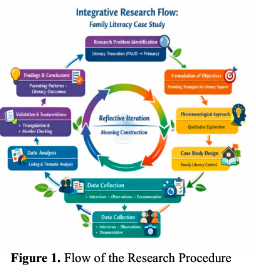
The transition from Early Childhood Education (or PAUD in the Indonesian context) to elementary school is a pivotal stage where children shift from "learning to read" to "reading to learn." This study examines the role of family parenting styles in enhancing children's literacy skills during this critical phase. Utilizing a qualitative phenomenological approach, the research explores parents’ lived experiences in supporting the development of reading and writing at home. Data were collected through in-depth interviews, participatory observations, and documentation, then analyzed using thematic analysis. The findings indicate that democratic parenting styles significantly foster children’s intrinsic motivation and independence in literacy. Key practices, such as intensive verbal interactions, dialogic reading, and post-reading discussions, were found to enhance comprehension, narrative skills, and expressive language. Furthermore, purposeful digital media use, combined with active parental mediation, supports multimodal literacy development. Consistent reading routines and strong emotional involvement were identified as vital supporting factors, while limited parental time and a lack of age- appropriate materials emerged as primary barriers. The study concludes that family parenting is a decisive factor in bridging literacy gaps during the transition to elementary school. This research contributes to the literacy transition discourse by establishing a multifaceted family literacy framework specifically tailored for the transition from PAUD to primary schooling. These findings imply the necessity for a family literacy model that integrates democratic parenting, rich verbal interaction, and guided digital literacy to ensure children are prepared for increasing academic demands.
Downloads
Adolph, R. (2016). Development of mother tongue-based early literacy assessment tools for Ilokano children. Journal of Indonesian Student Confidentiality and Education (JISCEDU), 1(2), 141–154. https://jurnal.unai.edu/index.php/jiscedu/article/view/290
Aji, I. A. B., & Pujiastuti, P. (2022). Development of natural science supplement books based on local wisdom in integrative thematic learning in elementary schools. Jurnal Prima Edukasia, 10(1), 82– 95. DOI: https://doi.org/10.21831/jpe.v10i1.40173
Aljuhani, E. A. (2024). Rethinking the education of multilingual learners: A critical analysis of theoretical concepts. International Journal of Multilingualism, 21(4), 2347–2350. DOI: https://doi.org/10.1080/14790718.2023.2181352
Amalia, D. (2023). Optimising early childhood literacy development through the use of digital devices. Tinta Emas: Jurnal Pendidikan Islam Anak Usia Dini, 2(1), 23–32. DOI: https://doi.org/10.35878/tintaemas.v2i1.743
Azizah, I. N., & Nalole, S. R. (2025). Building a reading culture at home from an early age: A study on the role of the family in fostering early childhood literacy. Gentala Pendidikan Dasar, 9(2), 304– 313. https://online-journal.unja.ac.id/gentala/article/view/38246
Azmin, G. G., Widiatmoko, S., Nugraina, C. N., & Oktaviani, R. (2022). Literacy training and read- aloud storytelling for children in the Betawi reading community. Sarwahita, 19(2), 315–330. DOI: https://doi.org/10.21009/sarwahita.192.7
Chambers, B., Cheung, A. C., & Slavin, R. (2016). Literacy and language outcomes of comprehensive and developmental-constructivist approaches to early childhood education. Educational Research Review, 18, 88–111. DOI: https://doi.org/10.1016/j.edurev.2016.03.003
Dewi, K., Andari, W., Sari, A., Nuryanti, M., & Arfiyanti, R. (2025). Augmented reality and its use in elementary school education: A systematic literature review. Jurnal Prima Edukasia, 13(1), 128– 145. DOI: https://doi.org/10.21831/jpe.v13i1.75094
Duke, N. K., & Cartwright, K. B. (2017). The science of reading progresses: Communicating advances beyond the simple view of reading. Reading Research Quarterly, 56(S1), 25–44. DOI: https://doi.org/10.1002/rrq.411
Flewitt, R. (2019). Young children’s digital literacy practices in homes: Past, present and future researchdirections. In The Routledge Handbook of Digital Literacies in Early Childhood. Routledge.
Fono, M., & dkk. (2022). The roles of parents in preventing bullying behavior in children at aged 5-6 years old. International Journal of Education & Curriculum Application, 5(3), 289–297. DOI: https://doi.org/10.31764/ijeca.v5i3.11145
Gazali, M., & Ningsih, D. P. (2025). Evaluation of the implementation of a local wisdom based primary school literacy programme in Central Lombok. Primary: Journal of Multidisciplinary Research, 1(5). DOI: https://doi.org/10.70716/pjmr.v1i5.326
Hamilton, L. G., Hayiou-Thomas, M. E., & Hulme, C. (2016). The home literacy environment as a predictor of the early literacy development of children at family-risk of dyslexia. Scientific Studies of Reading, 20(5), 401–419. DOI: https://doi.org/10.1080/10888438.2016.1213266
Hirai, D. L. C., Borrego, I., Garza, E., & Ahnee-Benham, K. C. (2009). Literacy strategies for adolescents: A how-to manual for educators. Routledge.
Inten, D. N., Mulyani, D., & Aziz, H. (2023). Mothers’ strategies in fostering literacy among children aged 5–6 years. Jurnal Obsesi: Jurnal Pendidikan Anak Usia Dini, 7(3), 2999–3012. DOI: https://doi.org/10.31004/obsesi.v7i3.4498
Justice, L. M., Jiang, H., & Strasser, K. (2018). Linguistic environment of preschool classrooms: What dimensions support children’s language growth? Early Childhood Research Quarterly, 42(1), 79– 92. DOI: https://doi.org/10.1016/j.ecresq.2017.09.003
Kamonthip, K., & Kongprasertamorn, K. (2009). Local wisdom, environmental protection and community development: The clam farmers in Tambon Bangkhunsai, Phetchaburi Province, Thailand. MANUSYA: Journal of Humanities, 10(1), 1–10. DOI: https://doi.org/10.1163/26659077-01001001
Kennedy, E., Dunphy, E., & Dwyer, B. (n.d.). Literacy in early childhood and primary education (3-8 years). National Council for Curriculum and Assessment.
Lonigan, C. J., Burgess, S. R., & Schatschneider, C. (2018). Examining the simple view of reading with elementary school children: Still simple after all these years. Remedial and Special Education, 39(5), 260–273. DOI: https://doi.org/10.1177/0741932518764833
Mol, S. E., & Bus, A. G. (2011). To read or not to read: A meta-analysis of print exposure from infancy to early adulthood. Psychological Bulletin, 137(2), 267–296. DOI: https://doi.org/10.1037/a0021890
Pancawati, N., & Widayati, M. (2024). The implementation of digital educational games in the development of early childhood reading and writing literacy skills. Journal of Education Action Research, 8(4), 624–635. DOI: https://doi.org/10.23887/jear.v8i4.86023
Paris, S. G. (2011). Reinterpreting the development of reading skills. Reading Research Quarterly, 40(2), 184–202. DOI: https://doi.org/10.1598/RRQ.40.2.3
Prastiti, M. R., & Adi, B. S. (2024). Science digital library: Innovation in improving science literacy of elementary school students. Jurnal Prima Edukasia, 12(2), 216–227. DOI: https://doi.org/10.21831/jpe.v12i2.64687
Psyridou, M., Tolvanen, A., De Jong, P. F., Lerkkanen, M.-K., Poikkeus, A.-M., & Torppa, M. (2021). Developmental profiles of reading fluency and reading comprehension from grades 1 to 9 and their early identification. Developmental Psychology, 57(11), 1840–1854. DOI: https://doi.org/10.1037/dev0000976
Lean, R. E., Paul, R. A., Smyser, C. D., & Rogers, C. E. (2017). Maternal intelligence quotient (IQ)predicts IQ and language in very preterm children at age 5 years. The Journal of Child Psychology and Psychiatry, 59(2), 150–159. DOI: https://doi.org/10.1111/jcpp.12810
Rahayu, E. W., & Mustadi, A. (2022). The read-aloud method to develop reading literacy at the school’s educational park. Jurnal Prima Edukasia, 10(2), 104–113. DOI: https://doi.org/10.21831/jpe.v10i2.41364
Rakhmawati, Y., & Mustadi, A. (2022). The circumstances of literacy numeracy skill: Between notion and fact from elementary school students. Jurnal Prima Edukasia, 10(1), 9–18. DOI: https://doi.org/10.21831/jpe.v10i1.36427
Ratri, S. Y., & Aviyanti, L. (2025). Unlocking digital literacy in Indonesia: Insights from the use of social media platforms. Jurnal Prima Edukasia, 13(1), 191–200. DOI: https://doi.org/10.21831/jpe.v13i1.83433
Silinskas, G., Sénéchal, M., Torppa, M., & Lerkkanen, M. K. (2020). Home literacy activities and children’s reading skills, independent reading, and interest in literacy activities from kindergarten to grade 2. Frontiers in Psychology, 11, 1508. DOI: https://doi.org/10.3389/fpsyg.2020.01508
Solichah, N., & Fardana, N. A. (2023). Analysis of parental involvement in early literacy in Malang, Indonesia. Jurnal Obsesi: Jurnal Pendidikan Anak Usia Dini, 7(4), 4441–4450. DOI: https://doi.org/10.31004/obsesi.v7i4.4832
Suryanti, S., Mariana, N., Yermiandhoko, Y., & Widodo, W. (2020). Local wisdom based teaching material for enhancing primary students’ scientific literacy skill. Jurnal Prima Edukasia, 8(1), 51– 61. DOI: https://doi.org/10.21831/jpe.v8i1.32898
Torppa, M., Vasalampi, K., Eklund, K., & Niemi, P. (2022). Child long-term effects of the home literacy environment on reading development: Familial risk for dyslexia as a moderator. Journal of Experimental Child Psychology, 215, 105314. DOI: https://doi.org/10.1016/j.jecp.2021.105314
Hindman, A. H., & Wasik, B. A. (2011). Exploring Head Start teachers’ early language and literacy knowledge: Lessons from the ExCELL professional development intervention.NHSA Dialog, 14(4), 293-315. https://eric.ed.gov/?id=EJ951212
Winarni, E. W., & Purwandari, E. P. (2020). Project-based learning to improve scientific literacy for primary education postgraduate students in science subject. Jurnal Prima Edukasia, 8(1), 67–77. DOI: https://doi.org/10.21831/jpe.v8i1.29170
Wong, K. M., & Neuman, S. B. (2016). Educational media supports for preschool-aged English language learners. In R. E. Tremblay, M. Boivin, & R. D. Peters (Eds.), Encyclopedia on Early Childhood Development. http://www.child-encyclopedia.com/technology-early-childhood- education/according-experts/educational-media-supports-preschool-aged
Yin, R. K. (2014). Case study research: Design and methods (5th ed.). SAGE.
Yusuf, R., Arifin, A. M., Octaviana, U., Abbas, S., & Syawal, J. (2024). Integrating local wisdom in character education: A collaborative model for teachers, parents, and communities. Al-Ishlah: Jurnal Pendidikan, 16(3), 4226–4238. DOI: https://doi.org/10.35445/alishlah.v16i3.5271
Copyright (c) 2026 Yasinta Maria Fono, Elisabeth Tantiana Ngura , Ludgardis Wea

This work is licensed under a Creative Commons Attribution-ShareAlike 4.0 International License.
The copyright of the received article shall be assigned to the journal as the publisher of the journal. The intended copyright includes the right to publish the article in various forms (including reprints). The journal maintains the publishing rights to the published articles.

Jurnal Prima Edukasia by http://journal.uny.ac.id/index.php/jpe/index is licensed under a Creative Commons Attribution-ShareAlike 4.0 International License.