Understanding differentiated learning for primary education students as prospective teachers
Downloads
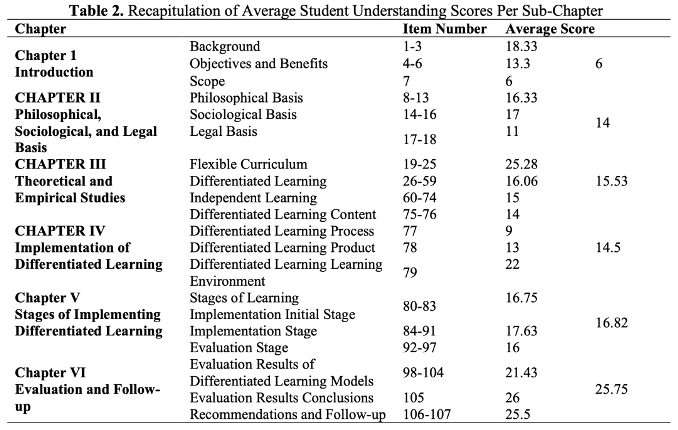
This study aims to measure the understanding of differentiated learning (DL) among primary education students as primary school teachers. Most research focuses on its implementation in schools, but rarely examines the extent to which prospective teachers are prepared to implement the curriculum. DL implementation in elementary and secondary education units is a particular concern for prospective teacher students. Curriculum changes also impact learning outcomes at the university level. Universities strive to produce outcomes that align with the needs of their respective fields. Teaching materials at universities need to adapt to DL as well. Students also need to become accustomed to new learning outcomes, namely being able to master, design, and practice all learning tools related to DL. The research method employed was a qualitative description, utilizing 107 multiple-choice questions. A total of 30 students became the subjects of this study. The questions given to students were adapted from the DL implementation book, which has six chapters. The score given was 1 for correct answers and 0 for incorrect ones. Therefore, each question received a score of 30 if it could be answered correctly by all students. The study’s results indicate that students’ understanding of DL remains low. The understanding of prospective teacher students in the PGSD study program, particularly at Khairun University, needs to be improved. Starting from the DL background, theoretical and empirical studies, and DL implementation, consisting of various types of grouping. For the scores obtained by students, 13 students achieved a correct score of 50% or above. If calculated overall, the classical achievement percentage was 43.33%.
Downloads
Abdullah, S., Nurharyanto, D. W., Hasanuddin, M. I., & Hasanuddin, M. I. (2024). Comprehension of elementary teacher education ’ s students as future teachers toward the implementation of the independent curriculum principles. Jurnal JPSD (Jurnal Pendidikan Sekolah Dasar), 11(2), 50–59. https://doi.org/10.26555/jpsd.v11i2.a29340
Al-Shaboul, Y., Al-Azaizeh, M., & Al-Dosari, N. (2021). Differentiated instruction between apllication and constraints: Teachers’ Perspective. European Journal of Educational Research, 10(1), 127–143. https://doi.org/10.12973/eu-jer.10.1.127
Aminuriyah, S., Imron, A., Ma, A., & Destya, A. (2023). A Case Study of Differentiated Instruction at Elementary School. Al-Ishlah: Jurnal Pendidikan, 15(4), 6227–6240. https://doi.org/10.35445/alishlah.v15i4.3860
Begum, S., & Ambreen, M. (2021). Differentiated Instruction Based on Formative Assessment in Associate Degree in Education Program. Journal of Educational Research, Dept. of Education, IUB, Pakistan, 24(1), 112–128.
Bunga, J. B., Olano, M. L. R., & Morga, M. R. (2025). Differentiated Instruction in Multigrade Classrooms : Bridging Theory and Practice. International Journal of Educational Methodology, 11(3), 377–390. https://doi.org/https://doi.org/10.12973/ijem.11.3.377
Dulfer, N., Saito, T., & McKernan, A. (2025). Differentiated instruction: an investigation into the effect of class compositional factors on teaching processes. Asia Pacific Education Review, 2002. https://doi.org/10.1007/s12564-025-10065-y
Eikeland, I., & Ohna, S. E. (2022). Differentiation in education: a configurative review. Nordic Journal of Studies in Educational Policy, 8(3), 157–170. https://doi.org/10.1080/20020317.2022.2039351
Fadil, A., & Aryani, I. K. (2021). Improvement of teacher pedagogical competence through in house training activities. DINAMIKA Jurnal Ilmiah Pendidikan Dasar, 13(2), 89–92. https://doi.org/https://doi.org/10.30595/Dinamika/v12i2.
Fadillah, Jabu, B., & Muhalim. (2024). Navigating Teaching Practicum in the Real Classroom: Insights from ESL Teaching Practicum Experiences. Research and Innovation in Applied Linguistics (RIAL), 2(2), 111–123. https://doi.org/https://doi.org/10.31963/rial.v2i2.4811
Fahrozi, I., & Sutikno, P. Y. (2024). Profiling Student Learning Styles to Design Differentiated Learning to Support Independent Learning. Journal of Education Action Research, 8(3), 459–467. https://doi.org/https://doi.org/10.23887/jear.v8i3.78669 Profiling
Fan, T., Song, J., & Guan, Z. (2021). Integrating diagnostic assessment into curriculum: a theoretical framework and teaching practices. Language Testing in Asia, 11(1). https://doi.org/10.1186/s40468-020-00117-y
Gedera, D. (2025). A Holistic Approach to Authentic Assessment. Asian Journal of Assessment in Teaching and Learning, 13(2), 23–34. https://doi.org/https://doi.org/10.37134/ajatel.vol13.2.3.2023
Gibbs, K. (2023). Voices in practice : challenges to implementing differentiated instruction by teachers and school leaders in an Australian mainstream secondary school. The Australian Educational Researcher, 50(4), 1217–1232. https://doi.org/10.1007/s13384-022-00551-2
Griful-Freixenet, J., Struyven, K., & Vantieghem, W. (2021). Exploring pre-service teachers’ beliefs and practices about two inclusive frameworks: Universal Design for Learning and differentiated instruction. Teaching and Teacher Education, 107, 103503. https://doi.org/10.1016/j.tate.2021.103503
Haelermans, C. (2022). The Effects of Group differentiation by students’ learning strategies. Instructional Science, 50(2), 223–250. https://doi.org/10.1007/s11251-021-09575-0
Hajis, S. A., & Othman, N. (2024). Navigating Challenges and Strategies in Implementing Differentiated Instruction : A Conceptual Overview. Inetranational Journal of Academic Research in Business & Social Sciences, 14(8), 1182–1199. https://doi.org/10.6007/IJARBSS/v14-i8/22153
Hastomo, A. (2024). The Development of Educational Practice Lecture Models to Prepare Adaptive and Innovavtive 21st-Century Primary School Teachers. Jurnal Prima Edukasia, 12(2), 177–182.
Kara, S., & Tekindur, A. (2025). The Effect of Differentiated Instruction on the Academic Achievement and Opinions of 3rd-Grade Students in Science Education : A Mixed-Methods Study. Journal of Intelligence, 13(126), 1–28. https://doi.org/https://doi.org/10.3390/jintelligence13100126
Kibble, J. D. (2017). Best practices in summative assessment. Advances in Physiology Education, 41(1), 110–119. https://doi.org/10.1152/advan.00116.2016
Magableh, I. S. I. (2020). The Effectiveness of Differentiated Instruction by Streaming: A preliminary Study of Current Practices in the UAE. International Journal of Learning, Teaching and Educational Research, 19(6), 95–110. https://doi.org/https://doi.org/10.26803/ijlter.19.6.6
Molina-muñoz, D., Contreras-garcía, J. M., & Molina-portillo, E. (2025). Understanding Educational Inequality in Spain : Factors Influencing Low and High Mathematical Competence. Social Sciences, 14(463). https://doi.org/https://doi.org/ 10.3390/socsci14080463
Mustadi, A., Wibowo, S. E., Zubaidah, E., Supartinah, S., Sugiarsih, S., & Sayekti, O. M. (2024). Needs analysis of project based teaching module development in the independent curriculum. Jurnal Prima Edukasia, 12(1), 52–60. https://doi.org/10.21831/jpe.v12i1.66933
Musyarrofah, H., Kurniawati, A. A., Sidiq, Ahmad Asad, A., & Fadlillah, A. (2024). Differentiated instruction in ELT: Indonesian preservice and in- service teachers’ capabilities, strategies, and barriers. Journal of English Education and Linguistics Studies, 11(2), 877–906. https://doi.org/10.30762/jeels.v11i2.2847 Submission:
Nepal, S., Walker, S., & Dillon-Wallace, J. (2024). How do Australian pre-service teachers understand differentiated instruction and associated concepts of inclusion and diversity? International Journal of Inclusive Education, 28(2), 109–123. https://doi.org/10.1080/13603116.2021.1916111
Nirmala, S. D., Firdaus, F. M., Ramdhani, S., & Hidayat, A. R. (2025). Differentiated Learning Activities : How Does It Impact Students ’ Literacy ? Jurnal Prima Edukasia, 13(1), 169–180.
Pangestuningtyas, D., Gunansyah, G., & Mariana, N. (2025). Analysis of Diagnostic Assessment in the Science Subject for 4th Grade Elementary School. Science Education Journal, 9(1), 23–36. https://doi.org/10.21070/sej.v
Prastika, B. A., Senen, A., & Cahya, R. D. (2023). Immersive Pop-Up Books: Enhancing Disaster Awareness in the merdeka Curriculum. Jurnal Pima Edukasia, 11(2), 186–196.
Purba, M., Purnamasari, N., Soetantyo, S., Suwarna, I. R., & Susanti, E. I. (2021). Naskah Akademik Prinsip Pengembangan Pembelajaran Berdiferensiasi (Differentiated Instruction) Pada Kurikulum Fleksibel Sebagai Wujud Merdeka Belajar (1st ed.). Pusat Kurikulum dan Pembelajaran, Badan Standar, Kurikulum, dan Asesmen Pendidikan, Kementerian Pendidikan, Kebudayaan, Riset, dan Teknologi, Republik Indonesia.
Putri, K., & Elizar. (2025). Implementing a Differentiation Approach in Teaching to Accommodate Diverse Learning Styles Of Primary School Students : A Systematic Literature Review. Journal for Lesson and Learning Studies, 8(1), 119–128. https://doi.org/https://doi.org/10.23887/jlls.v8i1.89659
Rakhmawati, D., Kawuryan, S. P., & Adi, B. S. (2024). In-House Training : Improving Teacher Skills in Implementing Problem-Based Learning. 12(20), 99–110.
Ramaila, S. (2025). Unveiling the Potential : A Systematic Review on Harnessing the Affordances of Differentiated Instruction Unveiling the Potential : A Systematic Review on Harnessing the Affordances of Differentiated Instruction. Journal of Teaching and Learning, 19(2), 41–56. https://doi.org/https://doi.org/10.22329/jtl.v19i2.8561
Ramdhani, S., Nurcahyono, N. A., & Dewi, S. (2025). Designing Interactive E-Modules Based on Differentiated Instruction and the Theory of Didactical Situations for Primary Mathematics Education. Educational Process: International Journal, 17, 1–23. https://doi.org/https://doi.org/10.22521/edupij.2025.17.368 Designing
Romine, R. S., Schuster, J., Karvonen, M., Thompson, W. J., Erickson, K., Simmering, V., & Bechard, S. (2025). Learning Maps as Cognitive Models for Instruction and Assessment. Education Sciences, 15(3), 1–26. https://doi.org/https://doi.org/10.3390/ educsci15030365
Sandy, M. A. F., & Putri, N. S. E. (2024). Capturing pseudo-innovation in ELT : The analysis of implementing differentiated learning to suburban private madrasahs. English Language Teaching Educational Journal, 7(2), 124–138.
Setambah, M. A. B., Saad, M. I. M., Ghazali, N. H. binti C. M., & Adnan, M. (2025). A comprehensive synthesis of differentiated instruction approaches in mathematics. LUMAT: International Journal on Math, Science and Technology Education, 12(4), 3. https://doi.org/10.31129/lumat.12.4.2371
Sianturi, T. J. A. U., Suryadi, Santoso, B., & Fatwa, A. D. S. (2025). Impact of Teachers’ Understanding and Merdeka Curriculum Implementation on Teacher Competence and Student Academic Performance. Journal of Ecohumanism, 4(2), 757–774. https://doi.org/10.62754/joe.v4i2.6346
Spyropoulou, E., & Wallace, M. (2025). Differentiated Education Using Technology in Junior and High School Classrooms. Encyclopedia, 5(71), 1–14. https://doi.org/https://doi.org/10.3390/ encyclopedia5020071
Subban, P., Suprayogi, M. N., Preston, M., Liyani, A. N., & Ratri, A. P. P. (2025). “Differentiation is Sometimes a Hit and Miss”. Educator Perceptions of Differentiated Instruction in the Higher Education Sector. Asia-Pacific Education Researcher, 34(3), 873–884. https://doi.org/10.1007/s40299-024-00904-8
Tajik, O., Noor, S., & Golzar, J. (2024). Investigating differentiated instruction and the contributing factors to cater EFL students’ needs at the collegial level. Journal of Modern Research in English Language Studies, 4(1), 69–87. https://doi.org/10.1186/s40862-024-00299-5
Tomlinson, C. A. (2014). The differentiated classroom. Pearson Education, Inc.
van Vijfeijken, M., van Schilt-Mol, T., van den Bergh, L., Scholte, R. H. J., & Denessen, E. (2023). How teachers handle differentiation dilemmas in the context of a school’s vision: A case study. Cogent Education, 10(1), 1–21. https://doi.org/10.1080/2331186X.2023.2165006
Copyright (c) 2026 Suhardi Abdullah, Dwi Widyastuti Nurharyanto, M. Irfan Hasanuddin , Eka Agustina, Kyla Putri Nursyabani

This work is licensed under a Creative Commons Attribution-ShareAlike 4.0 International License.
The copyright of the received article shall be assigned to the journal as the publisher of the journal. The intended copyright includes the right to publish the article in various forms (including reprints). The journal maintains the publishing rights to the published articles.

Jurnal Prima Edukasia by http://journal.uny.ac.id/index.php/jpe/index is licensed under a Creative Commons Attribution-ShareAlike 4.0 International License.