
Teachers’ and Parents’ Roles in Addressing Learning Difficulties of Students with Autism
Downloads
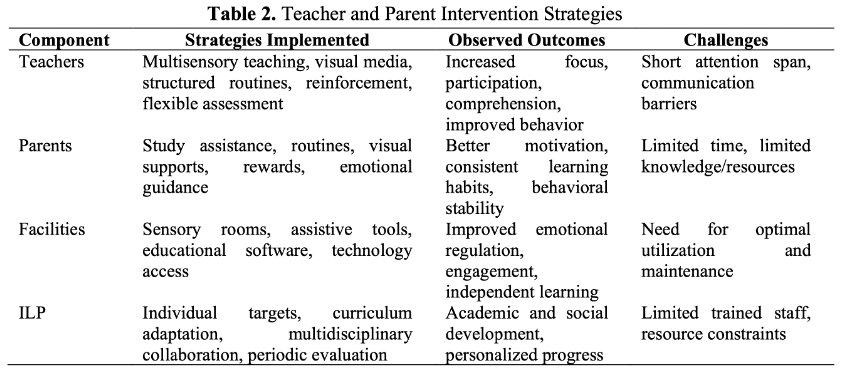
This study aims to describe the roles of teachers and parents in overcoming the learning difficulties of autistic students at Muara Bungo Special Elementary School. A qualitative case study design was employed involving the school principal, classroom teachers, parents, and second-grade students with autism. Data were collected through classroom observations, semi-structured interviews, and document analysis, and were analyzed using the Miles and Huberman interactive model, including data reduction, display, and verification. Triangulation techniques were applied to ensure credibility and validity. The findings reveal four interconnected factors that contribute to reducing learning difficulties: teachers' adaptive instructional practices, active parental involvement at home, supportive school facilities, and the implementation of Individualised Learning Programs (ILP). Teachers applied multisensory and visual-based strategies, structured routines, and positive reinforcement, which improved students’ attention, participation, and comprehension. Parents supported learning through consistent guidance, home routines, and emotional encouragement, promoting continuity between school and home. Sensory-friendly facilities and assistive technologies enhanced students’ emotional regulation and engagement, while ILPs enabled personalized academic and social development. Thesynergy among teachers, parents, and school resources was found to be essential for addressing students’ diverse needs. These results imply that strengthening teacher–parent collaboration, providing professional training, and optimizing individualized and resource-based support systems are critical for improving educational outcomes for autistic students in special and inclusive elementary settings.
Downloads
Abuk, S. D. A., Wardany, O. F., & Herlina, H. (2025). The role of parents in helping develop self- development skills in autistic children. Jurnal Basicedu, 9(1), 357–365. DOI: https://doi.org/10.31004/basicedu.v9i1.9762
Alnahdi, G. H. (2020). Assistive technology in special education: A review of research. Journal of Special Education Technology, 35(3), 140–151. DOI: https://doi.org/10.1177/0162643420919351
Altiere, M. J., & von Kluge, S. (2009). Family functioning and coping behaviors in parents of children with autism. Journal of Child and Family Studies, 18(1), 83–92. DOI: https://doi.org/10.1007/s10826-008-9219-2
Amalia, N., Mahdum, M., & Afrianto, A. (2021). Challenges and strategies in teaching students with autism spectrum disorder.Jurnal PAJAR (Pendidikan dan Pengajaran), 5(1), 87–95. DOI: https://doi.org/10.33578/pjr.v9i4.121
Azad, G. F., Kim, M., Marcus, S. C., Mandell, D. S., & Sheridan, S. M. (2016). Parent–teacher communication about children with autism spectrum disorder: An examination of collaborative problem solving. Psychology in the Schools, 53(10), 1071–1084. DOI: https://doi.org/10.1002/pits.21976
Azad, G. F., Kim, M., Marcus, S. C., Mandell, D. S., & Sheridan, S. M. (2018). Partners in School: An innovative parent–teacher consultation model for children with autism spectrum disorder. Journal of Educational and Psychological Consultation, 28(4), 460–486. DOI: https://doi.org/10.1080/10474412.2018.1431550
Blue-Banning, M., Summers, J. A., Frankland, H. C., Nelson, L. L., & Beegle, G. (2004). Dimensions of family and professional partnerships: Constructive guidelines for collaboration. Exceptional Children, 70(2), 167–184. DOI: https://doi.org/10.1177/001440290407000203
Chiang, H. M., Cheung, Y. K., & Chung, K. K. (2016). Effectiveness of individualized educational programs for children with autism in inclusive settings. Research in Autism Spectrum Disorders, 23, 87–98. DOI: https://doi.org/10.1016/j.rasd.2015.12.005
Creswell, J. W., & Poth, C. N. (2018). Qualitative Inquiry and Research Design: Choosing Among Five Approaches (4th ed.). SAGE Publications.
Denzin, N. K. (2012). Triangulation 2.0. Journal of Mixed Methods Research, 6(2), 80–88. DOI: https://doi.org/10.1177/1558689812437186
Eaves, L. C., & Ho, H. H. (2008). Young adult outcomes of autism spectrum disorders. Journal of Autism and Developmental Disorders, 38(4), 739–747. DOI: https://doi.org/10.1007/s10803-007- 0441-x
Fernández-Batanero, J. M., Román-Graván, P., & Reyes-Rebollo, M. M. (2023). Teacher training in inclusive digital competence for students with autism. Education and Information Technologies, 28(4), 4123–4140. DOI: https://doi.org/10.48550/arXiv.2601.06058
Fitri, S. S., & Somantri, S. (2022). Efforts to teach social interaction to autism students in inclusive elementary schools.Pedagonal: Jurnal Ilmiah Pendidikan, 6(2), 134–142. DOI: https://doi.org/10.55215/pedagonal.v6i1.4443
Ganz, J. B., Earles-Vollrath, T. L., Heath, A. K., Parker, R. I., Rispoli, M. J., Duran, J. B., & Dixon, D. R. (2012). Effects of individualized interventions on academic and social outcomes of students with autism spectrum disorders. Journal of Autism and Developmental Disorders, 42(10), 2016– 2028. DOI: https://doi.org/10.1007/s10803-012-1450-9Gurung, R. A. R. (2022). Supporting resilience and motivation in children with autism. International Journal of Developmental Disabilities, 68(4), 523–531. DOI: https://doi.org/10.1080/20473869.2021.1902456
Hart, S., & Whalon, K. (2012). Building family–school partnerships in autism spectrum disorder: Parent perspectives and challenges. Research and Practice for Persons with Severe Disabilities, 37(3), 151–163. DOI: https://doi.org/10.2511/027494812804582537
Juran, S., McCauley, H., & Njelesani, J. (2019). Global estimates of disability prevalence: Implications for education systems. Disability and Health Journal, 12(3), 416–423. DOI: https://doi.org/10.1016/j.dhjo.2019.03.001
Karst, J. S., & Van Hecke, A. V. (2012). Parent and family outcomes of children with autism spectrum disorders. Journal of Autism and Developmental Disorders, 42(8), 1606–1615. DOI: https://doi.org/10.1007/s10803-011-1354-2
Karst, J. S., & Van Hecke, A. V. (2015). Parent and family outcomes of PEERS: A social skills intervention for adolescents with autism spectrum disorder. Journal of Autism and Developmental Disorders, 45(3), 752–765. DOI: https://doi.org/10.1007/s10803-014-2231-6
Khimolasari, S., & Lutfiatin, D. I. (2024). The importance of the role of teachers in developing social interactions in autistic children at elementary school level. PPSDP Undergraduate Journal of Educational Sciences, 1(1), 138–153. DOI: https://doi.org/10.59175/pujes.v1i1.224
Kinnealey, M., Pfeiffer, B., Miller, L. J., Roan, C., & Shoener, R. (2012). Effect of classroom modification on the attention and engagement of students with autism spectrum disorder. American Journal of Occupational Therapy, 66(5), 511–519. DOI: https://doi.org/10.5014/ajot.2012.004093
Koegel, R. L., Koegel, L. K., Ashbaugh, K., & Bradshaw, J. (2013). The importance of teacher training in individualized programs for children with autism. Topics in Language Disorders, 33(4), 328– 343. DOI: https://doi.org/10.1097/TLD.0b013e3182a9d5b1
Kurnia, I. R., Kirana, P., Setiawan, A. A., Wandira, P. A., & Darmawan, A. S. (2025). Teacher strategies in supporting autistic children with an effective approach at Ananda Mandiri Special Needs School. Didaktik: Jurnal Ilmiah PGSD STKIP Subang, 10(4). DOI: https://doi.org/10.36989/didaktik.v10i04.5106
Linawati, L., & Dirgahayunita, A. (2025). The role of teachers and parents in building independent character in early childhood autism at RA Miftahul Ulum Probolinggo. YASIN, 5(1), 570– 586. DOI: https://doi.org/10.58578/yasin.v5i1.4940
Meliyana, Choiriyah, & Priendarningtyas, A. (2025). The role of accompanying teachers and parents in increasing the learning focus of autistic children through gross motor activities. Jurnal Caksana: Pendidikan Anak Usia Dini, 8(2), 754–761. DOI: https://doi.org/10.31326/jcpaud.v8i2.2451
Minke, K. M., Sheridan, S. M., Kim, E. M., Ryoo, J. H., & Koziol, N. A. (2014). Congruence in parent– teacher relationships and students’ academic and social outcomes. School Psychology Review, 43(4), 361–377. DOI: https://doi.org/10.1086/675637
Mirna, & Chamidah, A. N. (2025). Collaborative roles of teachers and parents in supporting students with special needs. Indonesian Journal of Innovation Studies, 26(4), 1764. DOI: https://doi.org/10.21070/ijins.v26i4.1764
Muliadi, M., Tsaputra, A., Rahmahtrisilvia, R., Nurhastuti, N., & Amani, R. (2025). Parental role in supporting inclusive education for children with autism. Indonesian Journal of Educational Development (IJED), 6(3), 832–844. DOI: https://doi.org/10.59672/ijed.v6i3.5351Nur, F. A. S., & Wirza, F. R. (2025). The role of collaboration between parents and schools in optimizing the behavioral development of children with autism spectrum disorder (ASD). Causalita: Journal of Psychology, 3(3), 595. DOI: https://doi.org/10.62260/causalita.v3i3.595
O’Connell, M. E., & Berger, E. (2025). Understanding children with special needs: Educational and developmental perspectives.Journal of Special Needs Education, 10(1), 1–12. DOI: https://doi.org/10.1007/s11218-024-09984-2
Odom, S. L., Hall, L. J., Morin, K. L., et al. (2021). Educational interventions for children and youth with autism: A 40 year perspective. Journal of Autism and Developmental Disorders, 51, 4354– 4369. DOI: https://doi.org/10.1007/s10803-021-04990-1
Octaviani, R. A. R., Tasyariefah, R., Ayu, D. P., Qurrotu, A. F., Ardianingsih, F., & Pamuji, P. (2025). Effective strategies to improve the behavior and cognitive abilities of autistic children in the learning process. Jurnal Pendidikan dan Pembelajaran Indonesia (JPPI), 5(3). DOI: https://doi.org/10.53299/jppi.v5i3.1618
Schreibman, L., Dawson, G., Stahmer, A. C., Landa, R., Rogers, S. J., McGee, G. G., ... & Halladay, A. (2015). Naturalistic developmental behavioral interventions: Empirically validated treatments for autism spectrum disorder. Journal of Autism and Developmental Disorders, 45, 2411–2428. DOI: https://doi.org/10.1007/s10803-015-2407-8
Shalehah, N., Suminar, T., & Diana, D. (2024). Teacher strategies in improving the social skills of children with Autistic Spectrum Disorder (ASD). Jurnal Obsesi: Jurnal Pendidikan Anak Usia Dini, 7(5). DOI: https://doi.org/10.31004/obsesi.v7i5.5287
Simpson, R. L. (2005). Evidence based practices and students with autism spectrum disorders. Focus on Autism and Other Developmental Disabilities, 20(3), 140–149. DOI: https://doi.org/10.1177/10883576050200030201
Simpson, R. L., de Boer-Ott, S. R., & Smith-Myles, B. (2003). Inclusion of learners with autism spectrum disorders in general education settings. Topics in Language Disorders, 23(2), 116– 133. DOI: https://doi.org/10.1097/00011363-200304000-00007
Syriopoulo, D. C. K., Cassimos, D. C., & Polychronopoulou, S. A. (2016). Collaboration between teachers and parents of children with ASD on issues of education. Research in Developmental Disabilities, 55, 330–345. DOI: https://doi.org/10.1016/j.ridd.2016.04.011
Tonge, B., Brereton, A., Kiomall, M., Mackinnon, A., & Rinehart, N. J. (2014). A randomised group comparison controlled trial of preschoolers with autism: Parent education and skills training intervention for young children with autistic disorder. Autism, 18(2), 166–177. DOI: https://doi.org/10.1177/1362361312458186
Wang, Y., & Wang, L. (2024). Creativity and school engagement among children with autism spectrum disorder. Journal of Autism and Developmental Disorders, 54(2), 389–401. DOI: https://doi.org/10.1007/s10803-023-05921-4
Winata, S. (2025). Teacher strategies in managing inclusive classes for students with autism at the junior high school level. Journal of Primary Education Research, 3(2), 32–37. DOI: https://doi.org/10.57176/primer.v3i2.53
World Health Organization, & United Nations Children’s Fund. (2023). Autism spectrum disorders: Global prevalence and implications. WHO Press.
Yulianti, R. T., & Rudiyanto, R. (2024). The role of parents with children with autism. Aulad: Journal on Early Childhood, 7(3), 918–925. DOI: https://doi.org/10.31004/aulad.v7i3.798
Zeidan, J., Fombonne, E., Scorah, J., et al. (2022). Global prevalence of autism: A systematic review update. Autism Research, 15(5), 778–790. DOI: https://doi.org/10.1002/aur.2696
Copyright (c) 2025 Jurnal Prima Edukasia

This work is licensed under a Creative Commons Attribution-ShareAlike 4.0 International License.
The copyright of the received article shall be assigned to the journal as the publisher of the journal. The intended copyright includes the right to publish the article in various forms (including reprints). The journal maintains the publishing rights to the published articles.

Jurnal Prima Edukasia by http://journal.uny.ac.id/index.php/jpe/index is licensed under a Creative Commons Attribution-ShareAlike 4.0 International License.