PEER-REVIEW PROCESS
Peer Review Process
Only manuscripts of sufficient quality that meet the aims and scope of WUNY will be reviewed. The manuscript will be sent to at least two reviewers (double-blind peer review). At their discretion, the reviewer may opt to reveal their name to the author in their review. However, our standard policy practice is for both identities to remain concealed.
The suggested decision will be evaluated in an editorial board meeting based on the reviewer's recommendation from several possibilities: rejected, requires major revision, requires minor revision, or accepted. Afterward, the editor will send the final decision to the corresponding author. All manuscripts are reviewed as rapidly as possible. The editors aim to reach an editorial decision within three months of submission.
Detailed information about the flow from manuscript submission (author) to acceptance by the editor is shown in the following figure.
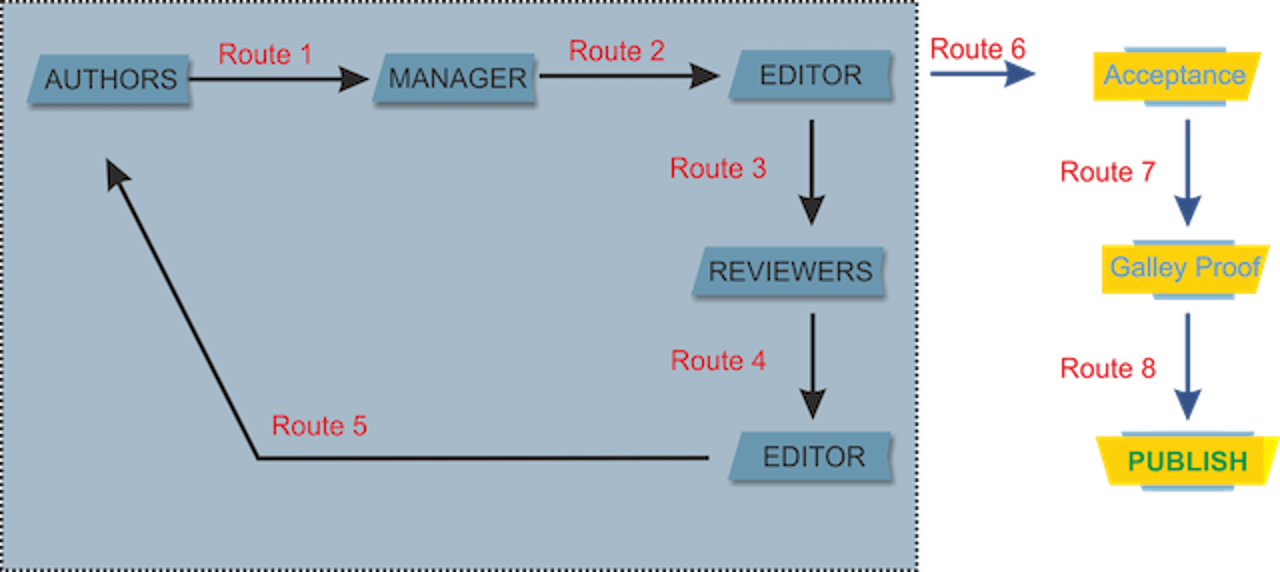
In short, the steps are:
- Manuscript Submission (by author) (route 1)
- Manuscript Check and Selection (by manager and editors) (route 2). Editors have the right to directly accept, reject, or review. Prior to further processing steps, a plagiarism check using Turnitin is applied for each manuscript.
- Manuscript Reviewing Process (by reviewers) (route 3-4)
- Notification of Manuscript Acceptance, Revision, or Rejection (by editor to author based on reviewers’ comments) (route 5)
- Paper Revision (by author)
- Revision Submission based on Reviewer Suggestion (by author) with a similar flow to point number 1. (route 1)
- If the reviewer seems to be satisfied with the revision, notification for acceptance (by editor). (route 6)
- Galley proof and publishing process (route 7 and 8)
The steps point number 1 to 5 are considered as 1 round of the peer-reviewing process (see the grey area in the figure). The editor or editorial board considers the feedback provided by the peer reviewers and arrives at a decision. The following are the most common decisions:
- Accepted, as is. The journal will publish the paper in its original form;
- Accepted with Minor Revisions, the journal will publish the paper and asks the author to make small corrections (let authors revise within a stipulated time);
- Accepted with Major Revisions, the journal will publish IF the paper provided the authors make the changes suggested by the reviewers and/or editors (let authors a stipulated time to revise);
- Resubmit (conditional rejection): the journal is willing to reconsider the paper in another round of decision-making after the authors make major changes;
- Rejected (outright rejection): the journal will not publish the paper or reconsider it even if the authors make major revisions.
Peer Review Policy
This journal uses double-blind peer review, which means that the reviewers of the paper won’t get to know the identity of the author(s), and the author(s) won’t get to know the identity of the reviewer. The idea is that everyone should get a similar and unbiased review.
Reviewers’ Responsibilities
(http://publicationethics.org/files/u7140/Peer%20review%20guidelines.pdf)
If WUNY’s Editor has invited you to review a manuscript, please consider the following items:
- Reviewing the manuscript critically but constructively and preparing detailed comments about the manuscript to help authors improve their research;
- Reviewing multiple versions of a manuscript as necessary;
- Providing all required information within established deadlines;
- Making recommendations to the editor regarding the suitability of the manuscript for publication in the journal;
- Declaring to the editor any potential conflicts of interest with respect to the authors or the content of a manuscript they are asked to review;
- Reporting possible research misconduct;
- Suggesting alternative reviewers in case they cannot review the manuscript for any reason;
- Treating the manuscript as a confidential document;
- Not making any use of the work described in the manuscript;
- Not communicating directly with authors, if somehow they identify the authors;
- Not identifying themselves to authors;
- Not passing on the assigned manuscript to another reviewer;
- Ensuring that the manuscript is of high quality and original research;
- Informing the editor if he/she finds that the assigned manuscript is under consideration in any other publication to his/her knowledge;
- Writing a review report in English only;
- Authoring a commentary for publication related to the reviewed manuscript.
What should be checked while reviewing a manuscript?
- Novelty;
- Originality;
- Scientific reliability;
- A valuable contribution to science;
- Adding new aspects to the existed field of study;
- Ethical aspects;
- Structure of the article submitted and its relevance to authors’ guidelines;
- References provided to substantiate the content;
- Grammar, punctuation, and spelling;
- Scientific misconduct.