
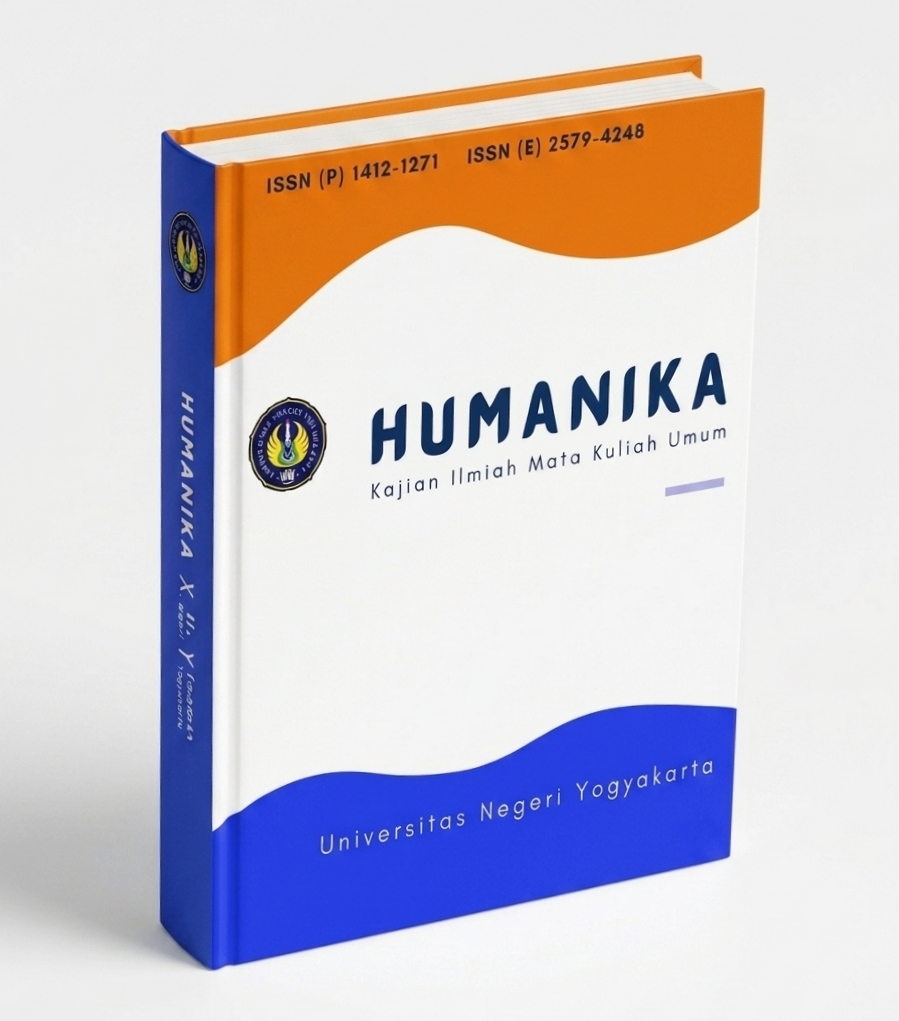
Reviewer Guidelines
HUMANIKA · EDITORIAL GUIDELINES
Reviewer Guidelines
Guidance for reviewers on accepting invitations, evaluating manuscripts, preparing constructive review reports, and maintaining ethical standards throughout the peer-review process at HUMANIKA: Kajian Ilmiah Mata Kuliah Umum.
Published by Universitas Negeri Yogyakarta, Indonesia
01. About Reviewing for HUMANIKA
Reviewers play an essential role in maintaining the quality, originality, relevance, and academic integrity of manuscripts submitted to HUMANIKA. Their evaluations assist the editors in making informed editorial decisions and help authors improve the clarity, rigour, and contribution of their work.
HUMANIKA applies a double-anonymous peer-review process. The identities of authors and reviewers are kept anonymous during the review process, and manuscripts considered suitable for external review are evaluated by at least two reviewers. Editorial decisions are made by the editor after considering the review reports and the journal's requirements.
Review Model
Double-Anonymous Review
Authors and reviewers should not attempt to identify one another during the review process.
Reviewer Assignment
At Least Two Reviewers
Manuscripts selected for external peer review are assessed by a minimum of two reviewers.
Review Submission
Through OJS
Review reports and recommendations should be submitted through the journal's online editorial system.
Review deadline: Please follow the deadline stated in the review invitation or communicated by the editor. If you need additional time, request an extension before the deadline.
These guidelines apply to original research articles, review and conceptual articles, and systematic literature reviews submitted to HUMANIKA.
02. Before You Accept a Review Invitation
Before accepting an invitation, reviewers should consider whether they can evaluate the manuscript competently, independently, and within the required timeframe.
Subject Expertise
Accept only manuscripts that fall within your area of expertise or professional competence. If you can evaluate only certain aspects of the manuscript, inform the editor before accepting or explain the limits of your assessment in the review.
Time and Availability
Confirm that you can complete the review by the deadline specified in the invitation. If your schedule does not permit a timely review, decline promptly or request an extension before accepting or before the deadline, as appropriate.
Conflict of Interest
Disclose relevant personal, professional, institutional, financial, or academic relationships that could compromise or appear to compromise your impartiality. Decline the invitation when an independent assessment cannot reasonably be provided.
Previous Review
Inform the editor if you have previously reviewed the same manuscript for another journal or have other relevant prior involvement. The editor will determine whether this affects the current review.
If you decline an invitation, respond promptly. You may suggest alternative qualified reviewers, provided that your suggestions are appropriate and free from conflicts of interest.
03. Confidentiality and Generative AI
Peer review is a confidential, independent scholarly process. Reviewers must protect the manuscript, supplementary files, review reports, and editorial communications entrusted to them.
HUMANIKA's Generative AI Policy
Reviewers must not upload submitted manuscripts, manuscript excerpts, supplementary files, review reports, or confidential communications into generative AI systems. They must not use generative AI to conduct, formulate, or determine the scientific assessment of a manuscript.
Reviewers must:
- Keep the manuscript and all associated materials confidential. Do not share, distribute, or discuss them with unauthorised individuals.
- Not upload manuscript content or confidential editorial information to generative AI tools.
- Not use generative AI to perform or formulate their scientific assessment or prepare reviewer comments.
- Not attempt to identify the authors or contact them directly about the manuscript.
- Not use unpublished data, arguments, methods, or findings from the manuscript for personal, professional, or research advantage.
- Notify the editor if a confidentiality breach or another relevant ethical concern arises during the review.
04. Step-by-Step Review Process
Reviewers should complete the assessment through the HUMANIKA Open Journal Systems (OJS) platform and follow the instructions provided in the invitation.
1
Open the Invitation
Read the invitation email, review the manuscript title and abstract, and note the review deadline. Follow the provided link or sign in to the journal system.
2
Accept or Decline
Confirm your availability and expertise. Declare any potential conflict of interest and inform the editor if you have relevant prior involvement with the manuscript.
3
Read the Review Instructions
Review these guidelines, the journal's editorial policies, and any specific assessment questions displayed in OJS.
4
Evaluate the Manuscript
Download the anonymised manuscript and any supplementary materials. Assess the manuscript using the criteria in Section 05. If preparing an annotated file, ensure that your name and other identifying information are removed from the document and its properties.
5
Write the Review Report
Provide constructive comments for the authors and place confidential remarks for the editor in the appropriate separate field. Distinguish essential revisions from minor editorial suggestions.
6
Make a Recommendation
Select the recommendation that best reflects your assessment, such as acceptance, minor revisions, major revisions, or rejection, according to the options available in OJS.
7
Submit and Confirm
Check that all comments and the recommendation are complete, then submit the review through OJS. Retain the confirmation provided by the system.
8
Request an Extension if Needed
If you cannot complete the review by the stated deadline, contact the editor before it expires. Extensions are subject to editorial approval.
05. What to Assess
Review the manuscript as a scholarly contribution to HUMANIKA's multidisciplinary scope, including education, social sciences, religious studies, and related interdisciplinary issues.
| Assessment Area | Questions for Reviewers |
|---|---|
| Scope and Contribution | Does the manuscript fit HUMANIKA's focus and scope? Does it make a clear, original, and meaningful scholarly contribution? |
| Title and Abstract | Do the title and abstract accurately represent the research problem, approach, principal findings, and conclusions? |
| Introduction and Research Problem | Is the problem clearly formulated? Are the objectives and research questions stated? Is the research gap sufficiently justified? |
| Literature and Theoretical Framework | Is the literature relevant, credible, and adequately current? Are the theoretical foundations appropriate and critically discussed? |
| Methods | Are the research design, data sources, participants, sampling, instruments, procedures, and analysis appropriate and sufficiently transparent? |
| Findings and Analysis | Are the findings clearly presented and supported by the evidence? Are tables, figures, quotations, or statistical results used appropriately? |
| Discussion | Are the findings interpreted critically in relation to previous research and relevant theories? Does the discussion explain the significance of the results? |
| Conclusion and Implications | Do the conclusions follow from the findings? Are the contribution, limitations, and implications for future research or practice adequately explained? |
| Research Ethics | Where relevant, are ethical approval, informed consent, participant protection, data integrity, funding, competing interests, and AI-use disclosures addressed? |
| References | Are citations accurate and complete? Are sources relevant and credible? Do references comply with HUMANIKA's current author guidelines? |
| Presentation and Clarity | Is the manuscript logically organised, clearly written, and presented in an appropriate academic style? Are tables and figures clear and necessary? |
Important: Evaluate a manuscript according to its research questions, design, disciplinary context, and stated contribution. Do not reject a valid methodological approach simply because it differs from your own research tradition.
06. Guidance by Manuscript Type
HUMANIKA receives original research and review or conceptual articles. Systematic literature reviews should also be assessed according to the methodological requirements applicable to that type of article.
A. Quantitative Research
- Assess the clarity of the research questions or hypotheses.
- Evaluate the appropriateness of the research design, sample, and sampling procedure.
- Check the validity and reliability of instruments where applicable.
- Assess whether statistical methods are suitable for the data and research questions.
- Check whether results are reported transparently and interpreted consistently with the evidence.
B. Qualitative Research
- Assess the clarity of the research questions and qualitative approach.
- Evaluate the selection of participants, cases, sites, and data sources.
- Check whether data collection and analysis are explained clearly.
- Assess credibility, trustworthiness, reflexivity, and ethical practice where relevant.
- Check whether quotations, observations, documents, or other evidence support the interpretations.
C. Mixed-Methods Research
- Assess the rationale for combining qualitative and quantitative approaches.
- Evaluate the quality of each methodological component.
- Check how the two forms of evidence are integrated.
- Assess whether the conclusions reflect the integrated findings.
D. Review and Conceptual Articles
- Assess the clarity and importance of the conceptual problem or review question.
- Evaluate the depth and critical quality of engagement with scholarship.
- Check the coherence of the theoretical argument or conceptual framework.
- For systematic reviews, assess the transparency of search, selection, and synthesis procedures.
- Evaluate the originality and significance of the article's contribution.
For systematic reviews, check whether PRISMA 2020 is followed where applicable. Assess reporting transparency and methodological suitability rather than relying on the presence of a checklist alone.
07. Writing the Review Report
A useful review report is balanced, specific, evidence-based, and constructive. It explains the strengths and weaknesses of the manuscript and provides clear guidance for improvement.
Recommended Report Structure
1
Brief manuscript summary
Summarise the research problem, approach, main argument or findings, and claimed contribution. This demonstrates that you have understood the manuscript.
2
Overall assessment
Identify the manuscript's principal strengths and the most important weaknesses affecting its quality, originality, validity, or contribution.
3
Major comments
Explain issues that materially affect the manuscript. For each issue, give a reason and a feasible suggestion for improvement.
4
Minor comments
Identify smaller issues involving wording, organisation, tables, figures, citations, references, or presentation. Give page or line numbers where possible.
5
Confidential comments to the editor
Use the designated confidential field for concerns that should not be communicated directly to the authors, including suspected misconduct or relevant conflicts of interest.
The recommendation to the editor should be consistent with the issues raised in the report. Do not introduce undisclosed requirements in confidential comments that fundamentally contradict your assessment presented to the authors.
Examples of Constructive Reviewer Comments
| Less Helpful Comment | More Constructive Comment |
|---|---|
| "The methodology is weak." | "The manuscript does not sufficiently explain how participants were selected. Please describe the sampling criteria and explain how the selected participants support the research objectives." |
| "The literature is outdated." | "The discussion relies mainly on older studies. Please consider relevant recent research to clarify how the manuscript advances current scholarship." |
| "The conclusion is not good." | "The conclusion introduces a claim that is not sufficiently supported by the findings. Please align the conclusion with the evidence or provide additional justification." |
08. Choosing a Recommendation
Reviewers provide recommendations to assist editorial decision-making. The editor retains responsibility for the final decision after considering the review reports, the manuscript, and the journal's policies.
Accept
The manuscript is original, methodologically sound, relevant to HUMANIKA, and makes a clear scholarly contribution. Only minor editorial or copyediting changes, if any, are needed.
Minor Revisions
The manuscript is generally sound and suitable for publication, subject to relatively limited changes involving clarity, presentation, references, or focused corrections that do not require substantial redevelopment of the study.
Major Revisions
The manuscript may become publishable but requires substantial improvement, such as stronger theoretical framing, more transparent methodology, additional analysis, substantial rewriting, or clarification of evidence and conclusions.
Reject
The manuscript has serious limitations that cannot reasonably be addressed through revision, falls outside the journal's scope, lacks a meaningful scholarly contribution, or presents substantial methodological or ethical concerns.
A recommendation should be based on the manuscript's scholarly quality and compliance with journal policy. It should not be based solely on the author's identity, institutional affiliation, nationality, or viewpoint.
09. Checklist Before Submitting Your Review
Before submitting the review in OJS, please confirm the following points.
- I have the expertise to assess the manuscript or have disclosed the limits of my expertise.
- I have disclosed any relevant conflicts of interest.
- I have maintained the confidentiality of the manuscript and editorial communications.
- I have not uploaded the manuscript, review report, or confidential materials to generative AI tools.
- I have not used generative AI to conduct or formulate my scientific assessment.
- My report addresses the manuscript's originality, relevance, theoretical foundation, methods, findings, ethics, references, and presentation as applicable.
- My major criticisms include reasons and practical suggestions for improvement.
- My comments are objective, respectful, and focused on the manuscript rather than the authors.
- My comments to the authors do not reveal my identity.
- Confidential concerns have been placed in the appropriate field for the editor.
- My recommendation is consistent with my written comments.
- I am submitting the review within the stated deadline or have obtained approval for an extension.
10. Tone and Professional Conduct
Reviewers are expected to maintain high standards of professionalism throughout the editorial process. Comments should support scholarly improvement while respecting differences in research traditions, disciplinary perspectives, and theoretical approaches.
- Be objective, respectful, specific, and evidence-based.
- Criticise the manuscript's arguments, methods, evidence, and interpretation rather than the author's personal characteristics or presumed motivations.
- Explain why a change is needed and, where possible, provide relevant evidence or scholarly references.
- Avoid discriminatory, insulting, threatening, or unnecessarily dismissive language.
- Do not demand citations to your own publications or particular journals unless they are genuinely relevant to the manuscript's argument.
- Respect methodological diversity and assess the manuscript according to its stated objectives and appropriate scholarly standards.
- Do not contact authors directly about the manuscript or attempt to influence the editorial decision outside the review process.
11. Suspected Research Misconduct
If a reviewer identifies possible plagiarism, fabricated or falsified data, duplicate publication, inappropriate authorship, undisclosed conflicts of interest, research ethics violations, citation manipulation, or potentially inappropriate AI use, the concern should be communicated to the editor.
How to report a concern
- Describe the concern clearly and identify the relevant page, passage, data, citation, or other evidence.
- Use the confidential comments field for suspected misconduct or other sensitive concerns.
- Do not independently investigate the authors, contact them about the allegation, or publicly discuss the case.
- Allow the editor to assess the evidence and determine the appropriate next steps under the journal's policies.
A concern should be reported in good faith. Honest errors, reasonable differences of interpretation, or disagreement with a theoretical perspective do not automatically constitute research misconduct.
12. Re-Review and Continuing Responsibility
When a revised manuscript is returned for further review, reviewers should evaluate the revised version against the substantive comments raised in the previous round.
- Read the authors' response to reviewers and assess whether each major concern has been addressed adequately.
- Identify comments that remain unresolved and explain why the revisions are insufficient.
- Avoid raising entirely new major issues unless they arise from the revision or are necessary to address a previously unrecognised substantive problem.
- Apply the same standards of fairness, confidentiality, methodological appropriateness, and scholarly rigour used in the initial review.
- Provide a recommendation consistent with the revised manuscript and the remaining concerns.
Reviewers contribute to the journal's continuing quality through careful, timely, and constructive assessments. Questions about assignments, deadlines, or review procedures should be directed to the HUMANIKA editorial team through the journal's official contact channels.
Related HUMANIKA Policies
Reviewers should also consult the following policies when assessing manuscripts.
HUMANIKA
Kajian Ilmiah Mata Kuliah Umum
Universitas Negeri Yogyakarta, Indonesia
p-ISSN 1412-1271 | e-ISSN 2579-4248 | DOI Prefix 10.21831