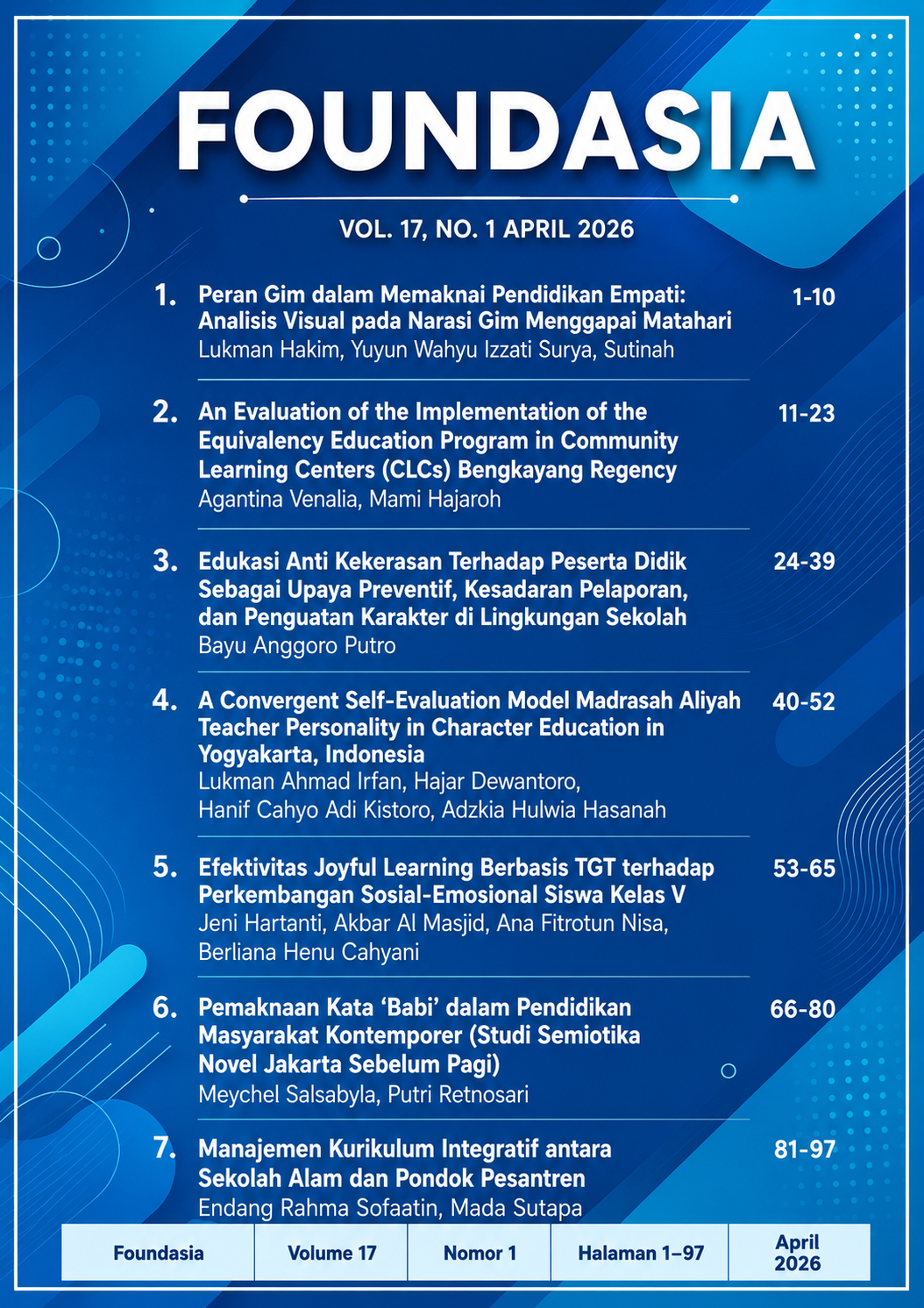
Manajemen Kurikulum Integratif antara Sekolah Alam dan Pondok Pesantren
DOI:
https://doi.org/10.21831/foundasia.v17i1.97917Abstract
This study aims to analyze the management of an integrative curriculum between nature-based schools and Islamic boarding schools (pesantren) as a holistic educational model that combines ecological and religious values. The research employed a descriptive qualitative approach using a case study method conducted in two educational institutions in Bondowoso over six months. The research subjects included principals, teachers, ustadz, students, and parents selected through purposive sampling. Data were collected through participatory observation, in-depth interviews, and document analysis of curricula and evaluation records. Data analysis utilized the interactive model of Miles and Huberman (2014), encompassing data reduction, data display, and conclusion drawing, with validity ensured through source, technique, and time triangulation. The findings indicate that curriculum planning is carried out collaboratively, implementation integrates nature-based learning with worship habituation, and evaluation emphasizes the balance of cognitive, affective, and spiritual aspects. This integrative model demonstrates effectiveness in fostering creative, independent, environmentally conscious, and religiously grounded learners. The study contributes to the development of alternative curriculum models that promote spiritual and ecological balance in Indonesian education.
References
Al-Zarnuji, Burhan al-Islam. (2012). Terjemah Ta'limul Muta'allim Bimbingan Bagi Penuntut Ilmu Pengetahuan. (Terj. Aliy As'ad). Kudus: Menara Kudus.
Albar, M. K., Hamami, T., Sukiman, S., & Roja Badrus Z, A. (2024). Ecological Pesantren as an Innovation in Islamic Religious Education Curriculum: Is It Feasible? Edukasia Islamika, 9(1), 17–40. https://doi.org/10.28918/jei.v9i1.8324
Budiono, S., Sanusi, M., Ghafur, O. A., & Ardianto, R. A. (2024). Pembelajaran Pendidikan Agama Islam Berbasis Proyek. Tsaqofah, 4(3), 1534–1544. https://doi.org/10.58578/tsaqofah.v4i3.2897
Firdiana, L., Muchasin, F. V., & Khoir, M. A. (2025). KONTRIBUSI KI HAJAR DEWANTARA DALAM MEMBANGUN PENDIDIKAN NASIONAL INDONESIA. Jurnal Penelitian Guru Indonesia, 5(September 2025), 4268–4280.
Hafid, B. (2026). AL-AFKAR : Journal for Islamic Studies Pendidikan Multikultural Menurut H . A . R Tilaar Dan Relevansinya Dalam Kehidupan Sosial Masyarakat Kota Cirebon. 9(1), 810–824. https://doi.org/10.31943/afkarjournal.v9i1.1943.Multicultural
Novo, L. (2011). Sekolah Alam: Menumbuhkan Generasi Kreatif dan Mandiri dari Alam.
Rahmawati, Z. D. (2019). PENDIDIKAN KEPEMIMPINAN PERSPEKTIF K.H. IMAM ZARKASYI Received : Oct 29. 2(1), 107–115.
Rizky Nurkamaliyah, A., Erihadiana, M., Fauzi Nazar, R., Ahadiah Halimah, N., & Sunan Gunung Djati Bandung, U. (2025). Integration of Islamic Socio-Cultural Values in Nature-Based Education: A Systematic Literature Review Study of Nature Schools and Eco-Pesantren (Indonesia) With Forest Schools (Europe). ENDLESS: International Journal of Futures Studies, 8(3), 46–66. http://endless-journal.com/index.php/endless46
Rustiawan, H. (2005). Modernisasi Sistem Pendidikan Di Pesantren. Alqalam, 22(2), 269. https://doi.org/10.32678/alqalam.v22i2.1380
Subagis, J., Nurkholik, E., Jumiah, J., Setiawan, A., & Martriwati, M. (2025). Arisen : Assessment and Research on Education Pengembangan instrumen penilaian afektif kerjasama siswa sekolah dasar Assessment instrument development affective cooperation of elementary students. 5(1), 10–20.
Utami, D. R., Pahrudin, A., Rahmi, S., Raden, U., Lampung, I., Uin, A.-R., & Banda, A. (2025). Curriculum Development Management and Integrated Learning Strategies to Enhance Education Quality in the Globalization Era. Arji, (76). https://journal.nahnuinisiatif.com/index.php/ARJI/article/view
Downloads
Published
How to Cite
Issue
Section
License

This work is licensed under a Creative Commons Attribution-ShareAlike 4.0 International License.
 | ProGCouns: Professional Guidance and Counseling Journal by https://journal.uny.ac.id/index.php/progcouns is licensed under a Creative Commons Attribution-ShareAlike 4.0 International License. |