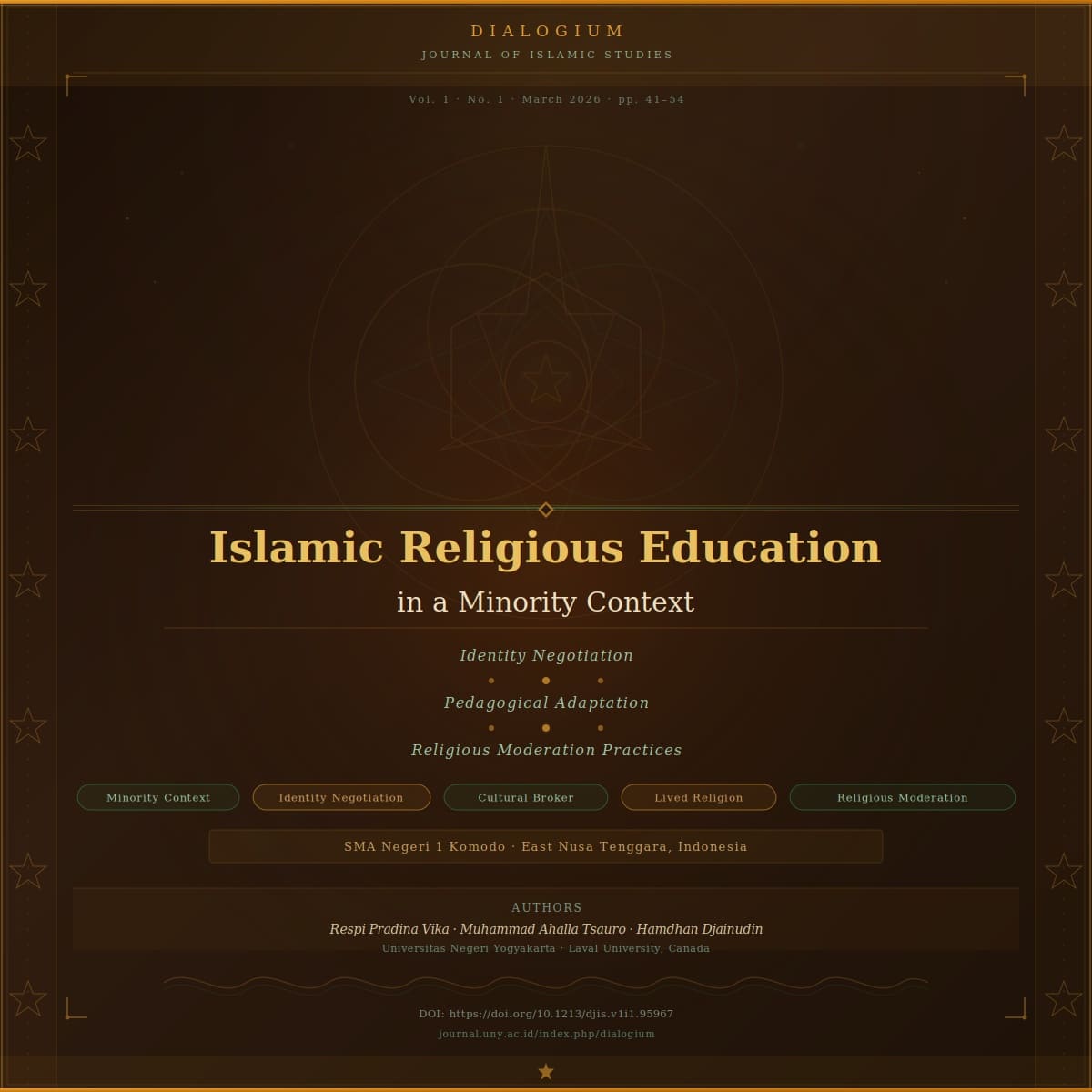
Islamic Religious Education in a Minority Context: Identity Negotiation, Pedagogical Adaptation, and Religious Moderation Practices

Downloads
Islamic Religious Education (IRE) in demographic minority regions faces complex challenges in balancing the strengthening of faith (aqidah) with the necessity of social adaptation amidst the dominance of other religious cultures. This study aims to analyze how IRE at SMA Negeri 1 Komodo, East Nusa Tenggara, serves as an arena for identity negotiation and pedagogical adaptation for minority Muslim students. This research employs a qualitative approach with a case study design, where data were collected through participant observation, in-depth interviews, and document analysis. The results indicate that minority status does not drive Muslim students toward self-isolation; rather, it fosters the formation of a fluid and confident identity in which the school functions as a "contact zone" for social negotiation. IRE teachers act as "cultural brokers" who undertake pedagogical adaptations by shifting from a textual approach toward value transmission through the "hidden curriculum" and extracurricular activities. The findings also emphasize that religious moderation in this setting manifests as "lived religion," emerging organically through the support of the social ecosystem and the local wisdom of the Labuan Bajo community. This study concludes that IRE in minority settings is capable of transforming from a dogmatic approach into a socio-constructivist approach that effectively builds social cohesion.
Allport, G. W. (1954). The nature of prejudice. Addison-Wesley.
Azra, A., Afrianty, D., & Hefner, R. W. (2022). Islamic education in Indonesia: Moderation, modernity, and the challenge of pluralism. Journal of Islamic Studies, 33(1), 120-145.
Bakri, S. (2022). Islamic education in minority regions: Negotiating identity and tolerance in Bali. Indonesian Journal of Islam and Muslim Societies, 12(1), 79-105.
Campbell, S., Greenwood, M., Prior, S., & Shearer, T. (2020). Purposive sampling: complex or simple? Research case examples. Journal of Research in Nursing, 25(8), 652-661.
Creswell, J. W. (2014). Research design: Qualitative, quantitative, and mixed methods approaches (4th ed.). SAGE Publications.
Creswell, J. W., & Poth, C. N. (2018). Qualitative inquiry and research design: Choosing among five approaches (4th ed.). SAGE Publications.
Denzin, N. K., & Lincoln, Y. S. (Eds.). (2018). The SAGE handbook of qualitative research (5th ed.). SAGE Publications.
Djainudin, H. 2022. The conception of religious moderation in interfaith dialogue in Indonesia; Case study in Flores Nusa Tenggara Timur. Humanika: Kajian Ilmiah Mata Kuliah Umum. 22, 2 (Nov. 2022), 139–146. DOI:https://doi.org/10.21831/hum.v22i2.54304.
Giroux, H. A. (2005). Border crossings: Cultural workers and the politics of education (2nd ed.). Routledge.
Hefner, R. W. (2021). Islam and institutional religious freedom in Indonesia. Religions, 12(6), 415.
Ismail, R., Abdullah, I., & Muttaqin, A. (2022). Lived religion and religious moderation: The negotiation of
Muslim minority identity in Papua. Al-Jami'ah: Journal of Islamic Studies, 60(1), 35-62.
Merriam, S. B., & Tisdell, E. J. (2016). Qualitative research: A guide to design and implementation (4th ed.). Jossey-Bass.
Miles, M. B., Huberman, A. M., & Saldaña, J. (2019). Qualitative data analysis: A methods sourcebook (4th ed.). SAGE Publications.
Mulkan, H. (2022). Hidden curriculum in Islamic religious education: A study on tolerance cultivation. Cakrawala Pendidikan, 41(2), 488-500.
Nisa, Y. F., Saada, N., & Syafruddin, D. (2021). Teaching tolerance and open-mindedness in Indonesian schools: Teachers' perspectives. Journal of Social Studies Education Research, 12(3), 143-169.
Patton, M. Q. (2015). Qualitative research & evaluation methods: Integrating theory and practice (4th ed.). SAGE Publications.
Parker, L. (2021). Religious education for peaceful coexistence in Indonesia? Journal of Contemporary Asia, 51(3), 486-506.
Pettigrew, T. F., & Tropp, L. R. (2006). A meta-analytic test of intergroup contact theory. Journal of Personality and Social Psychology, 90(5), 751–783.
Pratt, M. L. (1991). Arts of the contact zone. Profession, 33–40.
Tajfel, H., & Turner, J. C. (1979). An integrative theory of intergroup conflict. In W. G. Austin & S. Worchel (Eds.), The social psychology of intergroup relations (pp. 33–47). Brooks/Cole
Qodir, Z., Jubba, H., Hidayati, M., & Abdullah, I. (2021). Contesting religious identity in the public sphere: The case of Muslim minority in Indonesia. Heliyon, 7(4), e06576.
Rusydiyah, E. F., Purwati, E., & Prabowo, A. (2021). How to foster student's religious moderation? The role of teachers and schools. Cakrawala Pendidikan, 40(2), 365-377.
Suhadi, S., Arifinsyah, A., & Pohan, S. (2023). Interreligious engagement in schools: Bridging the gap between policy and practice. Journal of Indonesian Islam, 17(1), 1-22.
Supriyanto, A., & Wahyudi, A. (2024). Teacher agency in promoting religious moderation in multicultural classrooms. Jurnal Pendidikan Islam, 13(1), 89-104.
Suyanto, S., Sirry, M., & Sugihartati, R. (2022). Pseudo-inclusion in Islamic schools: The paradox of tolerance education. Asia Pacific Journal of Education, 42(3), 512-526.
Yin, R. K. (2018). Case study research and applications: Design and methods (6th ed.). SAGE Publications.
Zulkifli, Z., Darmawan, C., & Rahmat, M. (2023). Strengthening religious moderation through Islamic religious education in higher education. Jurnal Ilmiah Peuradeun, 11(2), 433-452.
Copyright (c) 2026 Respi Pradina Vika, Muhammad Ahalla Tsauro Tsauro, Hamdhan Djainudin Djainudin

This work is licensed under a Creative Commons Attribution-ShareAlike 4.0 International License.
Authors who publish with this journal agree to the following terms: Authors retain copyright and grant the journal right of first publication with the work simultaneously licensed under a Creative Commons Attribution-ShareAlike 4.0 International (CC BY-SA 4.0) that allows others to share the work with an acknowledgement of the work's authorship and initial publication in this journal.